

On this page
For over two decades, the Kishore Vaigyanik Protsahan Yojana (KVPY) was the premier scholarship for Indian students interested in basic sciences. However, in 2022, the Department of Science and Technology officially discontinued the KVPY aptitude test.
Instead of running a separate exam, the government merged KVPY into its larger Innovation in Science Pursuit for Inspired Research (INSPIRE) scheme. The move was designed to unify science funding under one umbrella and reduce the burden of overlapping exams, as many students were using KVPY as a mock test for medical and engineering entrances rather than committing to a science degree.
If you were selected as a KVPY fellow before 2022, your scholarship remains active. But new applicants must now secure funding through the INSPIRE-SHE (Scholarship for Higher Education) component.
How does the INSPIRE-SHE scholarship work?
The INSPIRE-SHE scholarship offers ₹80,000 per year to students pursuing a bachelor's or integrated master's degree in basic and natural sciences (such as a B.Sc., B.S., or Int. M.Sc.). Of this amount, ₹60,000 is paid as a monthly stipend of ₹5,000, and ₹20,000 is given as a summertime mentorship grant for research projects.
Since there is no longer a dedicated entrance exam, your eligibility for INSPIRE is based on your performance in standard board and competitive exams:
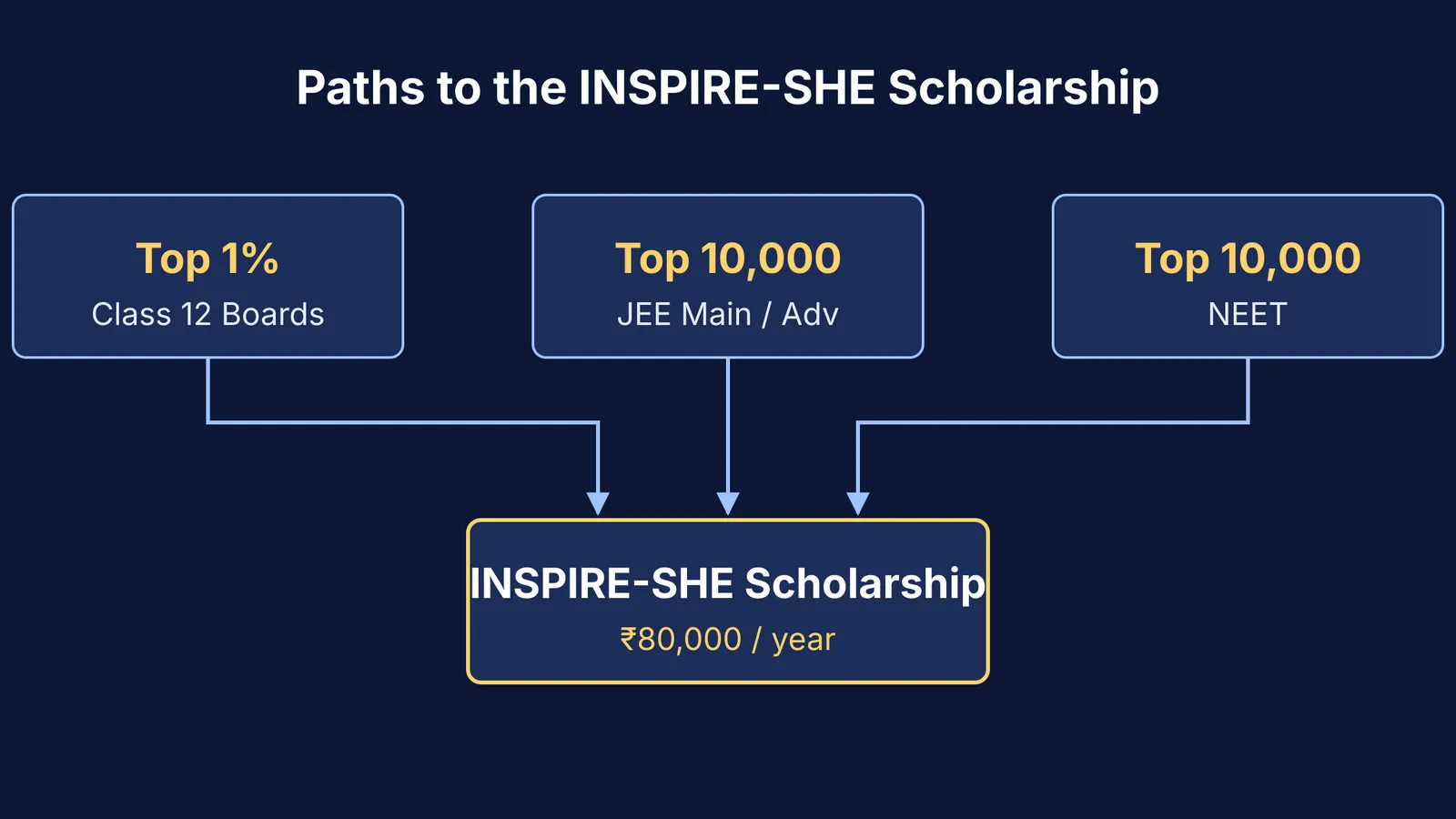
Board Exams: You qualify if your Class 12 aggregate marks place you in the top 1% of your respective state or central board.
Competitive Exams: You also qualify if you secure a rank within the top 10,000 in JEE Main, JEE Advanced or NEET, provided you choose to enroll in a basic science degree instead of engineering or medicine.
The scholarship supports students pursuing degrees in 18 broad subjects, including physics, chemistry, mathematics, biology, statistics, geology, astrophysics, and electronics. To keep receiving the funds, students must secure at least 60% marks in their annual examinations and pass all subjects in the first attempt. Applications typically open on the official INSPIRE online portal after Class 12 results are declared.
Are there other science scholarships for Indian students?
If you miss the top 1% cut-off for INSPIRE, there are other reputable science scholarships to look at:
Central Sector Scheme of Scholarships: Administered by the Ministry of Education, this scheme is open to students who score above the 80th percentile of successful candidates in their Class 12 board. The family income of the candidate should not exceed ₹4.5 lakh per annum. It provides ₹10,000 per year for the first three years of college and ₹20,000 for the fourth and fifth years. A total of 82,000 fresh scholarships are awarded annually, split equally into 41,000 for boys and 41,000 for girls. To renew this scholarship each year, a student must secure at least 50% marks in their annual examination and maintain at least 75% attendance. Applications must be submitted through the National Scholarship Portal.
State-Level Talent Searches: Programs like the JBNSTS talent search in West Bengal offer their own stipends and book grants to local students pursuing basic sciences.
How can you prepare for the cut-off?
Without the KVPY exam, the pressure shifts heavily onto your Class 12 board exams and your JEE or NEET performance. Securing a spot in the top 1% of your board for the INSPIRE scholarship requires deep conceptual clarity. Here is a study plan to stay on track:
Map your weak spots early: Use your mid-term exams to identify chapters where you struggled. Your preparation and final percentile score across different subjects will determine your overall rank.
Solve step-by-step: Don't just check the final answer. The Fermi Problem Library has worked problems with a step-by-step solver that explains the reasoning rather than printing an answer.
Get unstuck immediately: If you are struggling to bridge the gap between school textbooks and competitive problem-solving, Fermi's AI tutor can help. You bring a topic, a course, a problem set or a scanned assignment, and Fermi works out what you already know, builds a plan for the session, and teaches through it. It holds a line of reasoning across a whole session, notices where you are stuck, and decides whether to explain, ask, or show.


