

On this page
Class 11 is the foundation of the Joint Entrance Examination (JEE) journey, but it is also where many students stumble. The shift from Class 10 science to the rigour of JEE Physics, Chemistry, and Mathematics is steep. Parents often worry about whether their child is pacing their studies correctly, balancing chapter completion with actual understanding.
A healthy pace is not about finishing the entire two-year syllabus in one year. It is about building a bedrock of concepts that will support the advanced topics in Class 12.
Is my child on track for JEE in Class 11?
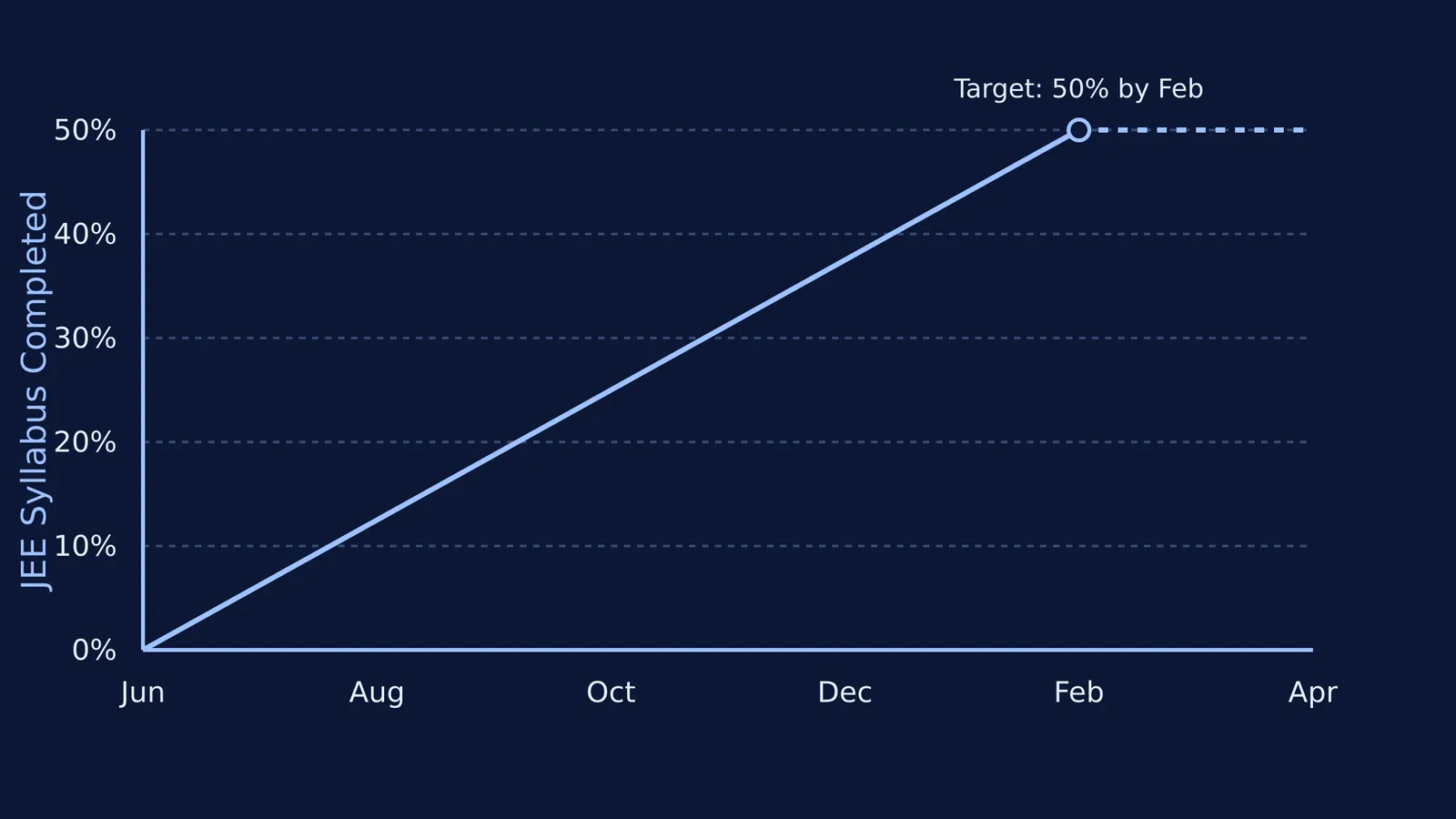
To check if your child is on track, look at the depth of their understanding, not just the number of chapters they have ticked off. The goal is to master the core Class 11 syllabus—which makes up roughly half of the total JEE material—by February. This allows for a smooth transition into Class 12 in March or April.
A strong indicator of a healthy pace is how they handle foundational topics. In physics, this means they can confidently solve mechanics problems, like calculating the time for a block to slide down a rough incline. In chemistry, they should be comfortable with general organic chemistry concepts, such as carbocation rearrangements. If they are grasping these core ideas, they are on the right path.
When chapters are rushed, students often rely on rote memorisation. JEE tests the application of concepts in unfamiliar ways, so a student who has sped through the syllabus without practicing enough problems will struggle when the difficulty ramps up.
What are the warning signs of burnout?
Pushing too hard to complete the syllabus quickly can backfire. Academic burnout is a real threat, and sleep deprivation is its clearest symptom. The Student Well-being Pulse Report by the IC3 Institute found that most Grade 12 students sleep six hours or less a night, driven heavily by academic overload and anxiety about their exams (IC3 Institute).
Watch for these warning signs that the pace is too intense:
Falling mock test scores: If your child is studying all day but their test scores are stagnant or dropping, they may be suffering from cognitive fatigue.
Skipping chapter tests: Avoiding tests out of fear of low marks indicates a gap in understanding, not just a lack of time.
Constant exhaustion: Waking up tired and struggling to focus during school hours suggests they are sacrificing sleep for late-night study sessions.
How does active learning change the pace?
The way your child studies dictates how fast they can safely move through the material. Reading textbooks and watching video lectures are passive activities; they feel productive but often lead to poor retention.
Active learning—where the student is constantly solving problems, answering questions, and testing their knowledge—is far more effective. A major study by Freeman et al. published in the *Proceedings of the National Academy of Sciences* found that students in traditional lecturing classes are 55% more likely to fail than those in active learning environments (PNAS).
Active learning ensures that the pace of syllabus completion matches the pace of actual comprehension. It forces students to confront what they do not know immediately, rather than discovering their weaknesses much later during a mock test.
How can we build a sustainable study plan?
To maintain a healthy pace, help your child build a structured and sustainable plan using this checklist:
Focus on chapter-level tests: In Class 11, frequent, smaller tests are more useful than full-syllabus mock exams. They reveal specific weak spots before they compound into massive backlogs.
Prioritise prerequisites: If time is short and backlogs are piling up, prioritize high-weightage foundation chapters like Mechanics, Algebra, and Chemical Bonding.
Protect sleep hours: Treat a full night of sleep as a non-negotiable part of the study schedule. A rested brain solves complex math problems faster than a tired one.
Use interactive tools: When a student is stuck, they need a clear next step, not just the final printed answer. Fermi's AI tutor works out what the student knows and builds a plan for the session. It holds a line of reasoning, noticing where a student is stuck, and decides whether to explain, ask, or show.
Pacing the JEE preparation is a marathon, not a sprint. By focusing on deep understanding, managing sleep, and shifting from passive reading to active problem-solving, your child can confidently build the foundation they need for Class 12.