

On this page
When a child begins preparing for the Joint Entrance Examination (JEE), it is natural for parents to want to help. You might look at the towering stack of books and wonder if you need to re-learn Class 11 and 12 physics and mathematics.
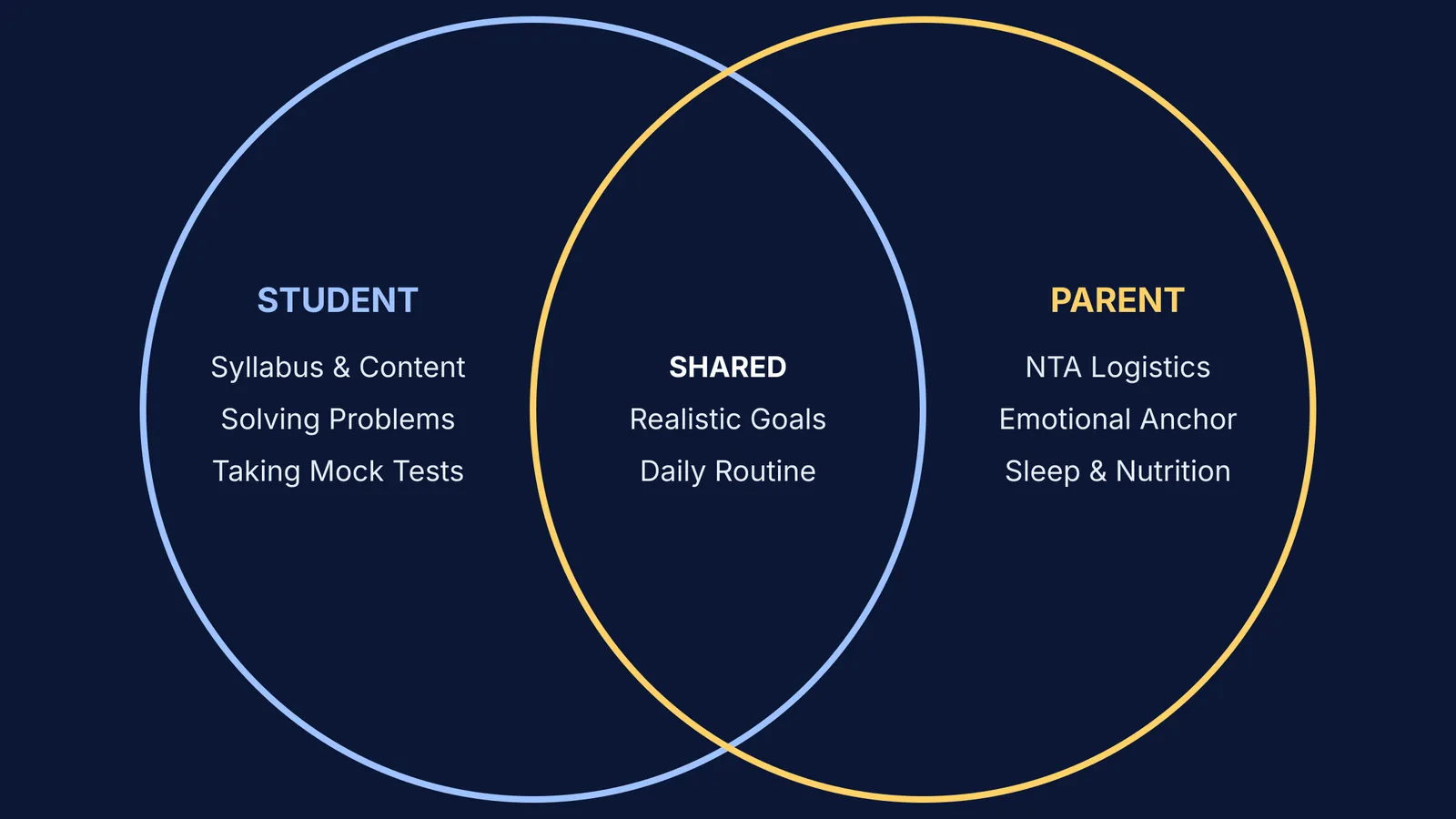
The short answer is no. You do not need to know how to solve a rotational mechanics problem to support a JEE aspirant. Instead, your most effective role is to manage the environment around the exam so your child can focus entirely on studying.
Should parents know the JEE syllabus to help?
While you do not need to learn the content, understanding the *structure* of the JEE syllabus is useful. The exam covers the entire Class 11 and 12 curriculum for physics, chemistry and mathematics.
Knowing this scope helps you set realistic expectations. Rather than expecting your child to master every topic perfectly every week, you can help them build a study routine that lasts. When they struggle with a traditionally difficult chapter like calculus or organic chemistry, you will understand why they are spending more time on it.
If they are stuck on a concept, you do not have to become the teacher. You can rely on tools like the Fermi Problem Library, which provides worked problems with a step-by-step solver that explains the reasoning rather than printing an answer.
How can parents help with JEE logistics?
The National Testing Agency (NTA) manages the JEE Main, and its administrative rules can be complex and stressful for a student to navigate alone. Parents can act as the "Chief Logistics Officer" by taking over these tasks.
For example, the NTA emphasizes Aadhaar authentication during registration to verify a candidate's identity. If there is a mismatch between the name on your child's Aadhaar card and their Class 10 certificate, resolving it requires time and attention. By checking the official portal at jeemain.nta.nic.in, managing application deadlines, and ensuring all documents are correct, you free up your child's mental bandwidth.
On the day of the exam, knowing the reporting time, the dress code, and ensuring they have the correct original ID and admit card prevents last-minute panic.
Why does emotional support matter more than physics?
The psychological toll of high-stakes competitive exams is immense. A 2015 study published in the *International Journal of Psychology and Behavioral Sciences* surveyed Indian high school students and found that 66% reported feeling pressure from their parents for better academic performance.
This pressure often backfires. When a child's entire identity becomes tied to their mock test scores, their risk of burnout increases. Instead of asking about their rank, you can focus your conversations on their effort. Celebrating the completion of a difficult chapter builds resilience far better than interrogating a test result.
Your home should be a safe haven from the intense competition of coaching centres. Helping children learn without pressure means insulating them from inquisitive relatives and assuring them that their worth is not defined by a single exam. If you notice signs of severe distress, the Ministry of Health and Family Welfare offers free, confidential support through the Tele MANAS helpline at 14416. Knowing when to get help for exam stress is a vital part of parenting an aspirant.
What is a practical checklist for JEE parents?
If you want to be actively involved without micromanaging the syllabus, focus on these three areas:
Manage the paperwork: Take charge of NTA registration, city intimation slips, and gathering the required exam day documents.
Reduce decision fatigue: Handle daily non-academic choices, such as preparing nutritious meals and maintaining a quiet, distraction-free study space.
Be an emotional anchor: Listen without immediately offering advice or drawing comparisons with other students. Sometimes, an aspirant just needs to vent their frustration.
By stepping back from the academic content and stepping up in logistics and emotional care, you provide the exact foundation your child needs to succeed.


