

On this page
Around midway through Class 11 or early in Class 12, a quiet withdrawal often happens in homes across India. A student preparing for JEE stops answering messages from school friends, rushes through dinner, and avoids birthday gatherings, sports, or family tea. When asked, their explanation is almost always practical: they feel they do not have time, and worry that every non-study hour will drop their percentile. Parents often hesitate to intervene because intense dedication feels like the prerequisite for cracking a competitive exam.
Why do JEE aspirants isolate themselves from friends?
Most students do not abandon their friendships out of antisocial preference; they do so out of acute performance pressure. In the NCERT Mental Health Survey (2022) of 3,79,842 students across India, 81% cited studies, examinations, and results as their chief source of anxiety, with emotional well-being dropping sharply during the secondary school years. In coaching batches where teachers praise exhausting marathon study days, students internalise a zero-sum fallacy: the belief that any minute spent laughing, kicking a football, or chatting with a classmate is stolen directly from their rank.
A second, less visible driver is social-evaluative anxiety. Many aspirants find that conversations with coaching peers quickly deteriorate into stressful comparisons about test scores, completed modules, or backlog tallies. Because casual conversations morph into unofficial rank audits, students conclude that cutting off everyone is the only way to protect their focus. Yet this withdrawal eliminates the very emotional release that adolescents require to process daily academic setbacks.
How does social isolation hurt exam performance?
Treating preparation as solitary confinement backfires directly on the brain's problem-solving apparatus. A large-scale study of 5,749 adolescents published in the *Journal of Affective Disorders* showed that loneliness significantly impairs three core dimensions of executive function: working memory, cognitive flexibility, and inhibitory control. The researchers found that subjective sleep disturbance acts as a major mediator; socially isolated students experience heightened nocturnal rumination, fragmenting deep sleep and leaving the prefrontal cortex depleted the next morning.
For a JEE aspirant tackling advanced kinematics or organic reaction pathways, working memory is the single most valuable cognitive asset. When students become chronically isolated, attention narrows into fatigue and problem-solving speed collapses. A standard practice set begins stretching across endless hours of blank staring. To learn more about identifying when routine pressure crosses into deeper distress, see our guide on recognising the warning signs of severe exam stress.
When students get stuck in these solitary study plateaus, they often spend entire evenings wrestling with confusing explanations. Instead of unguided struggle, Fermi's AI tutor works out what you already know and builds a plan for the session, giving students a clear next step rather than an intimidating backlog.
How does peer connection protect cognitive stamina?
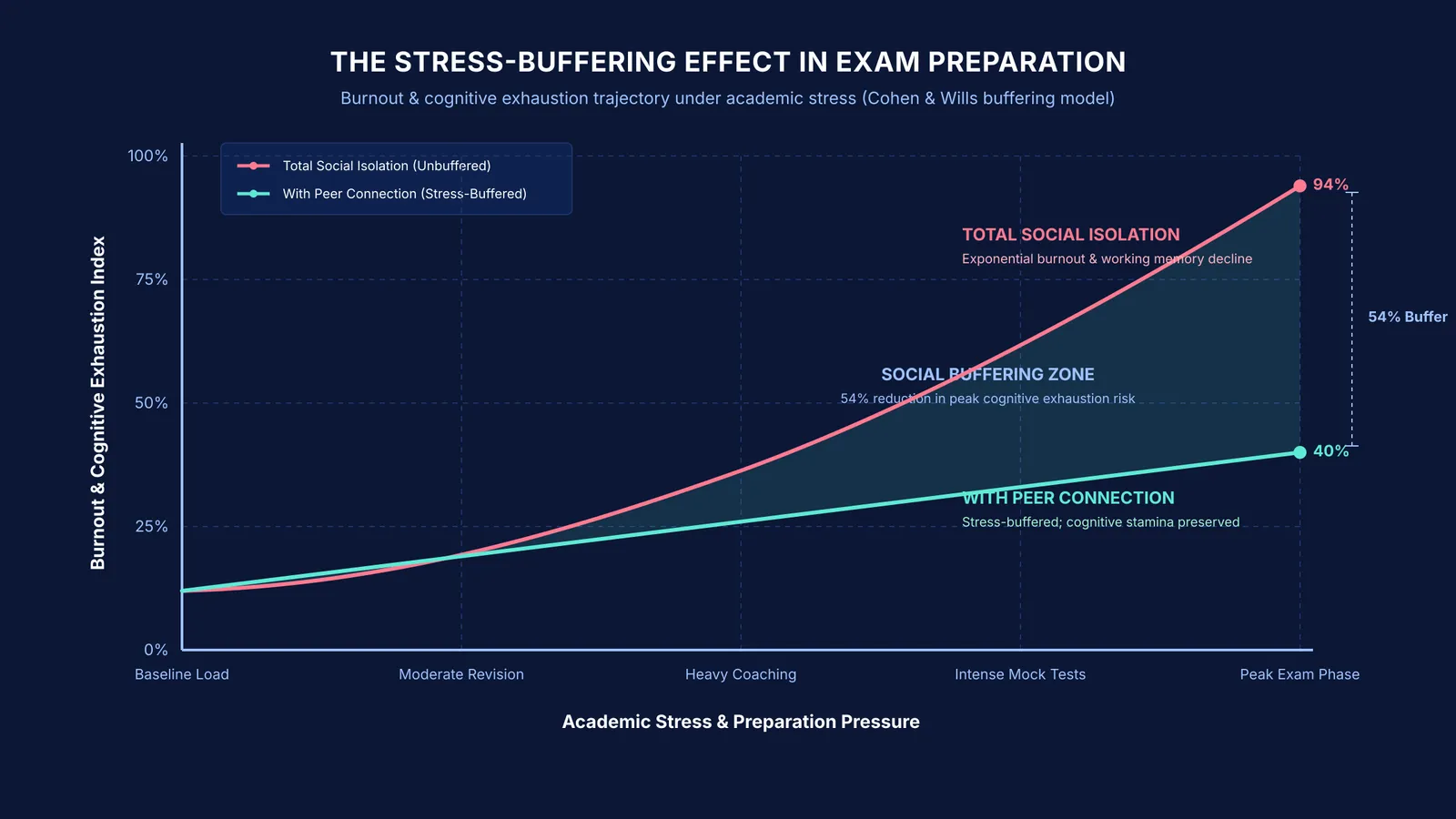
Decades of cognitive science confirm that social interaction is not a distraction from rigorous work; it is an active neurobiological reset. In their classic formulation of the stress-buffering hypothesis in *Psychological Bulletin*, Sheldon Cohen and Thomas A. Wills showed that social support prevents the neuroendocrine overactivation that degrades cognitive stamina. When students maintain trusted social connections, stressful events are perceived as manageable challenges rather than existential threats.
This buffering occurs on a physiological level during daily friction. An experimental study in *Developmental Psychology* demonstrated that having a close friend present during a negative experience significantly lowers salivary cortisol and prevents drops in global self-worth. Furthermore, a meta-analysis of 19 studies covering 95,434 students in *Stress and Health* found that peer social support directly reduces academic burnout, having its strongest mitigating effect on feelings of inefficacy—the paralyzing belief that one's efforts no longer produce results.
Social time allows teenagers to normalize struggles. Hearing a trusted classmate admit that they also found rotational dynamics or ionic equilibrium confusing breaks the illusion that everyone else understands effortlessly. Rather than grinding in isolation, collaborative study routines can turn peer time into mutual learning. Our article on setting up study groups that actually help you learn explains how to keep group sessions focused and productive. For independent practice, the Fermi Problem Library offers worked problems with a step-by-step solver that explains the reasoning rather than just printing an answer.
How can families set a guilt-free weekly social slot?
Aspirants will resist unstructured breaks because vague free time breeds intense guilt. The solution is not to demand spontaneous socialization, but to schedule a bounded, pre-budgeted social slot as an essential component of building an exam study routine that lasts.
Families can establish a dedicated weekly buffer using three practical ground rules:
Pre-budget the time block: Fix an unmovable weekly window (for example, Sunday late afternoon). Because it is written into the timetable before the week begins, the student does not feel they are stealing time from their books.
Enforce the no-syllabus boundary: Encourage the student to meet friends outside their immediate coaching peer circle—such as neighbourhood friends, schoolmates, or cousins—or agree with coaching friends that marks, percentiles, and chapter completion are off-limits during this slot.
Pick active, low-cognitive activities: Outdoor sports like badminton or cricket, a walk, or sharing a snack work far better than scrolling on a phone. Physical movement metabolises stress hormones and leaves the student feeling refreshed rather than drained.
If your child shows persistent withdrawal, severe sleep disruption, or feelings of hopelessness that go beyond normal study fatigue, reach out for supportive guidance. Families can contact the Ministry of Health's 24/7 toll-free helpline Tele MANAS at 14416 (or 1800-891-4416) or the Ministry of Education's Manodarpan helpline at 844-844-0632.


