

On this page
When parents consider introducing their children to computer programming, they usually imagine a laptop running Python or a tablet loaded with colourful coding apps. Yet some of the most effective ways to teach algorithmic reasoning require no electricity at all. By replacing screens with index cards, chalk mazes, and physical tokens, unplugged coding turns abstract computer science concepts into tangible games that children can touch, move, and test.
What are unplugged coding activities for kids?
Unplugged coding refers to teaching computer science fundamentals without digital hardware. Pioneered by Tim Bell and colleagues through the CS Unplugged project at the University of Canterbury, the approach shares core computational ideas through games, puzzles, and kinesthetic challenges.
As computer scientist Jeannette Wing outlined in her landmark 2006 paper in the *Communications of the ACM* (Wing, 2006), computational thinking is a universal problem-solving method built on four pillars: decomposition, pattern recognition, abstraction, and algorithm design. It is not about typing syntax or memorising keywords.
When young children learn to code on a screen, interface mechanics often compete for limited working memory. Offline games strip away this friction, letting children focus entirely on procedural logic. For parents seeking balanced family screen-time and homework routines, unplugged activities nurture computational fluency without added screen fatigue.
What does the research say about screen-free coding?
Empirical research strongly supports screen-free computer science. A 2023 meta-analysis in the *International Journal of STEM Education* examined 49 studies and analysed 13 empirical interventions involving K-12 students (Chen et al., 2023). The authors found a large overall effect size of Hedges's g = 1.028, showing that unplugged activities significantly boosted computational thinking scores over control conditions, with board and card games proving especially effective.
Controlled classroom experiments show similar gains. At the WiPSCE conference, Christian Brackmann and colleagues evaluated 73 primary pupils in Spain using the validated Computational Thinking Test (Brackmann et al., 2017). Unplugged instruction yielded an effect size of d = 0.59 over the control group and an intra-group improvement of d = 0.80.
Furthermore, a meta-analysis of 29 articles and 2,764 participants in *Education and Information Technologies* confirmed that unplugged activities prior to screen-based programming build stronger mental models and reduce early frustration (Li et al., 2022). Tangible logic creates a secure conceptual foundation before children encounter formal code.
Which screen-free coding games can you play at home?
You do not need specialised kits to practice computational thinking at home. These three games use everyday items to explore sequencing, algorithmic efficiency, and binary representation:
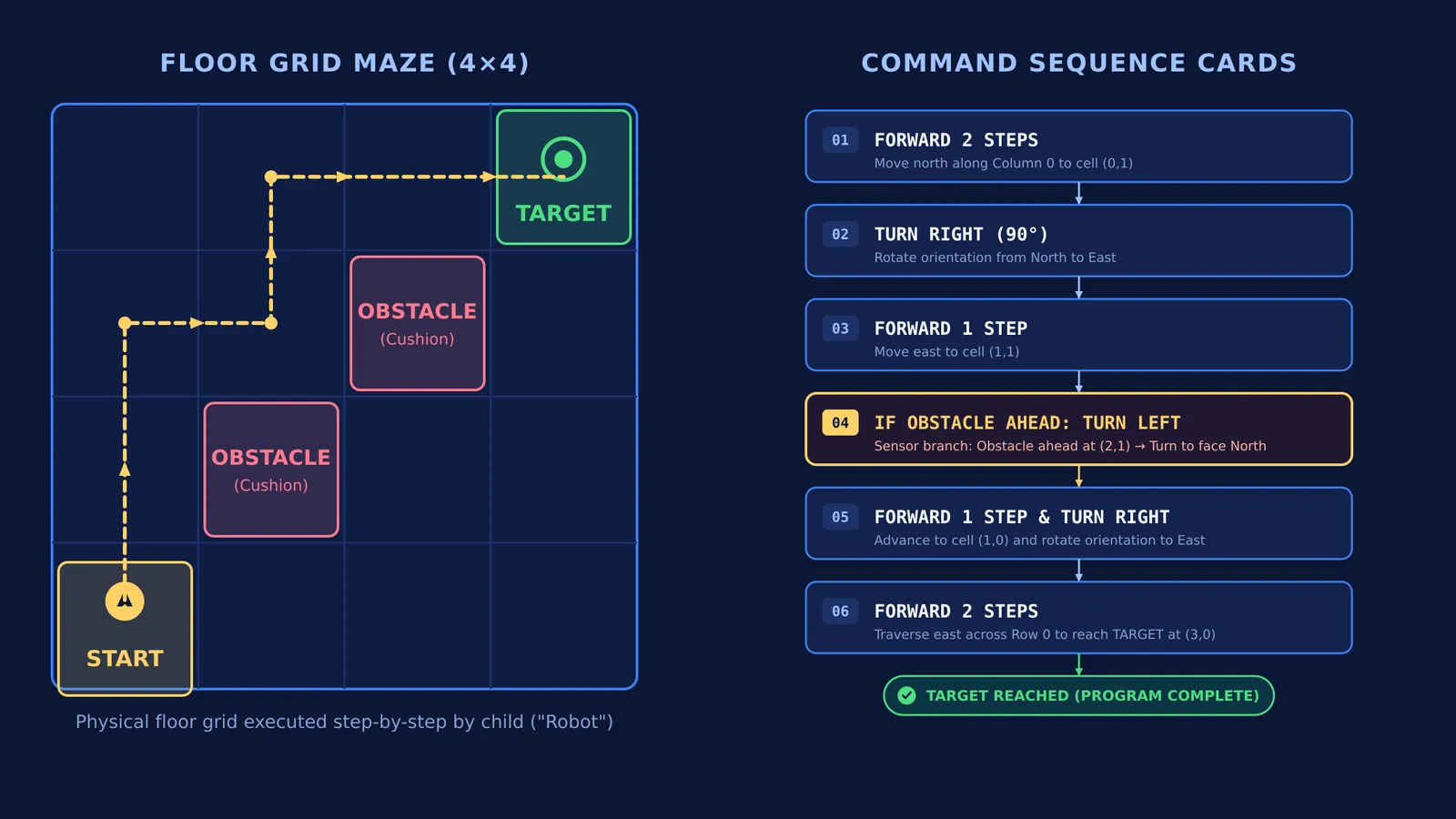
The Living Room Grid Maze (Sequencing and Conditionals): Create a 4×4 floor grid using masking tape. Place a toy at one corner as the Target and a cushion as an Obstacle. Write command cards on index cards: `FORWARD 1 STEP`, `TURN LEFT (90°)`, `TURN RIGHT (90°)`, and `IF OBSTACLE AHEAD: TURN LEFT`. One person plays Programmer and sets out cards; the second plays Robot, walking the grid following only those instructions. If the Robot bumps into a cushion, you have found a bug to debug.
The Deck-of-Cards Sorting Race (Algorithmic Efficiency): Shuffle six numbered cards face down in a row. You may only compare two adjacent cards at a time. Have your child sort them into ascending order using Bubble Sort (compare neighbours, swap if out of order, repeat) versus Selection Sort (scan for the smallest card and move it to the front). Counting comparisons shows that different algorithms solve the same problem with different efficiency.
The Secret Message Dot Cards (Binary Representation): Take five index cards with 16, 8, 4, 2, and 1 dots. Lay them in descending order. A face-up card equals 1 (on); a face-down card equals 0 (off). By flipping cards, any integer from 0 to 31 can be represented as a sum of powers of two. For example, 19 is 16 + 2 + 1, written in binary as 10011.
How can parents bridge physical games to abstract logic?
Educational psychologists describe the shift from physical play to abstract thought as concreteness fading: moving from physical objects (enactive) to flowcharts (iconic), and finally to formal code (symbolic). After playing a floor maze, have your child sketch the route on paper as a flowchart before translating it into Scratch blocks later on.
Framing these activities alongside everyday maths conversations with children helps demystify technical terms. Treating failed sequences as debugging puzzles reinforces learning at home without academic pressure, building persistence.
When students encounter formal STEM subjects in secondary school, moving from intuition to systematic problem-solving reveals conceptual gaps. On Fermi's AI tutor, the tutor notices where a student is stuck and decides whether to explain, ask, or show, adapting to their line of reasoning. Breaking problems into logical steps also underpins the Fermi Problem Library, where a step-by-step solver explains the reasoning rather than printing an answer. Starting with physical games today gives children lasting confidence with complex logic.


