

On this page
The two years of intermediate education (Classes 11 and 12) in Andhra Pradesh and Telangana are widely considered the most high-stakes period in a student's academic life. Over 20 lakh students appear for these exams annually across both states (Careers360). This intense environment is often the student's first encounter with long study hours, frequent testing, and severe peer competition. While the system produces many top rankers in national entrance tests, it also demands rigorous study schedules that can take a heavy toll on students.
Here is a breakdown of how the system operates, the realities of the coaching culture, and how parents can help their children navigate this intense period.
How does the two-year intermediate system work in AP and Telangana?
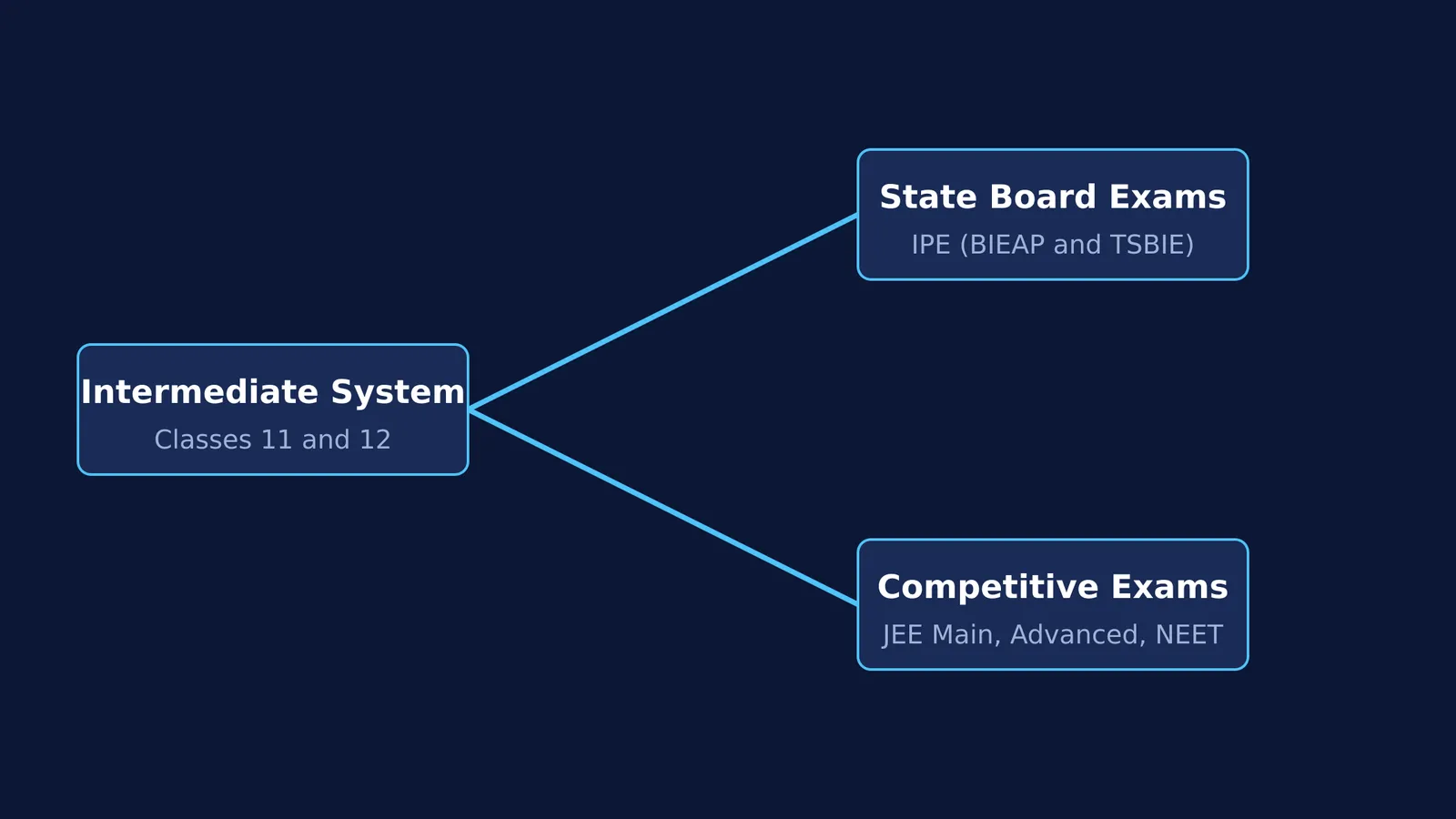
In Andhra Pradesh and Telangana, the state boards — the Board of Intermediate Education, Andhra Pradesh (BIEAP) and the Telangana State Board of Intermediate Education (TSBIE) — oversee the curriculum and examinations. Unlike the CBSE or ICSE boards, which spread competitive exam preparation across a broader framework, the state boards are deeply intertwined with entrance coaching.
The most popular streams are MPC (Mathematics, Physics, Chemistry) for engineering aspirants and BiPC (Biology, Physics, Chemistry) for medical aspirants. In 2025, over 10.17 lakh students appeared for the BIEAP exams (Careers360), and 9.97 lakh appeared under TSBIE (Careers360).
Most students simultaneously prepare for the Intermediate Public Examination (IPE) and highly competitive national exams like JEE Main, JEE Advanced, and NEET. The state board syllabus closely aligns with the national curricula. Topics such as Motion in a plane from r(t): velocity and acceleration vectors and Hell-Volhard-Zelinsky reaction: alpha-halogenation of acids form the core of both the board syllabus and competitive exam preparation. Success in the IPE is essential, as many national exams require a minimum percentage in the board results for final admission eligibility.
What is the "corporate college" culture for JEE and NEET?
The educational landscape is dominated by "corporate colleges" or integrated junior colleges. These institutions combine the standard state board syllabus with intensive, targeted coaching for engineering and medical entrance exams under a single roof. This model aims to eliminate the need for separate after-school tuition.
However, a 2022 study by Kanaparthy et al. found that students in corporate or private colleges experienced significantly higher academic stress compared to those in government colleges (SRJIS). The environment is highly competitive, with students frequently segregated into different batches or sections based on their weekly test scores. This constant evaluation and reshuffling is designed to push students harder, but it frequently leads to severe anxiety, peer pressure, and a feeling of inadequacy among those who struggle to keep up.
How many hours do intermediate students study?
The daily routine in an integrated junior college is famously exhausting and leaves little room for anything outside academics. Reports, including the foundational Nirada Reddy Committee report, describe study regimens lasting 16 to 18 hours per day (The News Minute).
A typical day for a hosteller might begin at 4:30 AM and end at 11:00 PM, filled with uninterrupted lectures, supervised study hours, and regular mock tests. Day scholars face similarly gruelling schedules, often attending college from 8:00 AM to 8:00 PM. This immersive approach leaves almost no time for physical activity, hobbies, family interaction, or relaxation, frequently leading to physical and mental burnout. While the state education boards periodically mandate stress-free education guidelines, mandatory counselling, and weekly sports periods, on-the-ground enforcement remains inconsistent across many private institutions.
How can parents support their child through intermediate first year?
Parents play a crucial role in buffering the intense pressure of the coaching environment. Your child is already facing immense competition at college; at home, instead of adding to the expectations, your focus should be on well-being, emotional support, and facilitating active learning.
Watch for signs of burnout. Look out for changes in sleep patterns, loss of appetite, irritability, or sudden withdrawal from family conversations. If your child is struggling, do not hesitate to seek professional help. The Tele-MANAS helpline (14416) is a free national mental health resource in India.
Focus on active learning, not just long hours. Sitting with a book all day does not guarantee genuine understanding. Help them recognise that quality matters more than quantity. Encourage them to practice actual problems, such as Quadratic word problems in Class 10: speed, age and area to build foundational skills before jumping into advanced JEE topics.
Use better tools when they get stuck. Staring at a difficult physics problem late at night can severely damage confidence. Instead of letting them struggle alone, Fermi's AI tutor can work out what they already know and build a plan for the session, so they sit down to a clear next step.
Keep the lines of communication open. Let them know that their worth is not tied to their weekly test scores, section placements, or their final entrance ranks. Regular, pressure-free conversations can make a significant difference.
Ensure adequate sleep and nutrition. The intense schedule often leads to sleep deprivation. Prioritise a regular sleep cycle over late-night cramming, as rested brains retain information far better than exhausted ones.
By understanding the system and prioritizing mental health over rote memorization, you can help your child succeed academically without sacrificing their well-being.


