

On this page
Choosing a school usually starts with boards, results and fees, and distance gets one line: "it's only 12 km." But your child lives in minutes, not kilometres, and every minute on a bus comes out of the same 24 hours as sleep, play and homework. Our guide to comparing CBSE, ICSE and state boards covers boards; this one is about the clock.
How far should my child's school be from home?
There is no official limit for a school you choose, but India's RTE rules give a benchmark. Under the RTE neighbourhood norms, which describe where a child should be able to find a school, a school should be within 1 km walking distance for Classes 1 to 5 and within 3 km for Classes 6 to 8 (RTE neighbourhood school norms). States write their own rules and can vary these limits, so treat them as a guide, not a rule.
For older children, time is a better yardstick than distance. In a two-year study of 5,785 high-school students in Oita, Japan, 48.9% of those commuting more than an hour had sleep disturbances, against 41.9% of those commuting under 30 minutes (Seta and colleagues, Sleep Medicine, 2025). Longer commutes in that study went with shorter sleep and more daytime sleepiness.
Our rule of thumb, using that study's time bands: under 30 minutes each way is comfortable, 30 to 60 minutes needs a plan, and more than an hour each way should be a deliberate trade-off, not an accident.
What does a long commute take away from a child's day?
Mostly sleep, then movement. The American Academy of Sleep Medicine recommends 9 to 12 hours of sleep per 24 hours for children aged 6 to 12, and 8 to 10 hours for teenagers aged 13 to 18 (Paruthi and colleagues, 2016). School start times rarely move, so an early bus moves the wake-up time, and bedtime seldom moves back to match.
Other studies point the same way:
In Brazil, a study of 1,126 high-school students found time in bed fell as travel time to school rose (Pereira, Moreno and Louzada, 2014).
Using American Time Use Survey data, Carole Turley Voulgaris and colleagues found longer school commutes strongly linked to less sleep, and long commutes to less exercise (Journal of Planning Education and Research).
In a two-year study that followed Japanese students from Class 10, a commute of an hour or more was linked to more absences caused by difficulty waking up (Otsuka and colleagues, 2025).
These are associations, not proof that the bus alone causes poor sleep, but the direction is consistent.
Movement matters too. WHO recommends that children and adolescents get at least an average of 60 minutes a day of moderate-to-vigorous physical activity across the week (WHO 2020 guidelines). A brisk walk to school can count towards that; sitting in a van does not.
How do you compare schools by total daily commute?
Kilometres mislead in city traffic. Compare door-to-door minutes.
Time the real trip. Ask the transport desk for the pickup and drop times at your stop, how many stops come first, and how much later the bus runs in the monsoon. Or travel the route once at that hour.
Add both directions and the waiting. Include the walk to the stop, the wait at the gate and the detours for other stops.
Add the second commute. Tuition after school adds its own travel.
Work backwards from sleep. Take the wake-up time the bus forces, subtract the sleep your child needs, and you have the bedtime.
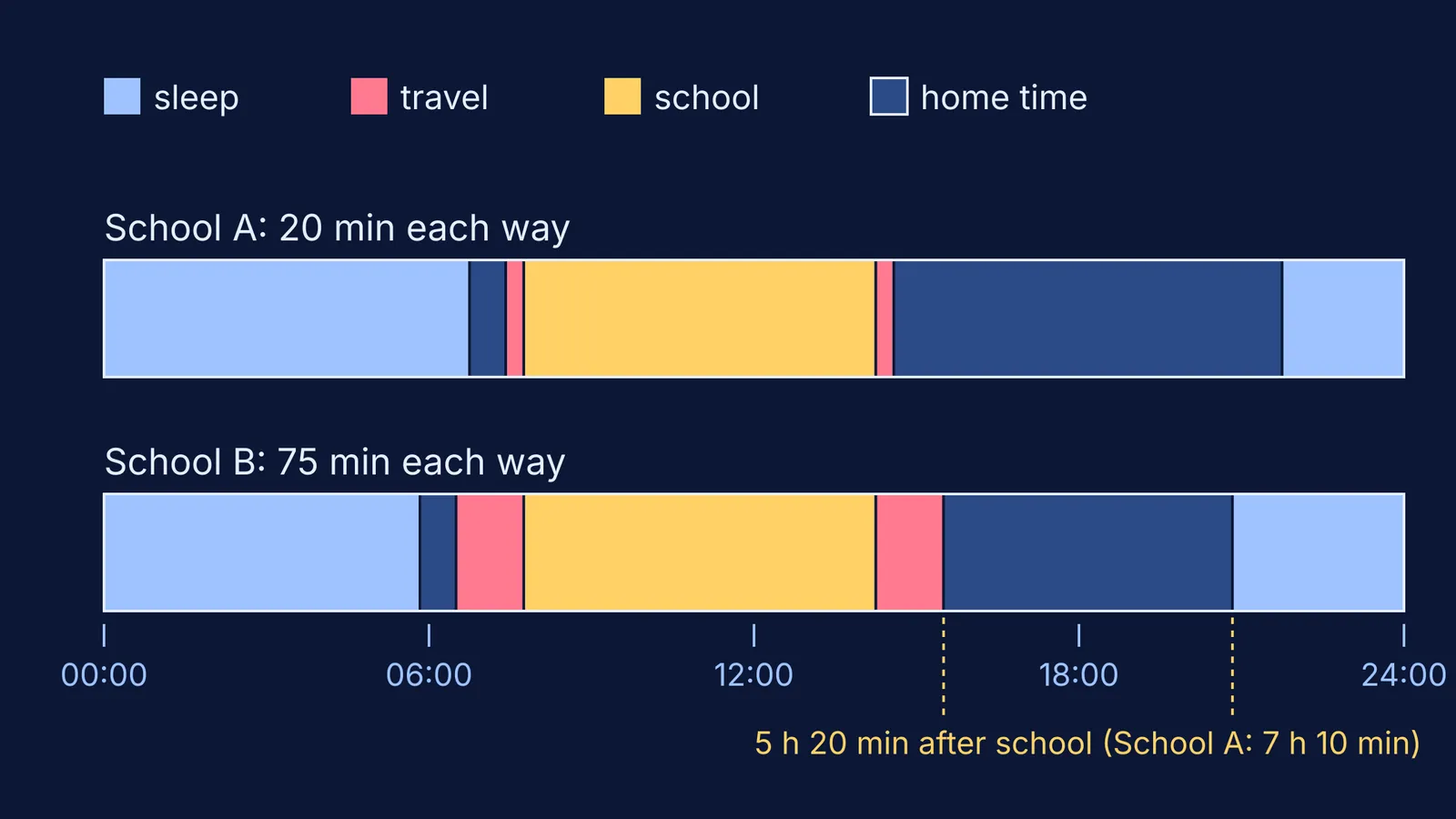
Count what is left. Subtract sleep, school, getting ready and travel from 24 hours. The rest is for meals, homework, play and family.
Over a five-day week, that gap is 9 hours 10 minutes, more than a whole school day. School B can still be the right choice; just make it knowing the price.
What can you do if the better school is far away?
Protect the sleep window. Fix a bedtime that matches the bus and keep weekends close to it. Our guide on how much sleep teenagers need has practical steps.
Keep travel time light. Audiobooks, a few flashcards or simply resting work; hard problem-solving on a moving bus rarely does.
Cut the second trip. A tuition class near home, or online, removes one commute.
Plan the shorter evening. A fixed weekly plan helps; see time blocking for students juggling school and coaching.
When evenings are short, getting started is the hard part. Fermi's AI tutor works out what your child already knows and builds a plan for the session, so a short hour at home begins with a clear next step.
If your child stays exhausted despite enough time in bed, talk to your doctor. If tiredness comes with low mood or constant worry, Tele MANAS offers free support on 14416.
Before you sign the admission form, do the trip once at the real hour.


