

On this page
Private tuition is now a normal part of school life in India. The National Statistics Office's Comprehensive Modular Survey: Education 2025 found that 27.0% of students were taking or had taken private coaching in the current academic year, and 30.7% in urban areas. The same survey puts average urban household spending on coaching at ₹3,988 per student a year, rising to ₹9,950 at the higher secondary level. With that much money and time at stake, the format matters.
Is one-to-one tuition better than group tuition?
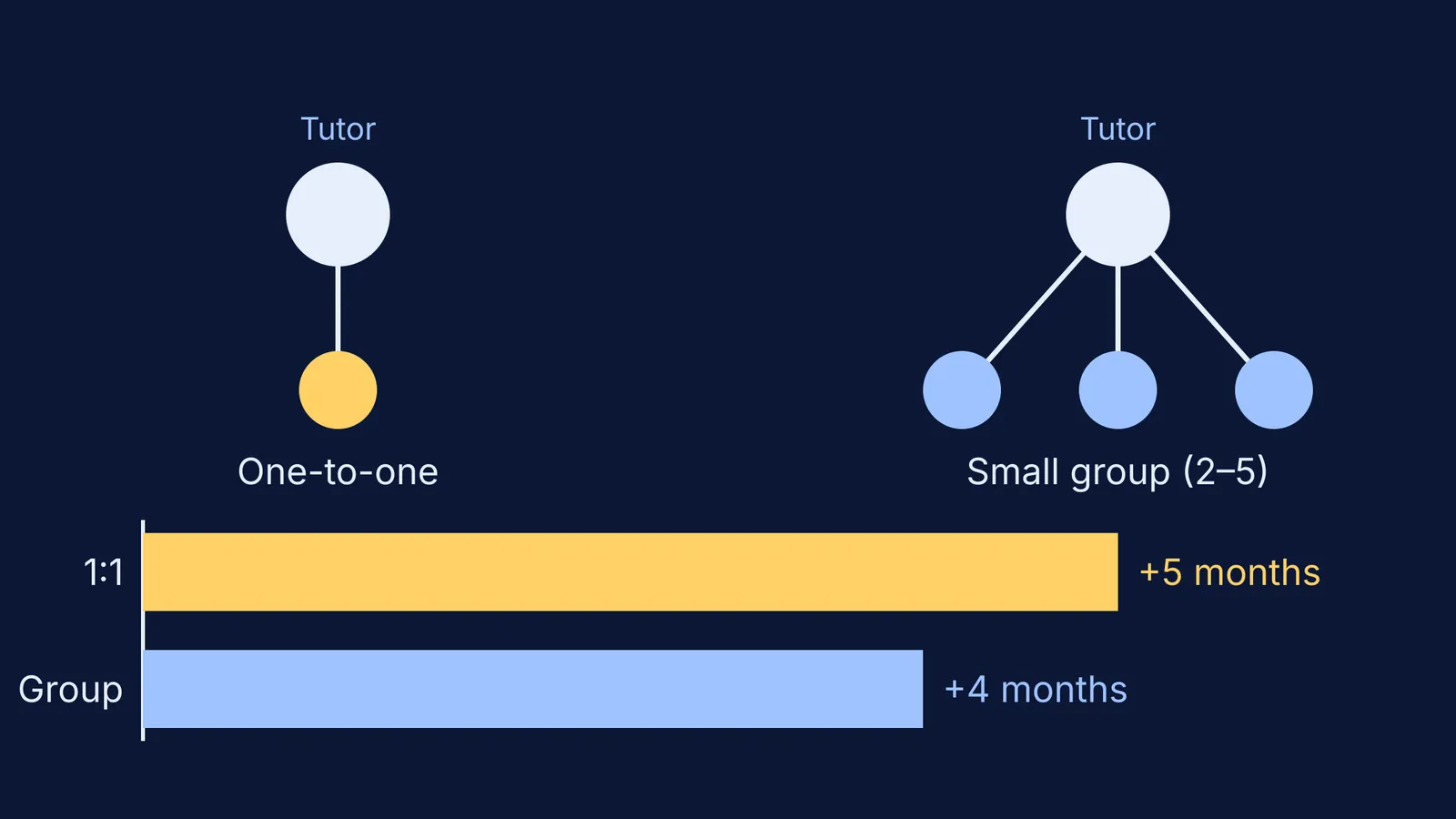
On average it is a little better, but the gap in the evidence is small. The UK's Education Endowment Foundation (EEF) says in its guide to effective tutoring that high-quality tuition aligned with classroom teaching can add up to five months of extra progress when it is one-to-one, and up to four months in a small group.
The EEF defines small-group tuition as one tutor working with two to five pupils. The same guide says the smaller the group the better, that groups of three are likely to keep high impact with good value for money, and that effectiveness drops noticeably once groups grow beyond six or seven. A batch of 25 at a local tuition centre is closer to a second class than to small-group tuition.
Who tutors matters too. A 2020 NBER meta-analysis by Nickow, Oreopoulos and Quan of experimental studies found tutoring had a pooled effect of 0.37 standard deviations on learning, with stronger effects on average when teachers or paraprofessionals tutored than when non-professionals or parents did.
How do pace, cost and confidence differ?
Pace. One-to-one moves at your child's speed and can stop on the exact step they get wrong. The EEF guide says tuition is likely to work best when it is targeted, using diagnostic assessment and timely feedback. In a group, the tutor has to balance several children's needs.
Cost. In a group, families share the tutor's time, so each usually pays less. The EEF guide says groups of three are likely to keep high impact with good value for money.
Confidence. The EEF guide notes that tutoring in groups may reduce any sense of stigma. One-to-one leaves nowhere to hide, which suits some children and wears others out.
Which suits a shy child, a fast learner or a struggling one?
A shy child may ask more questions when no classmates are watching, so one-to-one can be a good start. Some shy children, though, find a single adult's full attention tiring. A small group of two or three, the size the EEF guide calls good value, can be a middle path, especially with a friend in it. Our guide to asking better questions in class has question templates they can practise first.
A fast learner usually gets bored waiting for a group. One-to-one, or a small group of children at the same level, lets them move on to harder problems instead of repeating what they already know.
A struggling child often benefits most from the close targeting one-to-one allows, especially if the gaps go back several years. Once the basics are back, a small group can keep the progress going at lower cost.
If your child's worry about studies is affecting sleep, eating or daily life, talk to their school counsellor or a doctor, or call the free Tele MANAS helpline on 14416.
How do you know which format is working?
The EEF guide reports that sessions about three times a week, up to an hour long, over six to twelve weeks typically show the greatest impact. A four-week trial is shorter than that, but long enough for an early check on whether the format suits your child.
Before you start, write down the two or three topics your child finds hardest.
In the first session, ask the tutor how they will find out what your child already knows. A good answer involves questions, not just a test paper.
After week two, ask your child: 'What did you ask the tutor this week?' If the answer is nothing, the format may be wrong for them.
After week four, look at one piece of school work on a hard topic. Is it more accurate, or done with less help?
Then decide: keep going, change the group size, or change the tutor.
A short script for your first call with any tutor: 'How many children are in the group? How do you check what each one already knows? What will you tell us after a month?'
If the hardest part is knowing where to begin, Fermi's AI tutor works out what a student already knows and builds a plan for the session, and it can sit alongside either kind of tuition. For a fuller comparison, read our piece on choosing an AI tutor or a private tutor, and before paying any fee, our guide to evaluating a coaching institute.


