

On this page
Your child hands you a test with 11 out of 25, or a physics answer that went wrong in the second line. You want to help, and you also don't want a fight. The good news is that kind feedback and useful feedback turn out to be the same thing: specific, about the work, and pointed at what to do next.
Here is a script you can use tonight, the research behind it, and a worked example from real homework.
Why does "this is wrong" not help?
Feedback can make performance worse, not just better. A 1996 meta-analysis by Avraham Kluger and Angelo DeNisi pooled 607 effect sizes and found that over one third of feedback interventions decreased performance. Their explanation: feedback works less well the more it pulls attention away from the task and towards the self.
That is why "You're so careless" or "You're not a maths person" backfires. Your child stops thinking about the answer and starts defending who they are.
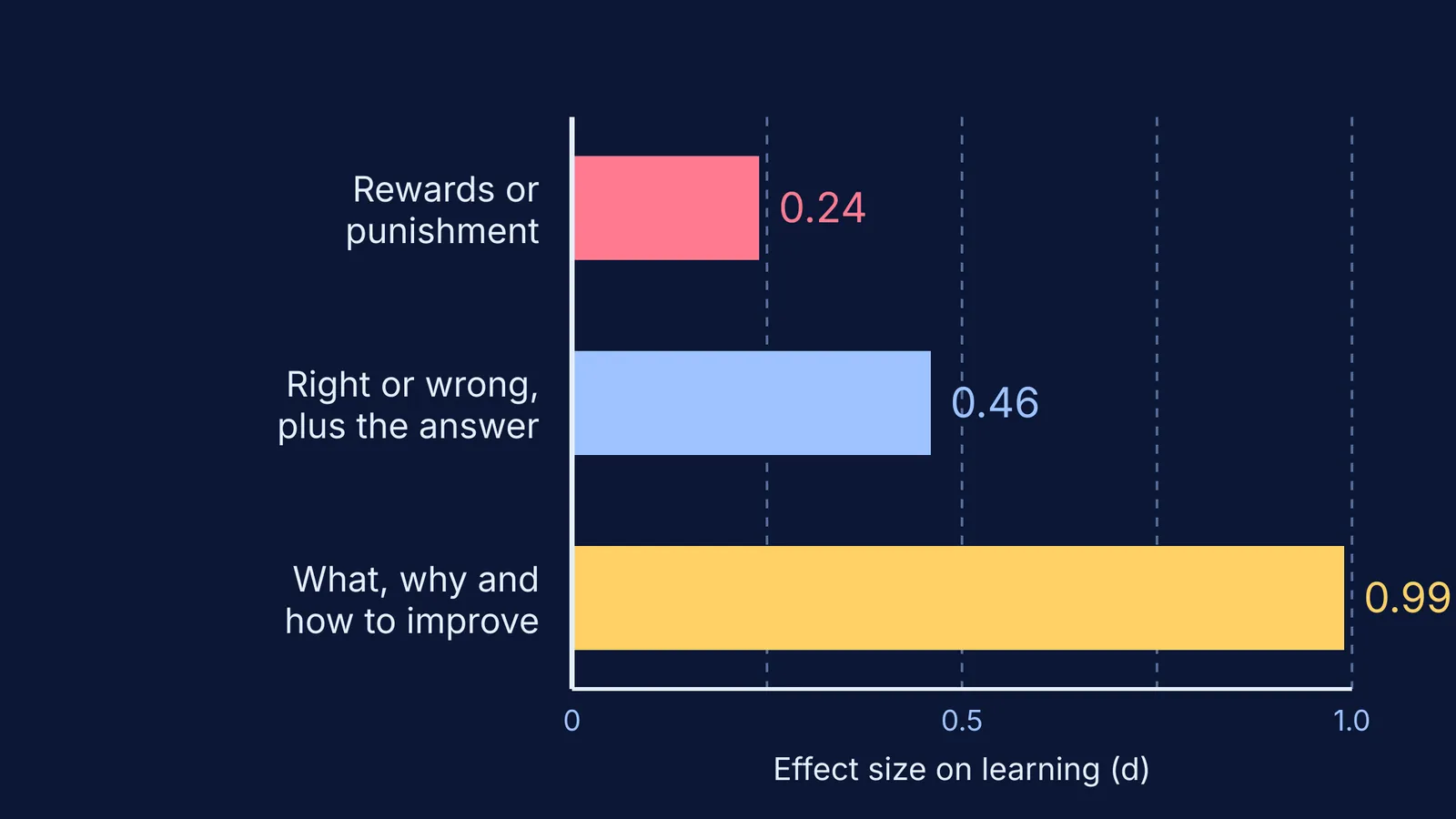
The type of feedback matters a lot. A 2020 meta-analysis of 435 studies with over 61,000 participants found that feedback is more effective the more information it contains. In that review, high-information feedback (what went wrong, why, and how to do better) had an effect size of 0.99, corrective feedback (right or wrong, plus the correct answer) 0.46, and rewards or punishment 0.24.
Praise alone is weak too. In John Hattie and Helen Timperley's review, praise had one of the lowest effects of any form of feedback, 0.14 across 11 meta-analyses, because it carries so little information about the task. That doesn't mean you should stop being warm. It means the warmth should be attached to something specific. Our guide to praising effort rather than ability goes into how.
What should you say when the answer is weak?
Hattie and Timperley describe good feedback as answering three questions: Where am I going? How am I going? Where to next? The script below borrows that idea and turns it into three moves a parent can make in a few minutes at the dining table.
Name one thing done well, and be exact. Not "good try" but "You drew the diagram and labelled the forces before writing equations." This tells your child what to keep doing.
Give one specific fix. Point to a line, not a person. "Look at line two. What sign should g have if up is positive?" Ask before you tell; if they find it, they own it.
Let your child choose the next step. Offer two or three options and let them pick: redo this question, try a similar one, or reread the textbook section first. Choosing gives them some say in what happens next.
Stop at one fix, even if you can see four. A list of everything wrong reads as a verdict, not help.
What does the script sound like on real homework?
Say your child is in Class 11 and got this wrong: a ball is thrown straight up at 20 m/s; how high does it go? They wrote v² = u² + 2gh, so 0 = 400 + 2(10)h, and got h = −20 m.
Done well: "You picked the right equation, and you knew v is zero at the top. That's the hard part."
One fix: "Your height came out negative, but the ball went up. You took up as positive for the speed. Which way does gravity point?"
Their choice: "Do you want to redo it now, try one with a ball thrown at 15 m/s, or look at how your textbook sets up signs first?"
With g taken as −10 m/s², the working gives h = 20 m. Your child found the error; you only pointed to the line.
If you can't follow the subject yourself, you can still run the script. Ask your child to talk you through the working line by line; the slip often shows up as they explain. For problems where the method itself is shaky, the Fermi Problem Library has worked problems with a step-by-step solver that explains the reasoning rather than printing an answer, which makes a good "next step" option to offer.
When should you give the feedback?
Not in the first minute after a bad result, when your child is still embarrassed or angry. Let them set the time: "Want to look at it together after dinner?" Our piece on when feedback helps most looks at the evidence on timing.
Sometimes a weak mark is a sign of something bigger. The Press Information Bureau's note on Tele MANAS describes the government's free, 24x7 mental health helpline.
For the bigger picture of how a wrong answer can become useful, see why mistakes help learning.
Try the three moves on the next piece of homework your child brings you: one thing done well, one fix, and their choice of what to do next.


