

On this page
Entering a competitive coaching classroom is an abrupt shock to your routine. In school, a single physics or mathematics chapter spans multiple weeks of predictable lessons and familiar textbook questions. In coaching, an instructor often covers dozens of pages of theory across a few rapid lectures, assigning extensive problem sets before the next morning. If you come home during the first week feeling drained, scattered, and convinced that everyone else in the batch is far ahead, you are experiencing the normal baseline of academic transition.
Why is the first month of coaching so exhausting?
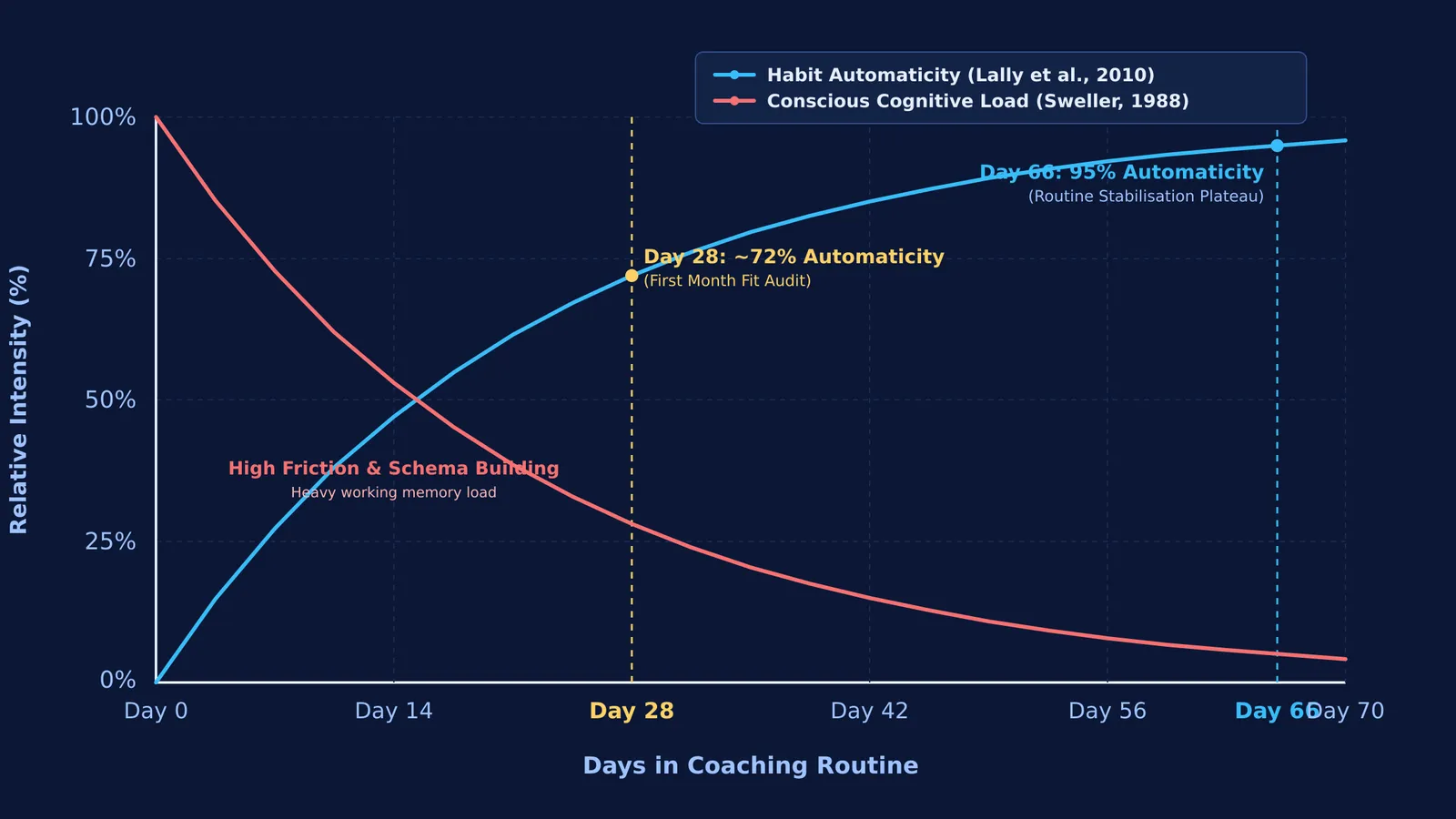
The exhaustion in your first weeks is primarily neurological. In his research on cognitive load theory, John Sweller demonstrated that when learners encounter unfamiliar domains with heavy element interactivity, working memory overloads because domain schemas have not yet formed. While Class 10 questions required one formula, coaching problems combine vectors, calculus, and coordinate geometry simultaneously, demanding intense conscious effort for every step.
Compounding this strain is acute sleep loss. A consensus statement by Shalini Paruthi and colleagues in the *Journal of Clinical Sleep Medicine* established that adolescents aged 13 to 18 require 8 to 10 hours of sleep per 24 hours for healthy cognitive function. Adding long commutes and daily practice sheets to school schedules usually compresses sleep first.
Cutting sleep directly damages analytical ability. In a study on chronic sleep restriction in *Sleep*, Hans P. A. Van Dongen and colleagues found that restricting sleep to 6 hours or 4 hours per night across 14 consecutive days produced working memory and vigilance deficits equal to one to two nights of total sleep loss. Crucially, participants grossly underestimated their cognitive impairment. When problem sets feel impossible, the culprit is often sleep deprivation rather than a lack of talent.
Why do your test scores suddenly drop?
Students accustomed to top marks in school board exams frequently receive scores that look alarmingly low on their first coaching test. This sudden drop triggers an acute crisis of confidence known in educational psychology as the Big-Fish-Little-Pond Effect. In a study of 103,558 students across 26 countries published in *American Psychologist*, Herbert W. Marsh and Kit-Tai Hau found that moving into an academically selective peer group causes a steep drop in academic self-concept, even when individual ability has not changed. In a selective coaching batch, you sit among top achievers facing negative marking and papers calibrated for a demanding percentile spread rather than high raw scores.
When homework problems require combining several unfamiliar concepts at once, the Fermi Problem Library provides worked problems with a step-by-step solver that explains the reasoning rather than printing an answer.
How long does it take to adjust to coaching?
Academic adjustment requires time for biological and behavioural adaptation. In a study on habit formation published in the *European Journal of Social Psychology*, Phillippa Lally and colleagues tracked 96 participants over 12 weeks and showed that reaching automaticity takes a median of 66 days, with timelines spanning 18 to 254 days. The researchers also confirmed that missing an isolated day does not disrupt the habit-formation process.
Expecting to handle demanding lecture schedules and daily problem sets automatically within a few weeks contradicts how habits form. The first month represents acute adjustment friction; routines require sustained repetition across several months to stabilise fully.
If prerequisite gaps from Class 10 leave you feeling lost in class, Fermi's AI tutor works out what you already know and builds a plan for the session so you sit down to a clear next step.
When should you judge whether the coaching centre fits?
Families often make hurried choices during the first month, either abruptly leaving the institute or hiring private tutors that worsen burnout. Distinguish between normal adjustment friction and structural misfit:
Normal adjustment friction (Stay the course): Early evening fatigue, disappointing marks on the first diagnostic test, moving slowly through problem sheets, or feeling hesitant at doubt counters. These reflect expected cognitive stretch during transition.
Structural misfit (Intervene): Excessive daily commutes that systematically cut into necessary sleep, classroom batches where asking questions is actively discouraged, or instruction that skips foundational derivations entirely.
If exam stress becomes overwhelming, free and confidential support is available 24/7 across India through the Ministry of Health and Family Welfare's Tele MANAS helpline at 14416.
How should families navigate the first month of coaching?
Use this weekly roadmap to steady your routine during the first month:
Week 1 (Protect sleep): Anchor an unbroken window of 8 hours of sleep. Focus on understanding lecture notes rather than attempting every difficult problem.
Week 2 (Triage homework): Split problem sheets into questions you can solve immediately, those needing notes, and those where you are stuck. Finish the first two groups and take the third to doubt counters.
Week 3 (Analyse the first test): Categorise lost marks into concept gaps, misread wording, or calculation slips rather than obsessing over raw percentages.
Week 4 (The fit audit): Evaluate routine sustainability and doubt access. Postpone final decisions about programme fit until completing the 66-day habit stabilisation window.


