

On this page
When the pre-board marksheet arrives, the atmosphere at home often shifts. A student who consistently scored high marks throughout the year might suddenly bring home a 65. The immediate reaction is panic, from both the child and the parents, because it feels like a final prediction of the board results.
But educators and researchers agree: a pre-board score is not a final forecast. It is a diagnostic tool designed to test a student's preparation under the hardest possible conditions. Here is why the gap between pre-board and board marks exists, and how you can use this experience to your child's advantage.
Are pre-boards harder than board exams?
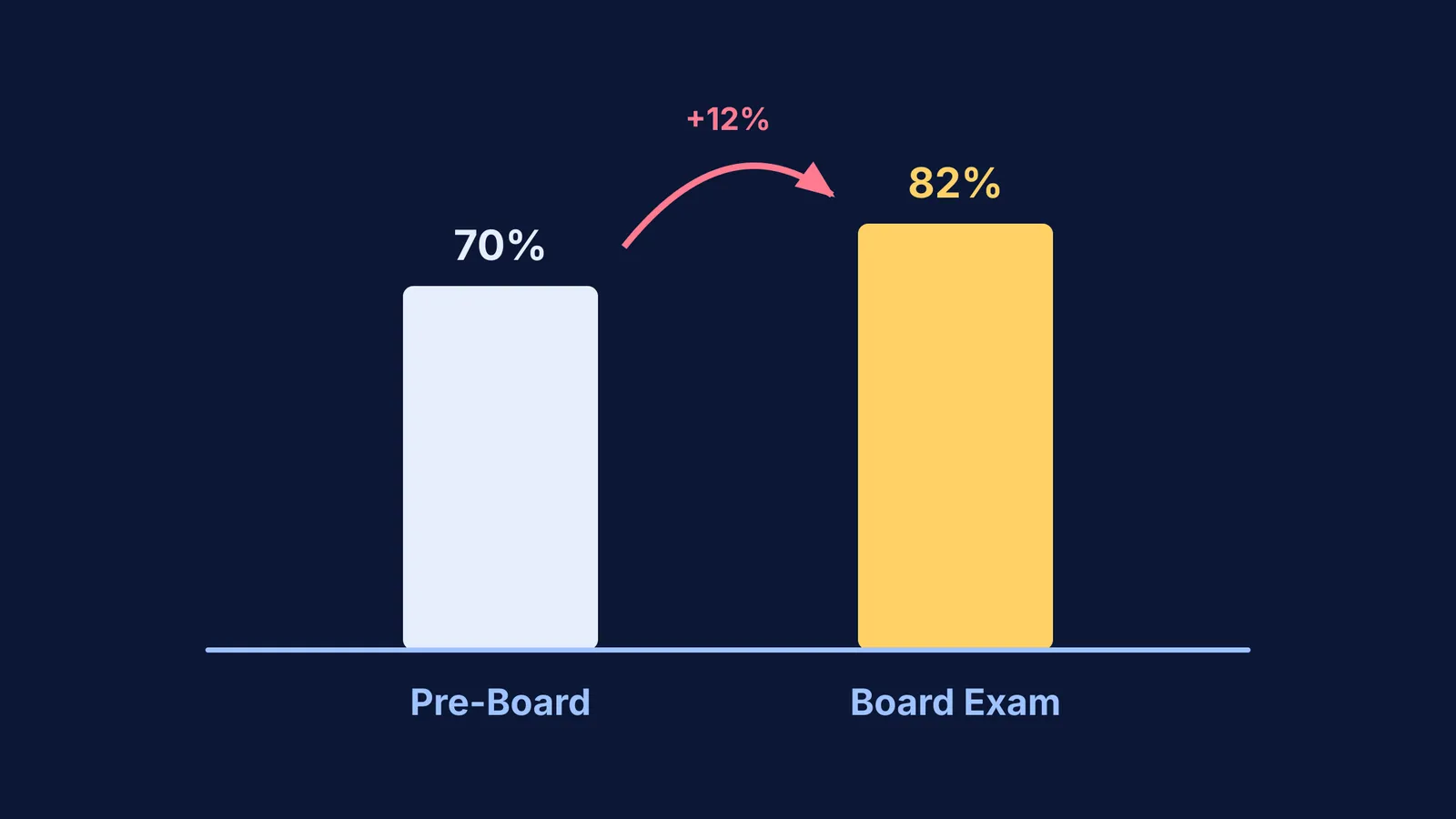
Yes, they usually are. A 2026 study published in the *International Journal For Multidisciplinary Research* analysed CBSE student data and found that final board scores consistently exceed pre-board scores.
The researcher, Anita Devi, discovered that Grade 10 students in the lowest pre-board quartile improved their final scores by 12 to 17 percentage points, while those in the highest quartile saw gains of 5 to 10 points. The study notes that these assessments act as an equity-supportive mechanism when paired with feedback, helping to bridge performance gaps before the finals. For Grade 12 students, the pre-boards serve a more predictive role, yielding uniform score improvements across performance levels.
Why do schools make pre-board papers so difficult?
Schools are not trying to discourage students; they are trying to simulate the worst-case scenario. When students face a tough pre-board, several productive things happen:
It provides a wake-up call: A lower-than-expected score highlights exactly which chapters a student has skimmed over or forgotten.
It builds exam stamina: Sitting for a full-length paper covering the entire syllabus is mentally draining. The pre-board is often a student's first attempt at doing this all at once.
It prepares them for strict examiners: Teachers mark pre-boards looking for missing steps, poor handwriting, and missing units in physics or mathematics. By penalising these now, they train the student to write the perfect board exam answer.
How should I talk to my child about their score?
When your child is disappointed by their results, the first step is to shift the focus from the grade to the process of learning.
Remind them that this is a practice match, not the finals. You might say, "Your teachers marked this strictly to show you where you can grab more marks next month. Let's look at what we can fix together."
This is also an excellent time to read about how parents can help children learn without adding pressure. Avoid comparing their pre-board score to their classmates' scores or their own previous unit tests. The pre-board is an entirely different kind of challenge.
How can we turn pre-board mistakes into a revision plan?
The real value of a pre-board exam lies inside the answer script itself. Do not just look at the total score; sit down with your child and categorise every mistake they made.
Time management mistakes: Did they leave questions blank because the clock ran out? They may need to practise skipping hard questions initially and coming back to them later.
Silly errors: Did they misread the question, forget a negative sign, or make an arithmetic mistake? This usually points to rushing or anxiety.
Concept gaps: Did they simply not know the answer, or apply the wrong formula entirely? These are the areas that need immediate re-learning.
For more details on reviewing the paper effectively, our guide on how to analyse a mock test: a 60-minute review routine provides a step-by-step framework you can follow at home.
If a concept gap caused the mistake, Fermi's AI tutor can work out what the student already knows and build a plan for the session to close it. The tutor teaches the concept rather than just providing the answer, checking understanding as it goes. If they struggle specifically with numericals, the Fermi Problem Library has worked problems with a step-by-step solver that explains the reasoning rather than printing an answer.
What should the study schedule look like now?
Once you have identified the gaps from the pre-board answer sheets, the next step is creating a targeted study plan. The time between the pre-boards and the final board exams is crucial for closing these specific gaps.
Focus entirely on the concept gaps first. Have your child re-read the textbook chapters for the questions that were marked completely wrong. Once they are confident, shift to practising numericals and writing out long-form answers to improve speed. Finally, take another full mock test at home, under strict exam conditions, to see if the time management has improved.
Pre-boards are a stressful milestone, but they are also the most useful piece of feedback your child will receive before the board exams. By treating the result as a map rather than a mirror, you can help them turn a score of 65 into an 85 on the final board result.


