

On this page
Teaching children about light and optics does not require a laboratory. Everyday objects such as mirrors, flashlights and toys can turn abstract physics concepts into something you can see and touch.
When children can see the "bounce" of light in action, the rules of optics stick. In fact, active learning makes a measurable difference in how well students grasp science. A 2014 meta-analysis found that failure rates under traditional science lecturing increase by 55% over those observed under active learning. Bringing this hands-on approach into your home helps build a durable understanding of physics from an early age.
Here are three simple mirror activities you can try at home to show how light behaves.
How does light bounce off a mirror?
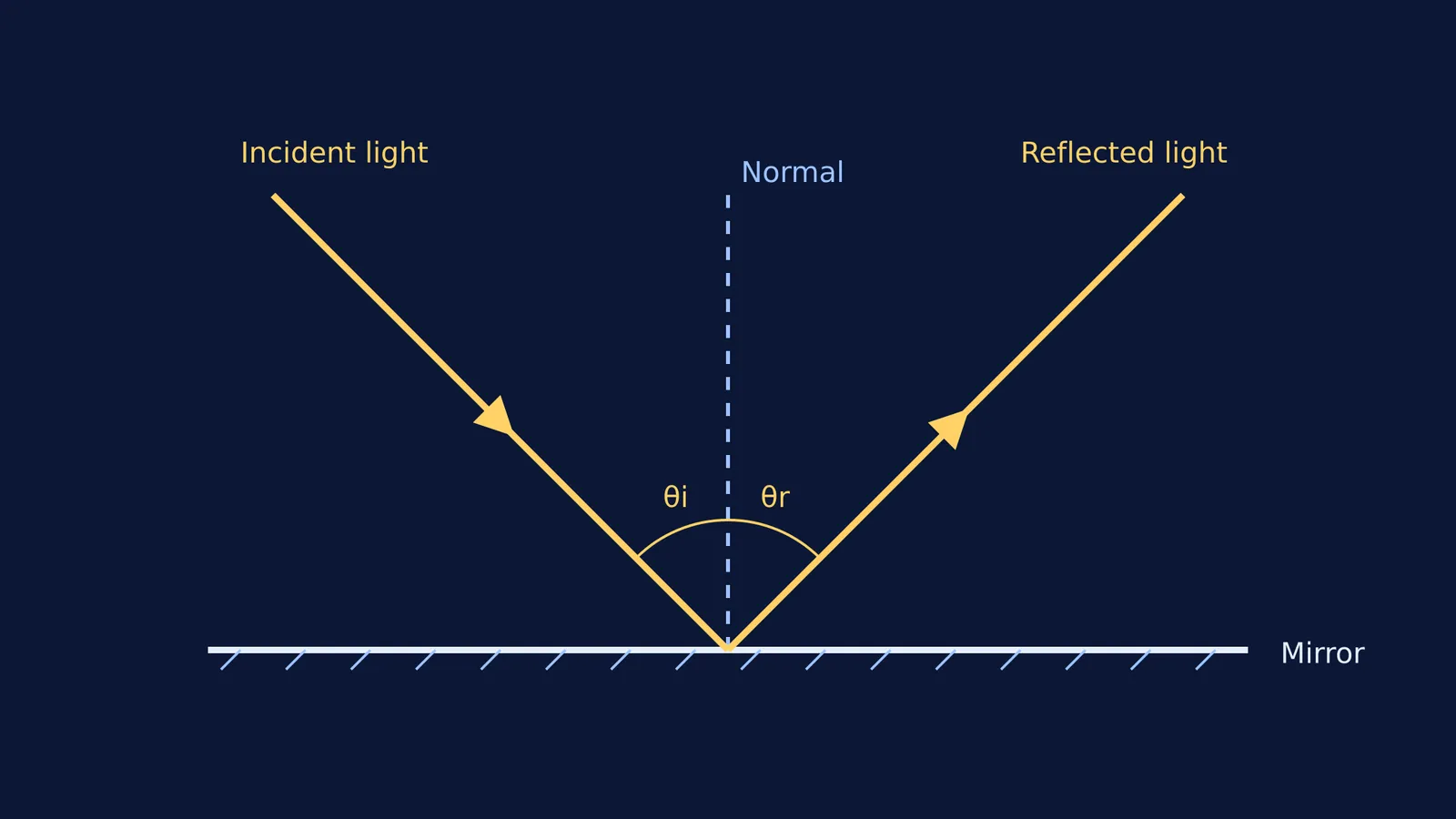
The fundamental rule of a flat mirror is the law of reflection: light bounces off a mirror at the exact same angle it hits it. Think of throwing a tennis ball against a smooth wall. If you throw it straight ahead, it comes straight back. If you throw it at a sharp angle, it bounces away at that same sharp angle.
In physics, the incoming light is called the incident ray, and the bouncing light is the reflected ray. If we draw an imaginary line perpendicular to the mirror—called the normal—the angle of incidence is always equal to the angle of reflection.
You can demonstrate this clearly with a flashlight.
What are some mirror experiments for kids to learn reflection?
1. The Flashlight Target
This is a straightforward way to see the law of reflection in action.
Tape a picture or draw a bullseye target on a wall in a darkened room.
Give your child a flashlight and hold a small flat mirror yourself (or let them hold the mirror while you hold the target).
Ask your child to stand away from the target, aim the flashlight at the mirror, and try to bounce the beam so it hits the bullseye.
What to say to guide them:
"Can you hit the target without shining the light directly at it?"
"What happens to the spot of light on the wall if you twist the mirror slightly?"
"Does the light bounce like a ball when it hits a wall?"
Once they succeed, change the position of the mirror or the target. This moves the activity from guessing to deliberately applying the bounce rule. If they later move on to topics like tracing a ray through a glass slab or refraction, this foundational understanding of angles is essential.
2. Secret Codes and Symmetry
Mirrors flip images left-to-right, creating symmetry. This is why the word "AMBULANCE" is written backward on the front of the vehicle—so drivers see it correctly in their rear-view mirror.
Have your child write their name on a piece of paper and hold it up to a mirror to see how the letters reverse.
Challenge them to write a "secret code"—writing a word backward so that it only looks normal when viewed in the mirror.
Draw half a butterfly or half a face on a piece of paper. Place the edge of a mirror along the centre line to "complete" the drawing. This is a brilliant way to explore lines of symmetry.
3. The Corner Periscope
A periscope bounces light twice, allowing you to see over or around obstacles. You can build a simple one using a long cardboard tube (like an empty kitchen roll or two milk cartons taped together) and two small mirrors.
Cut a small window near the top and bottom of the tube, on opposite sides.
Slit the sides of the tube at a 45-degree angle behind each window.
Slide a mirror into each slit, facing inward. The top mirror should face forward and down, while the bottom mirror faces backward and up.
When you look through the bottom window, light from the top window reflects down the tube and into your eye. Understanding how two optical devices interact is a crucial skill for later physics, such as solving a lens and mirror set apart.
Why do multiple mirrors create an infinity tunnel?
When you place two mirrors facing each other, light bounces back and forth between them. With each bounce, a new virtual image is formed, creating a tunnel that seems to stretch on forever.
You can set this up by holding a small hand mirror up to a large bathroom mirror, with your child standing in between. If you angle the small mirror slightly, you will see a curving line of reflections. This multiple-reflection principle is also what powers a kaleidoscope, where three mirrors arranged in a triangle bounce the image of coloured beads into a repeating, symmetrical pattern.
If you are exploring colours and light splitting, you can complement this activity by studying the dispersion of white light by a glass prism to see how light is made of different colours.
How can Fermi help?
When your child begins encountering these concepts in school, abstract diagrams can sometimes be difficult to interpret. The Fermi Simulation Lab provides interactive simulations for the ideas that are easier to see than to read.
If they are struggling with a specific optics homework problem, the Fermi Problem Library has worked problems with a step-by-step solver that explains the reasoning rather than printing an answer. And as they explore the wider world of physics, the Concept Library houses every concept in physics, chemistry, biology, mathematics and computing, each with its own lesson and its place in the map.


