

On this page
Teenagers naturally grasp the idea of paying a monthly fee for streaming services or gym memberships. However, when it comes to borrowing money, the mathematics of interest and repayment often remains invisible. In the OECD's 2022 PISA financial literacy assessment, 18% of 15-year-olds performed below the baseline proficiency level, meaning they struggle to understand basic invoices or recognize the difference between needs and wants.
When young people see an advertisement for a new smartphone available for "just ₹4,000 a month," they usually think about their monthly pocket money, not the final total they will hand over to the bank. If you want to equip your teenager with financial common sense, the best classroom is a real-world family purchase.
What is an EMI, and why do banks offer it?
An Equated Monthly Installment (EMI) is a fixed payment made to a lender each month to clear a loan. Instead of lecturing about debt, wait until the family needs to buy a high-ticket item, such as a laptop for school or a new refrigerator. Sit down with your teenager and look at the checkout page together.
Point out the two options: paying the cash price today or paying in EMIs over 12 months. Ask them why the store might want to let you take the laptop home today while only paying a fraction of the cost.
The key lesson here is the trade-off. Explain that the bank pays the store the full amount upfront. In return, the bank charges a "convenience fee" for letting you use their money. This fee is called interest. The EMI is carefully calculated so that every month, you are paying back a portion of the original price (the principal) plus a slice of that interest fee.
How do you explain the cost of borrowing?
Numbers on a screen can feel abstract, so break the math down on a piece of paper.
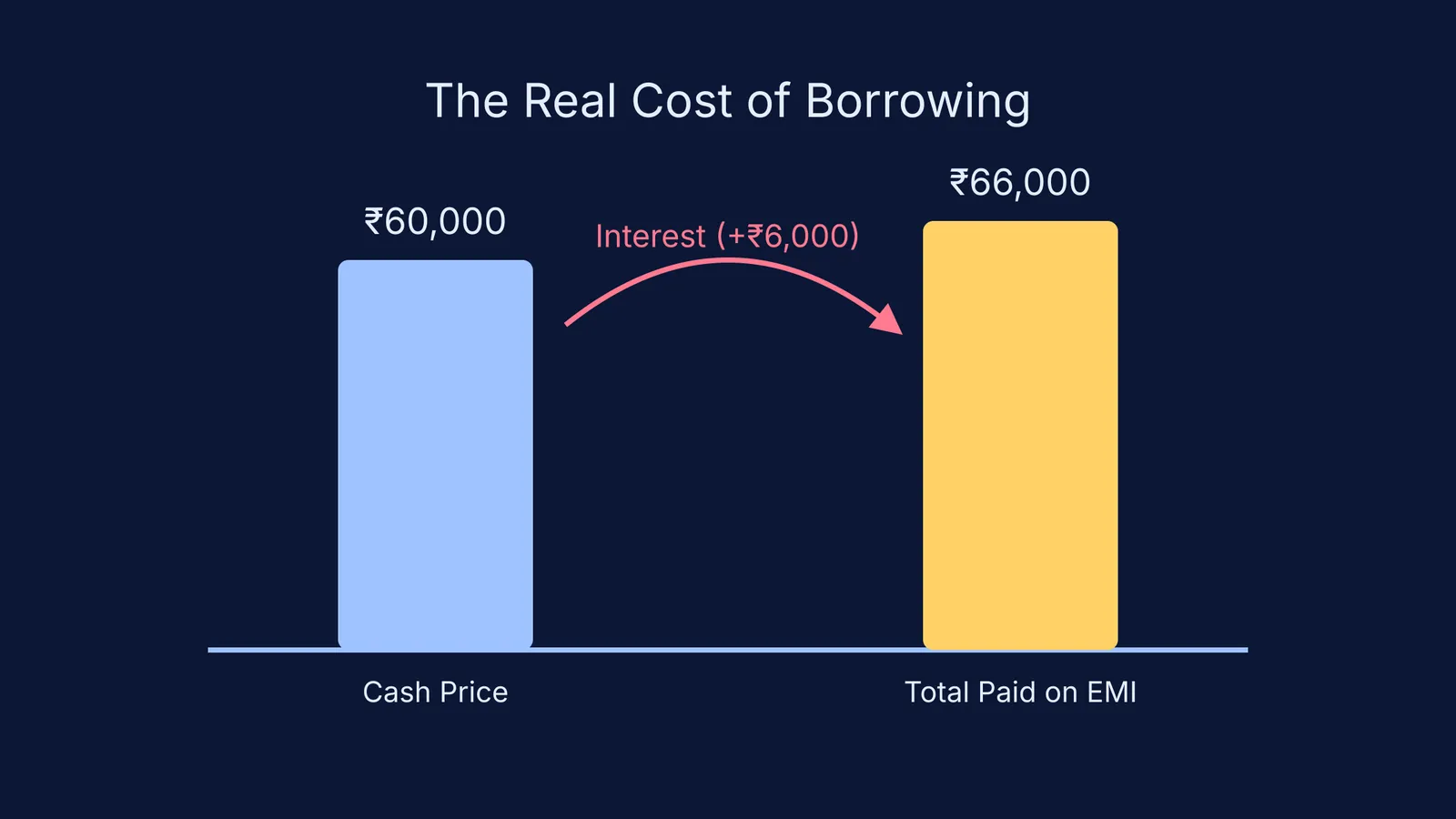
Imagine the laptop costs ₹60,000. The store offers a 12-month EMI plan at ₹5,500 per month. Have your teenager multiply ₹5,500 by 12. The total comes to ₹66,000.
That extra ₹6,000 is the cost of borrowing. It is the rent you pay for holding onto the bank's money. This simple multiplication exercise transforms a "cheap" monthly payment into a tangible premium.
Understanding how a steady interest rate compounds requires grasping the mathematics of series and exponential growth. If your teenager struggles to picture this geometric progression, Fermi's AI tutor can help. Rather than just handing out an answer, the tutor works out what the student already knows, builds a plan for the session, and teaches through the reasoning—drawing the graphs on a shared board to make the abstract numbers visible. You can see similar mathematical patterns at work in natural systems, such as arithmetic vs geometric growth in plants, where growth compounds over time.
Where does insurance fit in?
When you buy a larger item like a car on a loan, banks often require you to buy insurance alongside it.
Explain to your teenager that insurance is a protective shield. If the car is damaged, the insurance company covers the repair costs. Without insurance, you could end up in a situation where the car is unusable, but you are still forced to pay the monthly EMI to the bank. It is a calculated upfront cost to protect the family from unpredictable financial shocks.
Why is compound interest dangerous in debt?
Once they understand a simple EMI, you can introduce the concept of credit cards. If an EMI is a fixed, predictable schedule, a credit card minimum payment is a trap designed to maximize interest.
Show them that if you only pay the minimum amount on a credit card, the remaining balance is charged interest. The next month, you are charged interest on the original balance *plus* the new interest. This compounding effect means the debt grows exponentially.
In school, students learn how to sum sequences, such as recovering aₙ from a formula for Sₙ. The mathematics of debt is just the real-world application of these series. When they see the formula at work, the abstract danger of "getting into debt" becomes a very real, calculable consequence.
A practical script for parents
Next time your teenager asks for an expensive item and suggests using an EMI or a "buy now, pay later" service, you can use this simple script:
Acknowledge the desire: "I understand why you want this phone now, and breaking it into small payments seems easy."
Do the math together: "Let's multiply that monthly payment by the number of months. What is the final total we will pay?"
Identify the fee: "The cash price is ₹40,000, but the total EMI is ₹46,000. Are you willing to pay an extra ₹6,000 just to have it today?"
Discuss the opportunity cost: "If we save up for four months instead, you get to keep that ₹6,000. What else could you do with that money?"
By anchoring the concept of interest to things they actually want to buy, you turn abstract financial jargon into practical, everyday mathematics.


