

On this page
Your child drops a spoon, watches it hit the floor, and asks why. The honest answer is short, and it can stay true when they meet gravity again in Class 9 physics. Let them test it first, then name what they saw.
What should you say when a child asks why things fall?
Start with one sentence: "The Earth pulls everything towards it, and we call that pull gravity." That is true at age 6 and at age 16. Add a second idea only when the feather comes up: "Air pushes back on things as they fall, and it slows light, spread-out things the most."
Swap the common shortcuts your child would later have to unlearn:
Instead of "Heavy things fall faster", say "Everything is pulled down. Air slows some things more than others."
Instead of "Gravity is the air pushing down", say "Gravity is the Earth pulling. Air actually gets in the way."
Instead of "Gravity only pulls heavy things", say "The Earth pulls on everything, even a feather, even you."
Instead of "There's no gravity in space", say "Gravity reaches into space. Astronauts float because they are falling around the Earth."
Do heavier things fall faster than light ones?
Many children guess wrong here. In a study of 121 children aged 5 to 11, Michael Hast and Christine Howe found that the children's predictions about falling objects "were typically in error", yet they usually recognised a correct fall as correct when they saw one (Cognitive Development, 2015; abstract). So ask for a guess, then let them watch.
Do three drops over a bed, holding both objects at the same height and letting go together.
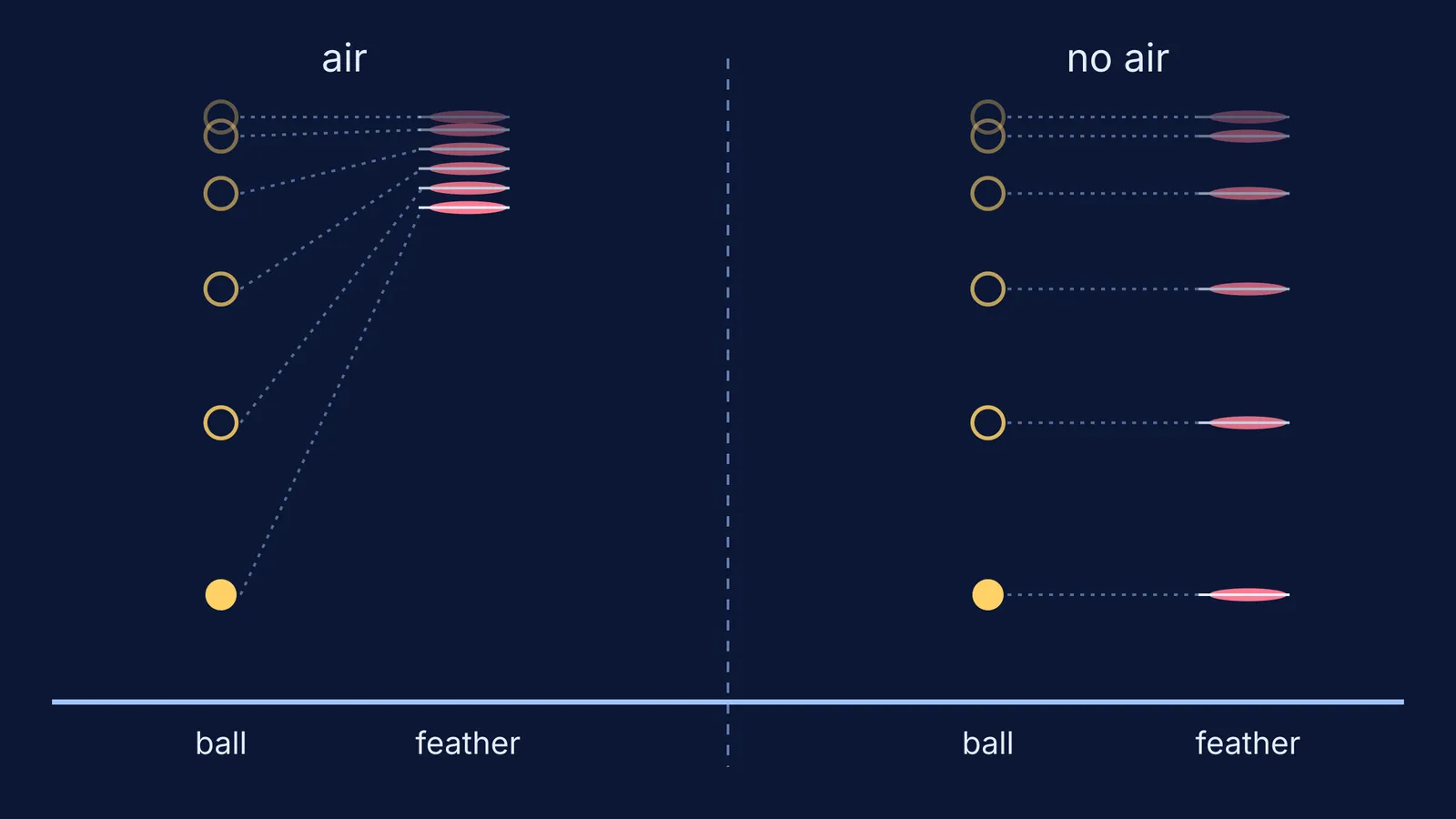
A ball and a feather (or a dry leaf). The ball lands first. Ask: "Is the Earth pulling the feather less, or is something slowing it down?"
Two sheets of the same paper, one flat and one crumpled into a tight ball. They weigh the same, yet the crumpled one lands first. Only the shape changed, so the air must be the difference.
A light ball and a heavier ball of about the same size, such as a plastic ball and an orange. They land almost together.
Then show them the real answer. At the end of the last Apollo 15 moonwalk, astronaut David Scott held out a 1.32 kg aluminium hammer and a falcon feather and dropped them together; with no air on the Moon, they fell at the same rate and hit the ground together (NASA). The NASA page links to the short film.
Why does a ball roll faster down a steeper ramp?
A ramp slows a fall enough for a child to follow it. Prop a tray or a hardback book on one cushion, then two for a steeper ramp. Solid glass marbles roll straight.
Same marble, gentle ramp then steep ramp. Ask first: "Which time will it be faster at the bottom?"
Steep ramp, a small marble and a big marble released together. They reach the bottom at nearly the same time.
What to say: "Gravity still pulls straight down. The steeper the ramp, the more of that pull goes into rolling, so the marble speeds up more."
Hast and Howe ran a similar study on slopes with 130 children aged 5 to 11; predictions were again typically in error, but the children largely recognised correct motion as correct (British Journal of Developmental Psychology, 2017). A wrong guess is the start of the conversation, not a problem.
Is there gravity in space?
NASA notes that "many people mistakenly think that gravity does not exist in space", and that about 250 miles above the surface, Earth's gravity is still 88.8 percent as strong as on the ground (NASA). Astronauts float because they and their space station are falling together, around the Earth rather than towards it. A child-sized version: "They are falling all the time, but they are going so fast sideways that they keep missing the ground."
What does an older sibling add to the same idea?
The words above grow up without being replaced. Near the Earth's surface, the value of g is 9.8 metres per second squared, and as a falling object speeds up, air drag grows until it equals the object's weight, after which it stops speeding up (NASA Glenn Research Center). A feather reaches that balance almost at once; a dropped ball does not. Our guide to vertical motion under gravity takes it on to the equations.
For an older child who likes to explore, the Fermi Simulation Lab has interactive simulations for the ideas that are easier to see than to read.
For more tests with things already at home, try our kitchen science experiments and these ideas for encouraging curiosity at home.


