

On this page
A solar eclipse is an astronomical event, but the vast distances of space can make it hard for children to picture exactly what is going on. When the Moon covers the Sun, it is simply casting a shadow, just like a tree blocking a streetlight.
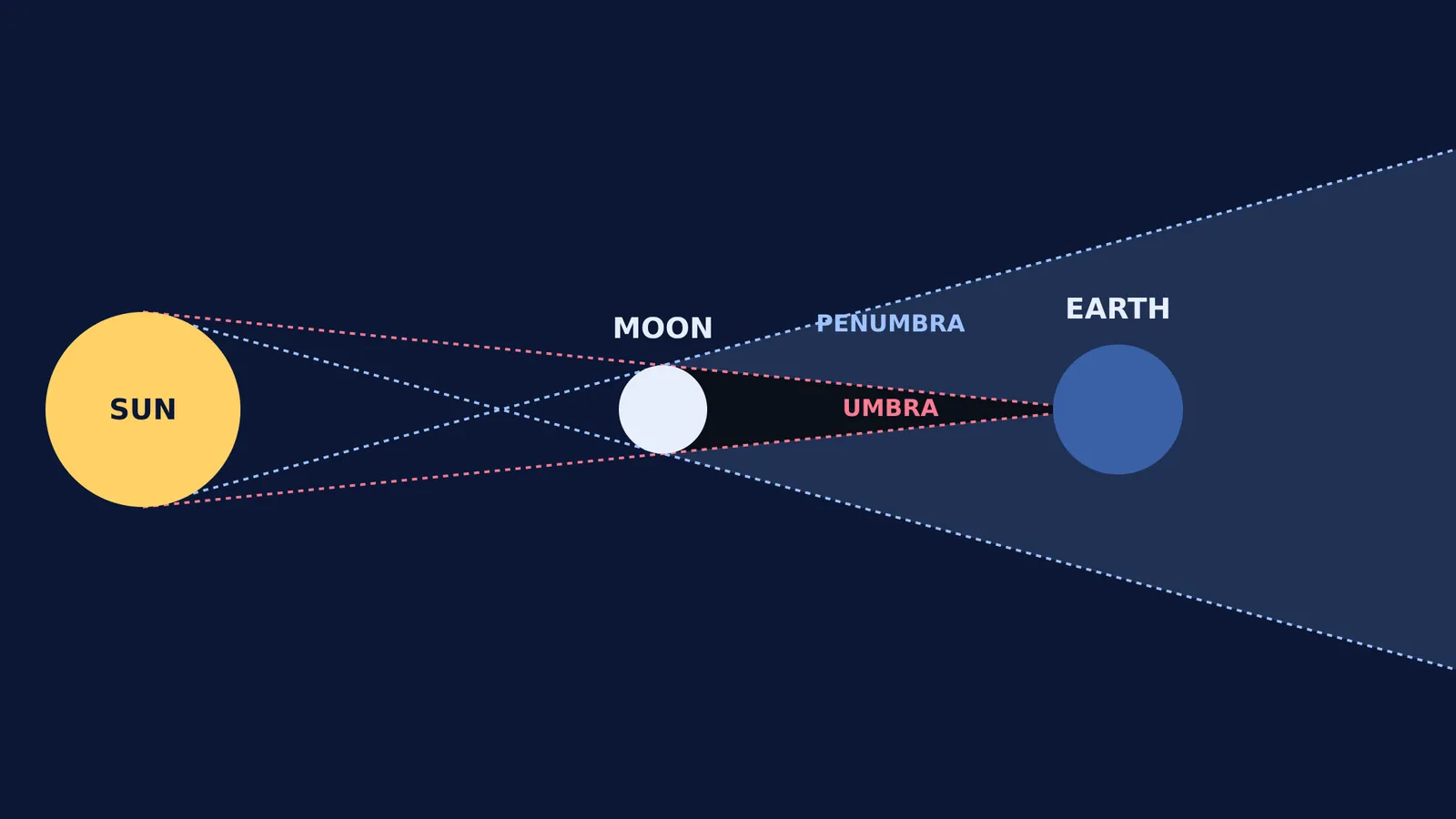
According to NASA, an eclipse happens when a planet or a moon gets in the way of the Sun's light. During a solar eclipse, the Moon moves between the Sun and Earth, casting a shadow on Earth. As this happens during the day, the sky darkens as if it were dawn or dusk. To help children remember the difference between the types of eclipses, you can teach them a simple memory trick: the name tells you what gets darker. In a solar eclipse, the Sun gets darker, and in a lunar eclipse, the Moon gets darker.
To bring this astronomical idea into focus, you can build a working model in your living room.
How to explain a solar eclipse to kids?
The best way to explain the geometry of an eclipse is through a hands-on activity. You do not need perfect scale models—a simple flashlight and two balls will do.
You will need:
A flashlight to act as the Sun.
A large ball, such as a basketball or globe, to represent the Earth.
A small ball, such as a tennis ball, to act as the Moon.
To show a solar eclipse, have your child hold the small Moon ball and move it slowly between the Sun and the Earth. As the Moon passes through the beam of light, it will cast a small, dark shadow onto the Earth ball.
Explain that the people standing in that tiny dark circle on the Earth are experiencing a total solar eclipse because the Moon is blocking their view of the Sun. To look more closely at the geometry of light and shadows, the Fermi Simulation Lab provides interactive simulations for the ideas that are easier to see than to read, such as how the umbra (full shadow) and penumbra (partial shadow) change with distance.
What is a lunar eclipse?
Once your child understands the solar eclipse, you can easily switch the model to demonstrate a lunar eclipse.
In this setup, move the Earth ball so it sits directly between the flashlight and the Moon ball. The Earth is much larger than the Moon, so it casts a massive shadow that completely swallows the small Moon ball. During a real lunar eclipse in the night sky, the full moon fades as it enters Earth's shadow. The Moon often turns a reddish color, which is caused by Earth's atmosphere bending sunlight, similar to a sunset.
This model shows why a lunar eclipse is visible to everyone on the night side of the Earth, whereas a solar eclipse is only seen by a lucky few in the Moon's narrow shadow path. The mechanics of light travelling in straight lines are the exact same principles that govern the dispersion of white light by a glass prism and the way light entering glass behaves.
How to safely view a solar eclipse?
If a real solar eclipse is approaching, safety must be the top priority. The Sun's rays are intense enough to cause permanent eye damage, even when partially covered.
According to NASA, except during the brief total phase of a total solar eclipse, when the Moon completely blocks the Sun's bright face, it is not safe to look directly at the Sun without specialized eye protection for solar viewing. There is no safe period for looking at a partial or annular eclipse.
Here is how to keep your children safe:
Use certified glasses: Safe solar viewers are thousands of times darker than regular sunglasses and ought to comply with the ISO 12312-2 international standard.
Sunglasses are not enough: Regular sunglasses, no matter how dark, are not safe for viewing the Sun.
Check for damage: Always inspect your eclipse glasses or handheld viewer before use; if torn, scratched, or otherwise damaged, discard the device.
Supervise closely: Always supervise children using solar viewers.
Avoid optics: Do not look at the Sun through a camera lens, telescope, binoculars, or any other optical device while wearing eclipse glasses—the concentrated solar rays will burn through the filter and cause serious eye injury. Instead, special-purpose solar filters must be secured over the front of the optics.
Indirect viewing methods
If you do not have certified glasses, you can safely watch the eclipse indirectly. One way is to use a pinhole projector, which has a small opening—for example, a hole punched in an index card. With the Sun at your back, you can use the pinhole to project an image of the Sun onto a nearby surface. Do not look at the Sun through the pinhole.
You can also make your own eclipse projector using a cardboard box, a white sheet of paper, tape, scissors, and aluminum foil. By taping foil over a hole in the box and poking a pinhole in it, you can project a crescent Sun onto the white sheet of paper taped to the inside of the box during the partial phases of a solar eclipse.
Alternatively, grab a kitchen colander. The circular holes of a colander project crescent shapes onto the ground during the partial phases of a solar eclipse.
Whenever you tackle these big ideas, remember that science is about active discovery. By building models and observing safety rules, you help your children see the mechanics of the solar system firsthand.


