

On this page
When a child reads that a solution is a "homogeneous mixture of two or more substances," the words rarely stick. Science can easily become a list of definitions to memorise rather than a description of the real world.
But you can show them what a mixture is using everyday items already sitting in your kitchen. A black marker appears to contain a single, solid dark colour, but it is actually a carefully blended mixture of several different dyes. By pulling those dyes apart in a simple, visual way, you can make an abstract chemistry concept immediately obvious. This approach to learning does more than provide an entertaining afternoon; it completely changes how a student engages with scientific material.
What is the marker chromatography experiment?
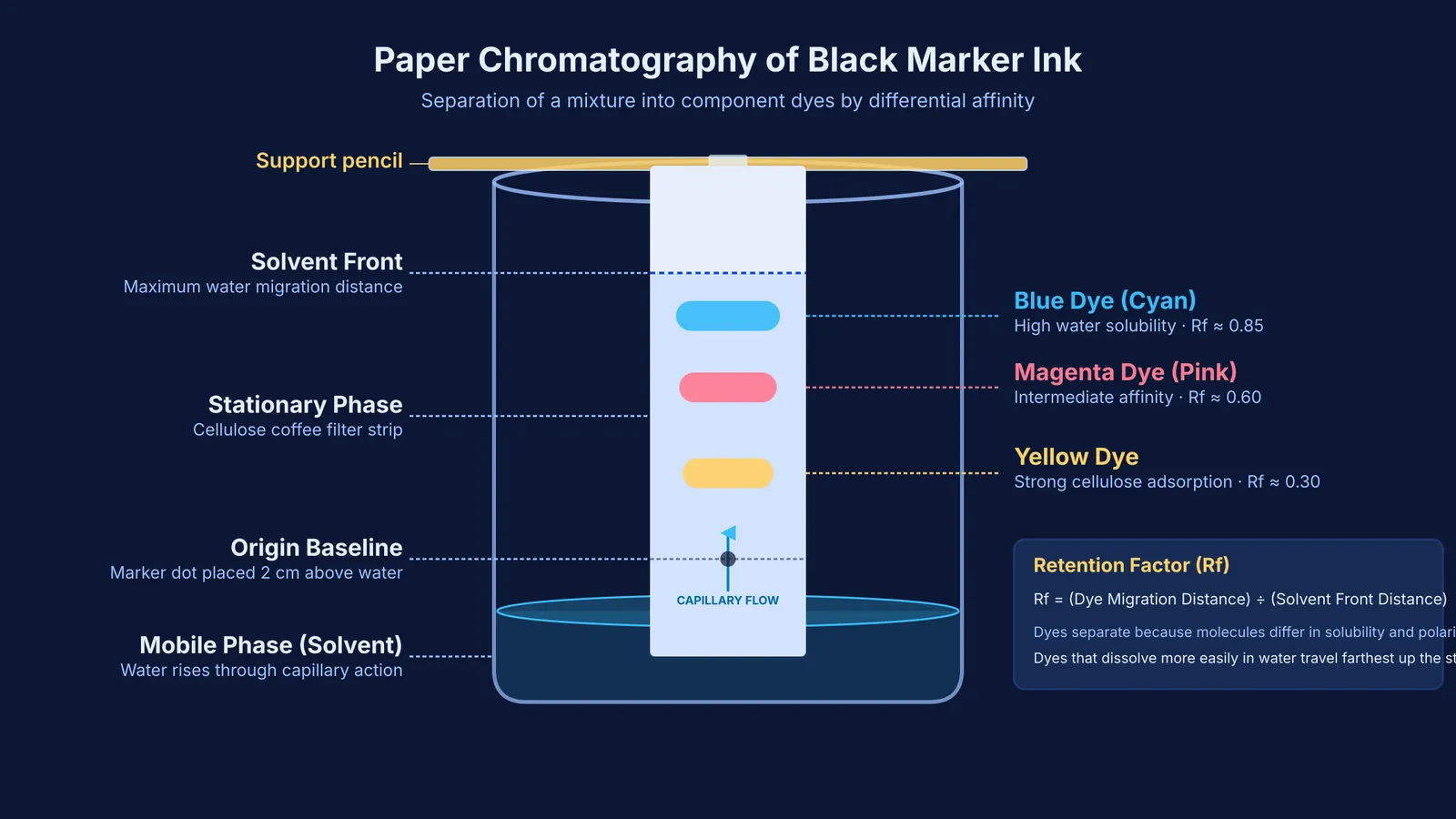
Chromatography is a laboratory technique used by chemists and biologists to separate the individual components of a mixture. In its simplest form, it uses a stationary phase (like a strip of paper) and a mobile phase (a solvent like water). As the water travels through the porous paper, it carries the mixture along with it.
Because different molecules have different sizes, shapes and solubilities, they travel at different speeds. The result is a clear, visual separation of the mixture's ingredients. For instance, Martin, Synge and partition chromatography won the Nobel Prize in Chemistry for developing a related technique to separate complex amino acids. In a modern school setting, calculating the Rf value in paper chromatography helps older chemistry students identify unknown substances by measuring exactly how far each dye travels relative to the solvent.
For young learners, a marker chromatography experiment simply reveals that things are not always what they seem. A single black dot will stretch out into a wide rainbow of blue, yellow, pink and red bands.
How do you do a marker chromatography experiment with kids?
You do not need a laboratory, safety goggles, or specialised equipment to separate dyes. Like many classic kitchen science experiments, you can set this practical demonstration up at the kitchen table in just a few minutes.
Cut a standard white coffee filter or a sturdy paper towel into a rectangular strip.
Draw a thick line or a heavy dot with a black, water-based marker about 2 cm from the bottom edge of the paper strip.
Pour a small amount of water into a clear drinking glass, ensuring you use just enough to cover the bottom of the glass.
Suspend the paper strip in the glass so the very bottom edge touches the water, but the black ink mark remains slightly above the water level. You can tape the top of the strip to a pencil resting horizontally across the rim of the glass to hold it in place.
Watch closely as the water climbs the paper and drags the hidden colours upwards.
Why does black ink separate in water?
The separation happens because of a scientific principle called differential affinity. As the water (which acts as the solvent) moves up the tiny cellulose fibres of the coffee filter via capillary action, it dissolves the ink along its path.
The individual dyes blended into the ink do not behave identically when exposed to the water. A dye that is highly soluble in water and poorly attracted to the paper fibres will race ahead, moving closer to the water's leading edge (known as the solvent front). Conversely, a dye that is less soluble, or one that sticks more strongly to the paper, will lag behind and stay closer to the bottom.
Over a span of five to ten minutes, this difference in travelling speed pulls the mixed dyes entirely apart, turning the original black dot into distinct, bright bands of colour.
How does active learning improve student performance?
Performing this experiment does more than pass the time; it fundamentally shifts the learning process. Reading about a mixture in a textbook is a passive exercise, while separating one with your own hands is an active experience.
The difference in academic outcomes between these two methods is stark. A landmark 2014 meta-analysis by Scott Freeman and his colleagues, published in the Proceedings of the National Academy of Sciences, examined 225 studies of undergraduate STEM courses. The researchers found that students in traditional, passive lecture courses experienced an average failure rate of 33.8%. In contrast, that failure rate dropped to just 21.8% for students who were engaged in active learning environments. In short, passive learning makes a student roughly 1.5 times more likely to fail.
If your child struggles to connect abstract textbook definitions to the physical world they live in, the Fermi Simulation Lab provides interactive simulations for the ideas that are easier to see than to read.
By showing rather than just telling—whether you are observing capillary action at the kitchen sink or running an interactive simulation on a screen—you give students the necessary context they need to properly understand the science around them.


