

On this page
Your teenager spends hours on pressure, friction and refraction in Class 9 to 12, then walks past all three without a second look. You don't need the formulas to change that. You need a few good questions and the ease to say “I don't know either, let's think.”
Why talk about physics at home at all?
Relevance matters. In a 2009 study in Science, Chris Hulleman and Judith Harackiewicz asked first-year high-school students to write either about what they had learned or about how it connected to their own lives. Personal connections predicted interest in further science courses and careers, and the effect was largest for students who started with the least confidence.
Parents can carry that message too. In a field experiment published in Psychological Science in 2012, Harackiewicz and colleagues sent parents two brochures and a website on why maths and science courses are useful. Teens whose parents were in that group took, on average, nearly one semester more of science and maths in their last two years of high school than the control group.
Neither study tested kitchen chats, but both suggest that seeing where science shows up in life helps teenagers stick with it.
The chapter hints below follow the NCERT science and physics textbooks; your child's board may order topics differently.
What everyday physics questions can you ask in the kitchen?
“Why does dal cook faster in the pressure cooker?” (Class 11 thermal physics: the boiling point rises with pressure.)
“Why does the steel spoon left in the pan get hot, but the wooden one doesn't?” (Class 11: conduction.)
“Why does a sharp knife cut tomatoes so much more easily than a blunt one?” (Pressure is force divided by area.)
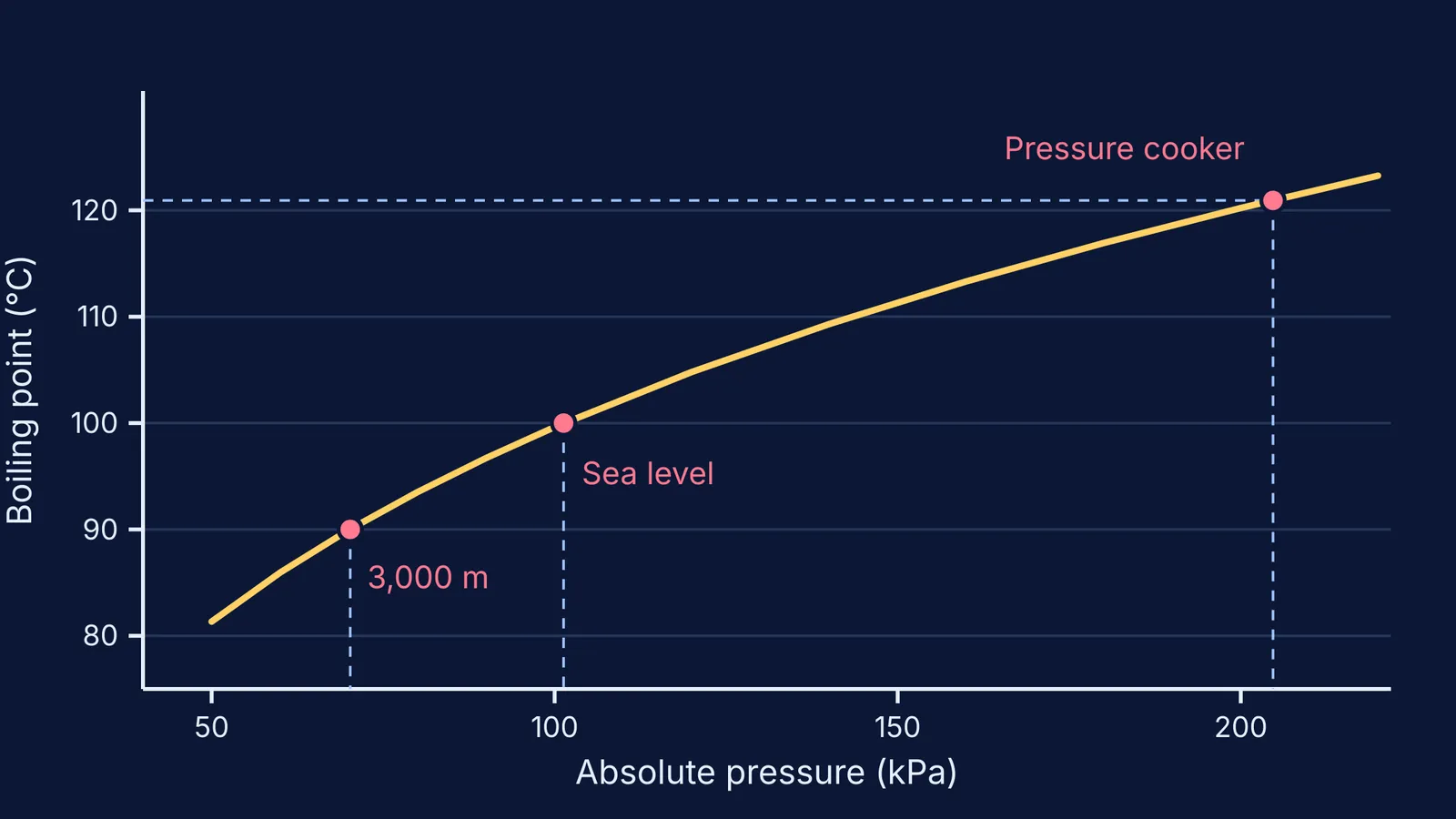
The cooker question has real numbers. According to HyperPhysics at Georgia State University, a typical cooker vents at about 15 pounds per square inch above atmospheric pressure, which raises water's boiling point to about 121 °C. Going the other way, NASA Glenn's atmosphere model gives about 70 kPa of air pressure at 3,000 m, and NIST's boiling-point fit for water puts the boiling point there near 90 °C. The chart at the top of this post plots that curve.
What can you ask on a bicycle or scooter?
“Why do you lean into a turn, and lean more when you're going faster?” (Class 11 laws of motion: friction from the road supplies the centripetal force.)
“Why does braking hard with only the front brake feel risky?” (Class 11 rotational motion: torque about the front wheel.)
“Why do the tyres feel harder after the cycle stands in the afternoon sun?” (Class 11 kinetic theory: gas pressure rises with temperature.)
“Why is a low gear easier uphill?” (Class 9 work and energy: the same work spread over more pedal turns, so less force on each.)
What questions work on a bus, train or plane?
“Why do we lurch forward when the bus brakes?” (Class 9: inertia and Newton's first law.)
“Why do your ears pop on a flight or a ghat road?” (Class 9 and 11: pressure in fluids.)
“Why does rain look slanted from a moving train, even when there's no wind?” (Class 11 motion in a plane: relative velocity.)
“Why does the highway look wet far ahead on a hot afternoon?” (Ray optics: refraction through layers of hot air.)
How do you ask without turning it into a quiz?
It is mostly tone. Six habits help:
Wonder, don't examine. “I've never understood why…” works better than “What's the formula for…?”
Ask for a prediction before any explanation. Guessing is low-stakes; recalling feels like an exam.
Say “I don't know” yourself, then think aloud together.
One question per trip or meal. If they shrug, let it go.
Never link it to marks. Skip “this will come in boards.”
Let them be the expert. Ask them to explain it to you or a younger sibling.
A short script for the kitchen:
You: “The cooker whistled three times and the dal is done. On our hill trip it took ages. Any idea why?”
Teen: “Something to do with pressure?”
You: “Pressure doing what, though?”
Teen: “More pressure, so water boils hotter?”
You: “So what happens up in the hills?”
Then stop. No marking, no correcting; you just kept the thread going.
If a question like the leaning cyclist is hard to picture, the Fermi Simulation Lab has interactive simulations for ideas that are easier to see than to read, and the Fermi Concept Library has a lesson for each concept in physics.
Younger siblings may prefer five safe kitchen science experiments. For more, read how to encourage curiosity by asking, not answering and how to stay involved in the high-school years.
Pick one question for your next meal or journey, and ask it as if you really want to know.


