

On this page
The competition for medical seats in India is intense. For the 2024–25 academic year, the National Medical Commission (NMC) approved 10,650 new MBBS seats, bringing the total to approximately 1,37,600 across 816 medical colleges. Despite this record increase, the gap between the number of aspirants and available seats means families must often weigh the costs of private education against the intense preparation required for a government seat.
How much does MBBS cost in a government college?
Government medical colleges (GMCs) offer the most affordable route to an MBBS degree because their fees are heavily subsidised. For a student who secures a high rank in the National Eligibility cum Entrance Test (NEET), the financial burden is minimal compared to private alternatives.
Annual tuition fees: These typically range from ₹6,000 to ₹1.5 lakh per year, depending on the state and the institution.
Top institutions: Premier institutes like AIIMS Delhi charge around ₹1,628 to ₹7,640 annually.
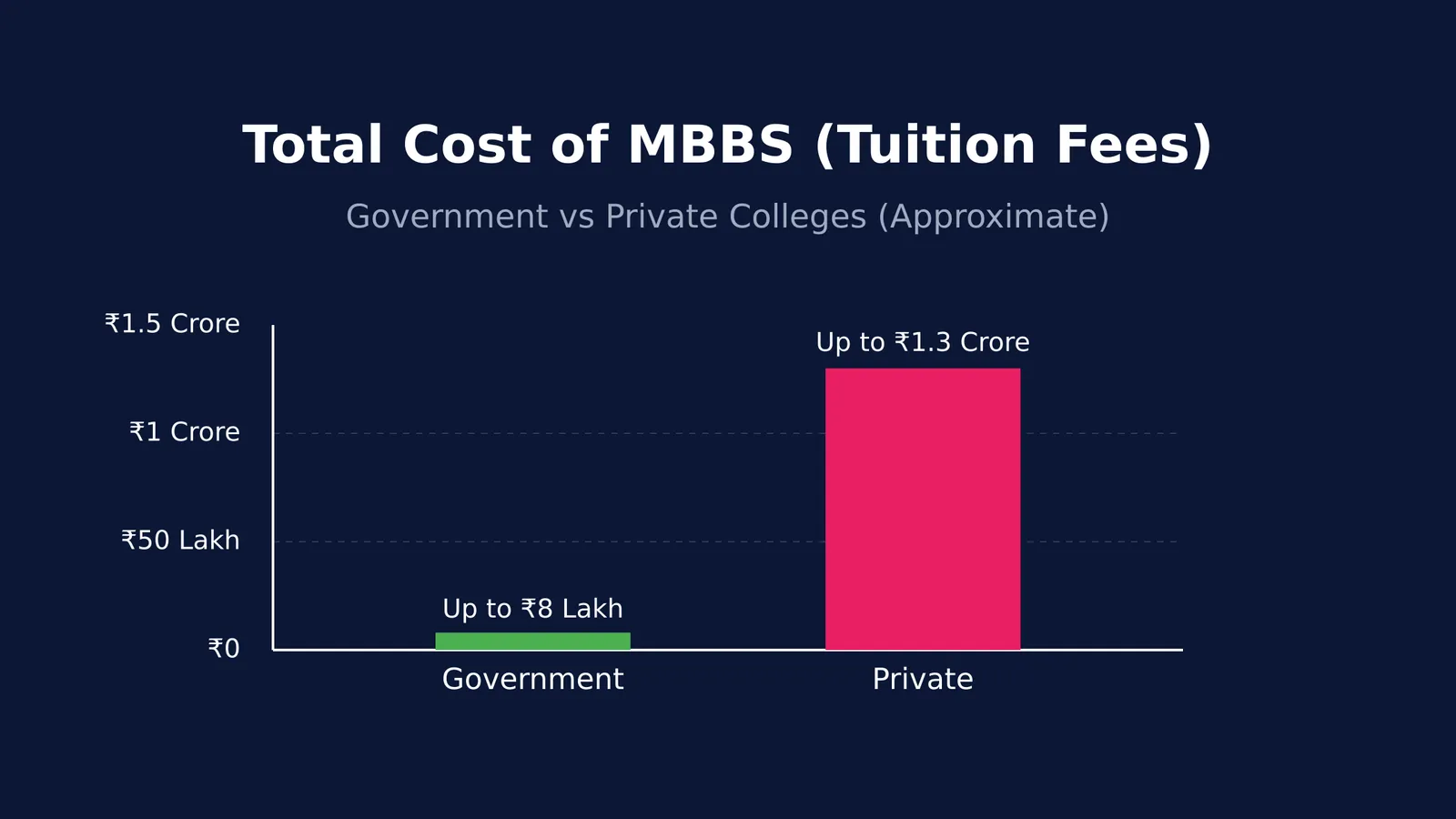
Total course cost: The entire 5.5-year MBBS programme (including the internship year) in a government college usually costs between ₹30,000 and ₹8 lakh in tuition.
Because these seats are highly coveted, the required NEET scores are steep. Preparing for this level of competition requires more than just memorisation; it demands a deep understanding of concepts and rigorous problem-solving. For students tackling difficult concepts in physics and chemistry, the Fermi Problem Library offers worked problems with a step-by-step solver that explains the reasoning rather than just printing an answer.
What are the fees for private medical colleges in India?
Private medical colleges and deemed universities are significantly more expensive. They operate largely without government subsidies, and their fee structures vary widely based on the institution and the type of seat (or quota) a student secures.
Government quota seats: Many private colleges reserve a percentage of their seats for state-domicile students at a regulated fee, typically between ₹2 lakh and ₹8 lakh per year.
Management quota seats: Open to students nationwide, these seats usually cost between ₹10 lakh and ₹25 lakh annually.
NRI quota seats: Reserved for Non-Resident Indians or sponsored candidates, these are the most expensive, often exceeding ₹1.5 crore for the full course.
Overall, the total tuition for an MBBS in a private college through the management quota can range from ₹50 lakh to well over ₹1.3 crore.
What is the 4.5-year fee rule from the NMC?
In April 2024, the NMC issued a strict directive to all medical colleges regarding how tuition fees are collected. The MBBS course consists of 4.5 years of academic study followed by a mandatory one-year internship.
The NMC warned that colleges are permitted to charge tuition fees only for the 4.5 years of academic study. They are strictly prohibited from demanding tuition for the final internship year. This rule is designed to prevent overcharging and provides a clear boundary for parents calculating the total cost of the degree.
What are the hidden costs of an MBBS?
Tuition is only one part of the financial equation. Families must also budget for living and academic expenses that accrue over the 5.5 years:
Hostel and mess charges: These can range from ₹10,000 to ₹50,000 per year in government colleges, but can jump to ₹80,000–₹2.5 lakh annually in private institutions.
Caution deposits: A one-time refundable fee collected at admission, often between ₹50,000 and ₹2 lakh.
University and exam fees: These recurring costs typically add ₹10,000 to ₹50,000 to the annual budget.
Books and equipment: Medical textbooks and basic equipment (like a stethoscope and dissection kit) can cost ₹20,000 to ₹50,000 in the first year alone.
How can families plan for medical college expenses?
Funding an MBBS education, especially in a private college, requires early and strategic planning. Here is a framework families can use:
Target state quotas first: If a government college seat is out of reach, aim for the government quota seats in your home state's private colleges. These offer a middle ground in terms of cost.
Understand the exam pattern: Maximise the student's chances by ensuring they are familiar with the NEET-UG paper pattern, including marking schemes and time management.
Explore education loans: Public and private banks offer education loans specifically for medical studies, often covering up to 100% of the tuition and hostel fees for premier institutions. Check the moratorium period, which should ideally extend beyond the internship year.
Look into specialised institutions: Colleges like AFMC Pune offer heavily subsidised medical education in exchange for a commitment to serve in the Armed Forces. The AFMC Pune MBBS admission process has its own specific physical and medical criteria alongside NEET scores.
Navigating the costs of an MBBS degree can feel overwhelming, but understanding the fee structures and NMC regulations allows families to make informed decisions and build a realistic financial plan.


