

On this page
Teenagers often look for volunteering opportunities to build their college applications, learn new skills, or simply give back to their neighbourhoods. One of the most effective and rewarding ways they can spend this time is by tutoring younger students at a local community centre or after-school programme. While the academic and social benefits for the younger child are obvious, parents are often surprised to discover that the teen tutor actually gains just as much—if not more—from the experience.
Why do teenagers learn more when they teach others?
When a student knows they have to explain a concept to someone else, they approach studying entirely differently than when they are just preparing for a test. This is known in cognitive science as the protégé effect. A 2009 study in the Journal of Science Education and Technology found that students spent more time on learning activities and learned more when they believed they were teaching a computer character (Chase et al., 2009).
Because another person's understanding is relying on them, teenagers feel a strong sense of social responsibility. They realise they cannot just skim a textbook, look at a solved example, and assume they know it. Instead, they are forced to break down complex ideas into their simplest parts, anticipate the questions the younger child might ask, and spot the hidden gaps in their own knowledge before the session begins. You can read more about how this mechanism works in our guide to learning by teaching: what the studies show and how to use it.
Does teen volunteering improve their own grades?
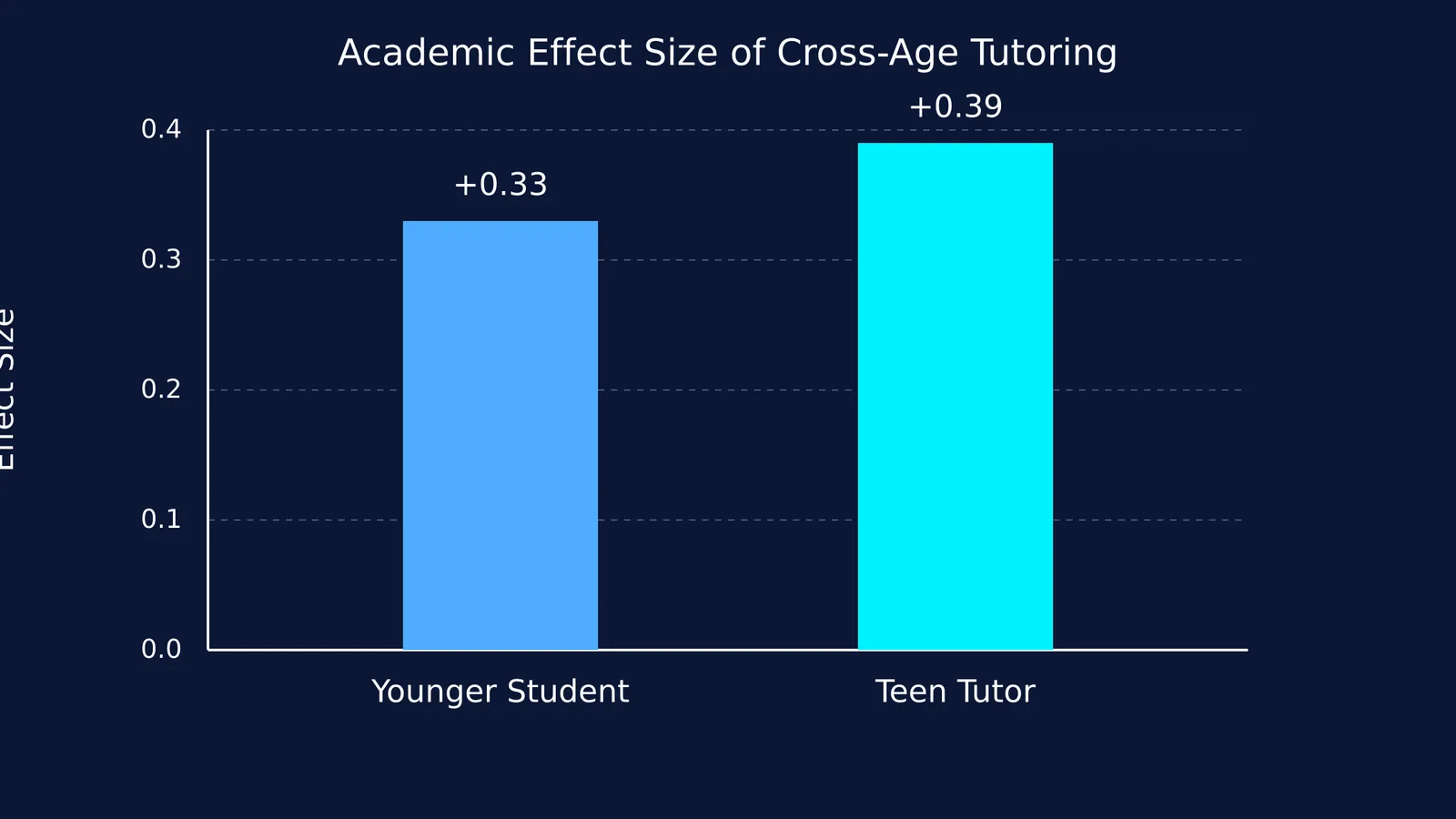
The academic benefits of cross-age peer tutoring—where an older student teaches a younger one—are both measurable and significant across different subjects. A 2025 meta-analysis published in Educational Psychology Review systematically examined 32 studies on cross-age tutoring (Chang et al., 2025). The researchers found that while the younger tutees benefited from the extra help with a positive effect size of +0.33, the older tutors actually saw an even greater positive effect on their own academic outcomes, registering an effect size of +0.39.
This happens because the act of teaching serves as a powerful form of active retrieval practice. When a teenager recalls information from their memory to answer a younger student's unexpected question, they strengthen their own neural pathways for that specific topic. Over time, this deep processing and continuous retrieval practice translates directly to better performance on their own delayed assessments and final exams.
How to help your teen start teaching in the community
Starting a volunteering or tutoring arrangement does not require signing up for a formal, time-consuming programme right away. It can begin quite informally, close to home.
Start small: Suggest they offer to help a younger sibling, a cousin, or a neighbour's child for just one hour a week on a Saturday morning.
Stick to their strengths: Ask them to pick their strongest subject, whether that is maths, biology, or English, so they can build their confidence early on.
Prepare briefly: Encourage them to spend just 15 minutes before the session reviewing what the younger child is currently learning in class, so they are not caught entirely off guard.
Stay consistent: Establishing a regular weekly slot builds a strong routine for both the teen and the younger student, fostering trust and accountability.
If they prefer working alongside their own classmates to solve problems, they can also organise collaborative sessions. See our advice on how to run a study group that actually helps you learn.
What if they get stuck on a difficult concept?
Sometimes, despite their best preparation, the teen will face a question they simply do not know how to answer. This is a completely normal part of teaching and should be treated as an excellent learning moment rather than a failure.
This is exactly where good educational tools come in. If they are teaching foundational science or maths and hit a wall, they can use Fermi's AI tutor together with their tutee. Fermi works out what they already know, builds a plan for the session, and teaches through it — writing on a board, drawing the figure, and checking understanding as it goes.
Using a tool like this models a fantastic habit for the younger child: admitting when you do not know something and finding a reliable, structured way to figure it out together.
Encourage your teenager to try volunteering as a tutor for just one month to see how it transforms their approach to their own studying.


