

On this page
When attending a parent orientation for JEE or NEET coaching, the presentation will naturally highlight the institute's top ranks and success stories. However, your role as a parent is to look past the marketing and ask how the institute will handle the vast majority of students, including your child.
The environment in these centres can be intense. A 2023 study published in the *Industrial Psychiatry Journal* found that 44.45% of coaching students in Kota suffer from high levels of academic stress, compared to just 3.33% of non-coaching students PubMed. Asking the right questions early on can help you understand whether the institute provides a supportive learning environment or just a competitive treadmill.
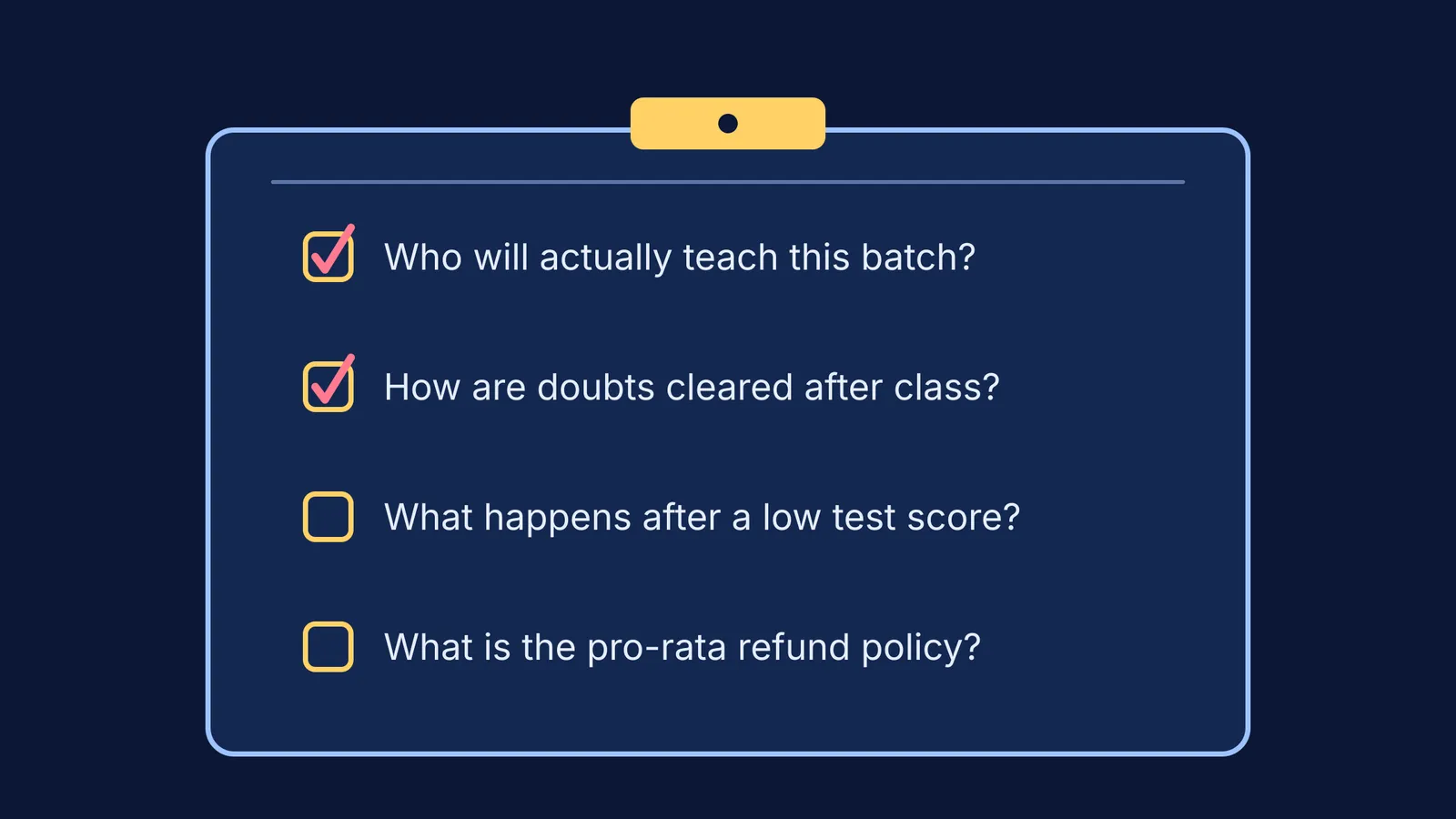
Who will actually teach my child's batch?
A common sales tactic is to promote "star faculty" during the orientation. However, these teachers often only instruct the top-performing batches. You need to know exactly who will be standing in front of your child on a Tuesday morning.
Ask for the specific names and experience levels of the teachers assigned to the regular batches for physics, chemistry and mathematics or biology. You should also ask about the faculty turnover rate; a high turnover means your child might have to adjust to a new teaching style halfway through the syllabus.
How are doubts handled outside of class hours?
Even with great teachers, students will inevitably get stuck on homework. Ask the institute how they manage out-of-class questions. Is there a dedicated doubt counter? Are teachers available for one-on-one help, or are students expected to figure it out themselves?
If the institute's doubt hours are crowded or intimidating, consider how your child will get unstuck at home. Most learning tools answer questions, but Fermi's AI tutor teaches. When a student brings a problem, Fermi works out what they already know, builds a plan for the session, and teaches through it—drawing the figure and checking understanding as it goes.
What happens after a low test score?
Testing is a major part of competitive exam preparation. Instead of asking how many mock tests they conduct, ask what happens after a student performs poorly.
Does the institute provide a detailed, one-on-one test analysis, or do they simply post the rank list on the noticeboard? A good institute will sit down with the student to identify whether they lost marks due to time management, calculation errors, or conceptual gaps. This is also a good time to ask Parent-teacher meeting questions that lead to real follow-up regarding how parents are kept in the loop about test performance.
What is the refund policy?
Sometimes, despite your best research on How to evaluate a coaching institute before you pay the fee, a coaching centre is just not the right fit. It is vital to know the exit strategy before you commit.
Under the Ministry of Education's 2024 guidelines for coaching centres, institutes are required to have a transparent pro-rata refund policy, ensuring that families are refunded for the remaining period of the course within 10 days if a student leaves early Ministry of Education. The guidelines also strictly prohibit enrolling students under 16 years of age. Ask the administration directly how they implement these specific rules.
How will we communicate about my child's progress?
A parent's involvement has a measurable impact on academic success. According to the OECD's PISA 2022 Results, students whose families regularly eat a main meal together and ask about their school day score 16 to 28 points higher in mathematics OECD.
To have those supportive conversations at home, you need accurate information from the coaching centre. Ask how often you will receive progress reports and what those reports will contain. A script you can use at the orientation is: *"If my child starts missing classes or falling behind in chemistry, how long will it take for me to be notified, and who will contact me?"* If the answer is vague, it may signal that parent communication is not a priority.
For more ways to support your child's learning at home, read our guide to setting up A family quiet hour: setting up shared study and reading time.


