

On this page
If you are choosing a school, you will hear strong opinions about co-ed and single-sex schools from relatives, parents and brochures. Below is what the studies show and what to check on a visit.
Do single-sex schools get better results?
The largest review of the question is a meta-analysis by Erin Pahlke, Janet Shibley Hyde and Carlie Allison in *Psychological Bulletin* (Pahlke, Hyde and Allison, 2014). It pooled 184 studies, covering the testing of 1.6 million school students in 21 countries, of single-sex classrooms and schools compared with co-education (abstract on PubMed).
The authors split the studies into two groups. Uncontrolled studies simply compared students in each setting. Controlled studies used random assignment or adjusted for who gets into which school.
Uncontrolled studies showed some modest advantages for single-sex schooling in outcomes such as maths, but not in science.
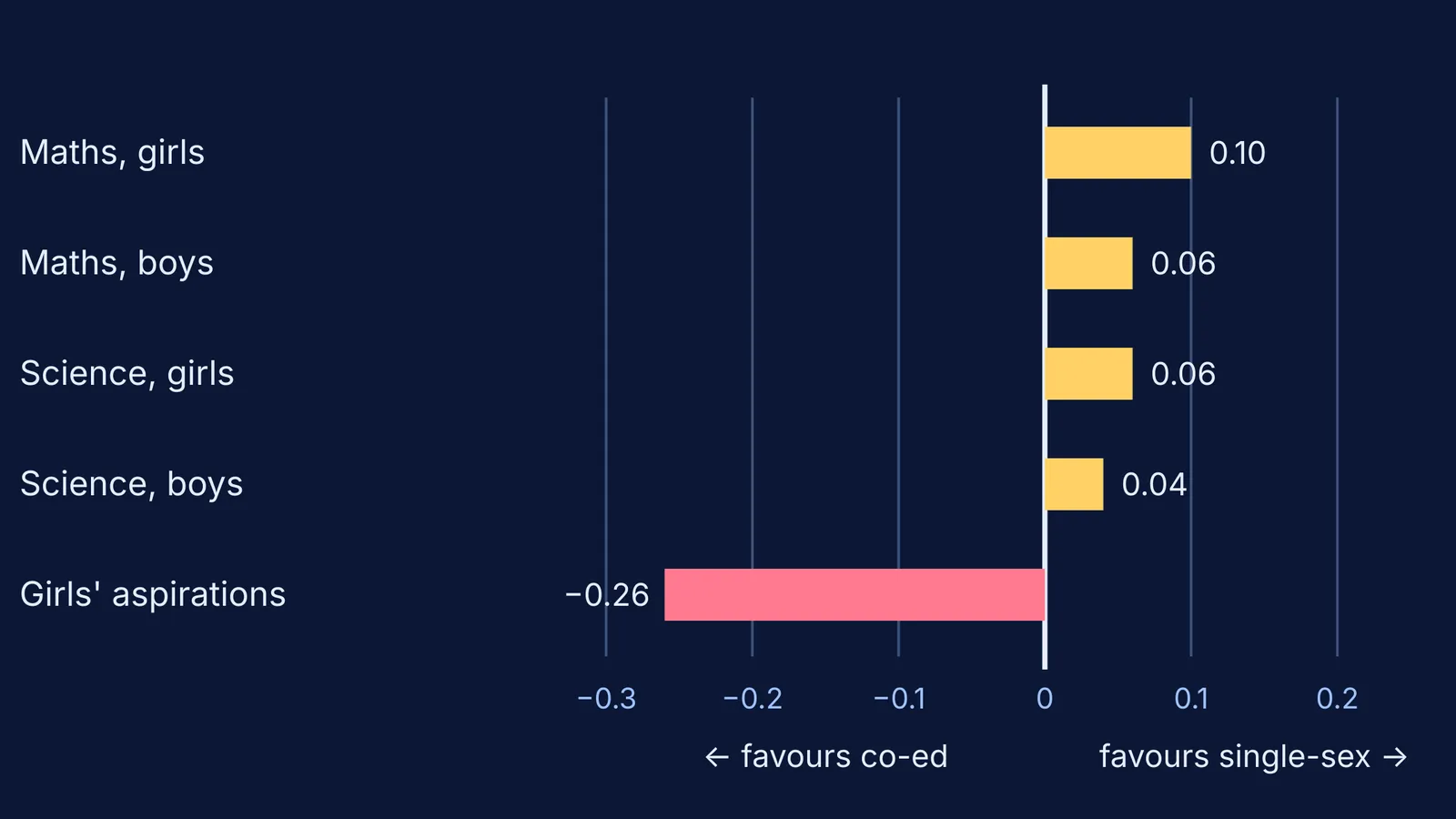
Controlled studies showed only trivial differences: an effect size of 0.10 for girls' maths and 0.06 for boys' maths, and 0.06 and 0.04 for science (PubMed abstract).
On girls' educational aspirations, the controlled studies showed a small difference favouring co-ed schools (an effect size of -0.26).
The gap between those two groups of studies is the main lesson. If a school's students start out ahead, its raw results look good whatever its type. Once studies account for who enrols, the advantage mostly disappears.
What about studies that found a real benefit?
The strongest evidence for single-sex schools comes from Seoul, where students were for many years randomly assigned to high schools within their district. Hyunjoon Park, Jere Behrman and Jaesung Choi used that lottery and found that students at all-boys and all-girls schools had higher average scores in Korean and English on the college entrance exam, and that these schools sent a higher share of graduates to four-year colleges (Park, Behrman and Choi, 2013, *Demography*).
About 80% of Seoul's single-sex schools were private, against about 30% of co-ed schools, and teachers were not randomly assigned. The authors adjusted for this and the effect held, but they warn that generalising from Seoul to other places "may be difficult because of other differences" (Demography paper). One study from one city cannot settle the question for a school in Pune or Patna.
Can single-sex schooling affect stereotypes?
In a 2011 article in *Science*, Diane Halpern and seven other researchers argued that there is no well-designed research showing that single-sex education improves academic performance, and that there is evidence sex segregation increases gender stereotyping (Halpern et al., 2011). The authors disclose that they are founders and board members of the American Council for CoEducational Schooling, and Janet Shibley Hyde also co-wrote the meta-analysis above.
They also argue that the few sex differences found in children's brains are not known to relate to learning, and that none justify different teaching methods. If a school's pitch rests on "boys learn differently", be sceptical, whichever type of school it is.
What should I look for on a school visit?
Since the label predicts little, use your visit to check what shapes a child's day, and ask to sit in on a class.
Teaching: Do teachers ask questions that make students think, or mostly dictate notes? Can students get it wrong without being mocked?
Teacher turnover: Ask how many maths and science teachers have left in the past two years. Frequent changes can disrupt learning.
Subject choice: In a co-ed school, ask how many girls take maths and physics in Class 11. In a single-sex school, ask whether every stream is offered, including computer science and biology.
Labs in use: Are the science labs used weekly, or kept locked and clean for visitors?
Behaviour and safety: Ask how the school handles teasing, bullying and online harassment, and who a student goes to first.
Mixing: If the school is single-sex, ask how students work with peers of other genders through clubs, events or exchanges.
Your child's view: Your child will spend years there. Ask what they noticed.
A script for the principal. You can say: "We are less worried about whether the school is co-ed and more about how students are taught. Could you tell us how a teacher here notices when a student is falling behind in maths, and what happens next?" A good answer names a specific routine, not a slogan.
We wrote separately about comparing CBSE, ICSE and state boards and about building girls' confidence in maths and physics.
How do I decide for my child?
Start with your child, not the label. A shy child who comes alive in one school, a long commute, a sibling already enrolled or a strong science department are all better reasons than co-ed or single-sex alone. If a school is good on the checklist, its type is unlikely to be what holds your child back.
After admission, these parent-teacher meeting questions help keep the conversation going. If a gap shows up in science or maths at home, the Fermi Concept Library has a lesson for every concept in physics, chemistry, biology and mathematics, so you can revisit the idea together.


