

On this page
When a student reaches Class 8, English grammar expectations change significantly. The focus shifts from identifying simple rules—like finding a noun or a verb—to complex, integrated application. If you find your child is suddenly struggling, it is usually because they know a rule in isolation but cannot apply it correctly when editing a paragraph or writing an essay.
The instinct is often to schedule a long weekend study session to "catch up" on tenses or prepositions. However, cognitive science suggests this is exactly the wrong approach for language retention.
Why is a Class 8 child weak in English grammar?
In middle school, the curriculum introduces advanced structures such as reported speech, the passive voice, and complex subject-verb agreement. A child who can easily conjugate a verb might still fail to spot a tense inconsistency in a long sentence.
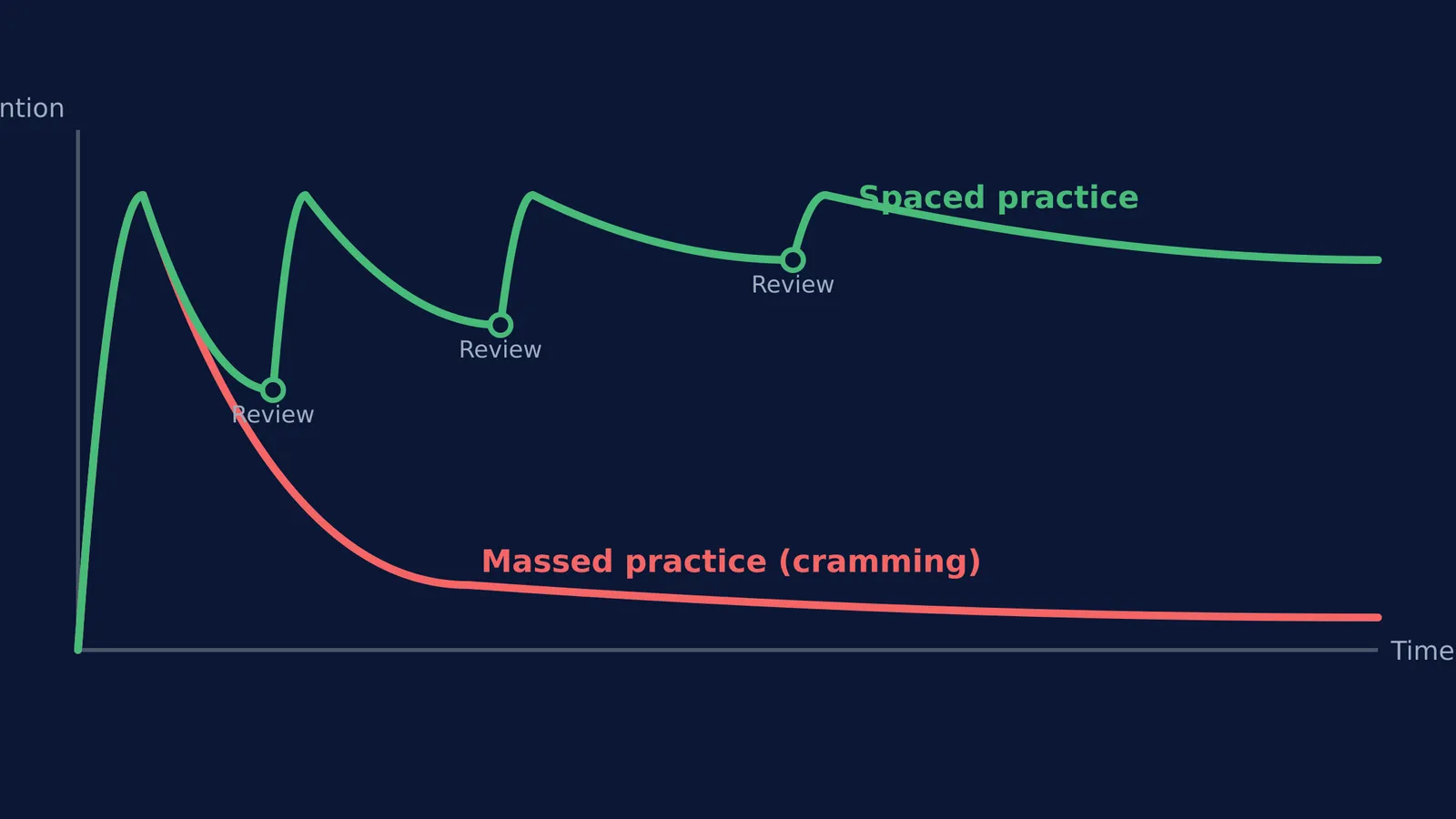
The core issue is that real-world grammar requires the brain to synthesize multiple rules at once. When a child learns a rule and immediately moves on to the next chapter, they suffer from the natural "forgetting curve." Without review, a student quickly loses new information. They need repeated exposure to turn a memorized rule into an automatic habit. Cramming might help them pass a Friday quiz, but the knowledge will vanish before the final exams.
What are the specific grammar gaps to look for?
To fix a weakness, you first need to identify the exact point of failure. Review your child's recent test papers or homework for these common middle school grammar gaps:
Active vs. passive voice: The struggle is often not just the mechanical conversion, but understanding when a sentence requires the passive voice to sound formal or objective.
Subject-verb agreement with complex subjects: Students frequently mishandle sentences where the subject is separated from the verb by a prepositional phrase, such as "The group of students *is* going."
Reported speech: Mastering the backshift of tenses is notoriously difficult (for example, knowing that "He said, 'I am tired'" must become "He said that he *was* tired").
Integrated grammar: The inability to spot errors in a mixed "editing and omission" paragraph, which tests prepositions, articles, and tenses all at once in a single block of text.
If you need a more structured approach to finding these gaps, Fermi's AI tutor works out what the student knows and builds a plan for the session. It holds a line of reasoning across a session to figure out exactly where they are stuck.
How does spaced practice fix grammar gaps?
Spaced practice, also known as distributed practice, involves breaking study time into short, regular sessions spread out over weeks, rather than cramming it all into one long sitting.
A 2011 study of middle school students found that a one-week spacing between learning sessions produced superior long-term retention compared to massed learning. When students are forced to recall a grammar rule just as they are about to forget it, the neural pathways grow stronger. In fact, an earlier foundational study showed that participants using spaced intervals retained up to two and a half times as much vocabulary over a long period compared to those who crammed.
This means a short daily review is far more powerful and less stressful than a long session on a weekend.
How do you build a daily grammar routine?
You can set up a simple spaced practice routine at home to tackle one specific gap at a time. Pick one rule—like reported speech—and follow this schedule:
First session (Initial Learn): Spend a short time learning the rule and completing focused practice questions. Ensure the child understands the "why" behind the rule.
Next session (First Review): Give a quick quiz using active recall. Do not let them look at their notes first; the effort of remembering is what builds retention.
A week later (Integrated Application): Ask them to write a short paragraph or complete a mixed-exercise worksheet using the new rule alongside older rules.
Two weeks later (Final Check): Use an "editing" exercise where they have to find and correct intentional mistakes in a text.
If your child struggles with the practice questions along the way, the Fermi Problem Library provides a step-by-step solver that explains the reasoning.
Building a daily habit of short, spaced reviews will not only close the grammar gaps for school exams but will also create deeply embedded knowledge that lasts through high school. If you want to know more about how habits and environment affect learning, you might explore whether changing where you study helps memory. For a deeper dive into how the brain retains information, read about Endel Tulving: why you forget answers you actually know.


