

On this page
Many students who enjoy science find it hard to choose between engineering and medicine at the age of 15. Opting for Physics, Chemistry, Mathematics, and Biology (PCMB) keeps both doors open, but it also means preparing for two of the most competitive exams in the country simultaneously.
Can my child prepare for JEE and NEET together?
Yes, and many students take this path. In 2024, the National Testing Agency (NTA) reported that 14.15 lakh unique candidates appeared for the JEE Main, while 23.33 lakh appeared for NEET UG (NTA, 2024).
The strategy of taking both has become more viable recently. The National Medical Commission (NMC) updated its guidelines to allow Biology or Biotechnology to be taken as an additional subject (NMC, 2023). This means a student studying Physics, Chemistry, and Mathematics (PCM) can write their board exams and clear Biology separately, still remaining eligible for NEET.
Many medical aspirants also write the JEE Main simply to practice taking a high-pressure, national-level exam. Because the JEE is taken early in the year, it is a useful benchmark before sitting for NEET.
What does preparing for both JEE and NEET involve with PCMB?
The PCMB stream is undeniably rigorous. Managing four core subjects demands exceptional time management. A student attending regular school or coaching typically needs extensive focused self-study daily.
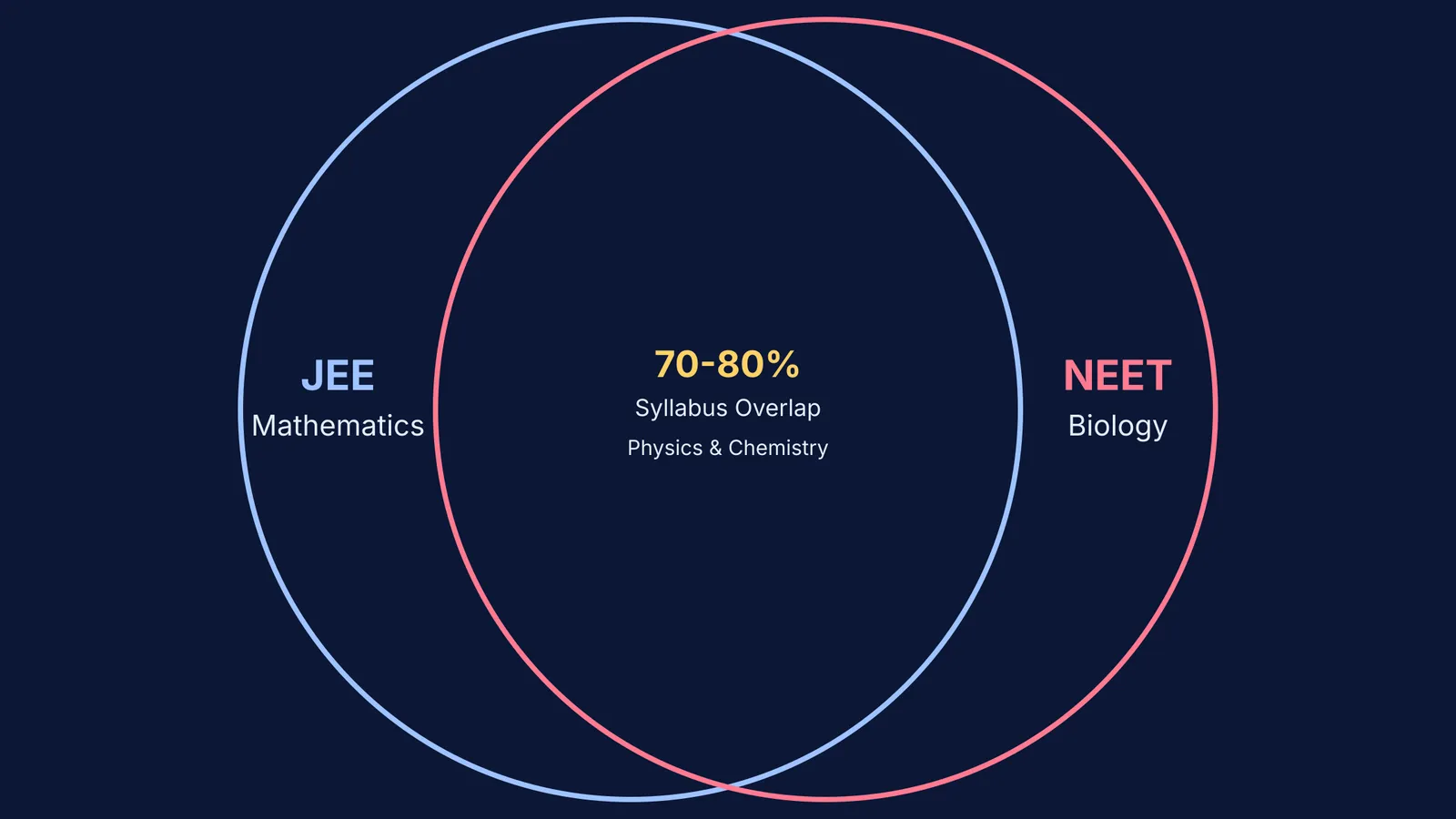
However, the burden is eased by a massive common ground. There is a 70% to 80% syllabus overlap in Physics and Chemistry between the two exams (Shiksha, 2024). Students who master JEE-level questions on topics like energy bands: conductors, semiconductors and insulators compared or integrated rate law graphs: reading reaction order from straight lines usually find NEET Physics and Chemistry highly manageable.
The real challenge lies in the remaining subjects. JEE demands rigorous, practice-heavy Mathematics, while NEET requires a memory-intensive approach to Biology. Mastering the NCERT textbook line by line—down to chapters like Mendelian disorders: sickle-cell anaemia, thalassemia and PKU—is non-negotiable for medical aspirants.
How can you build a study plan for both exams?
If your child decides to pursue both, a structured approach is vital to prevent burnout. Here is a framework to balance the workload:
Establish a primary goal: Choose either JEE or NEET as the main target by mid-Class 12. Allocate the majority of independent study time for the non-overlapping subject (e.g., Biology) to the primary goal and a smaller portion to the secondary one.
Alternate the demanding subjects: Do not study Mathematics and Biology on the same day. Dedicate alternating days to each, pairing them with the overlapping subjects of Physics or Chemistry.
Use active recall for Biology: Rely on flashcards and closed-book testing rather than passive reading to retain vast amounts of biological data.
Prioritise mock tests: Take alternating JEE and NEET full-length mock tests on Sundays to build stamina and track performance in the distinct exam formats.
When to choose one over the other?
Watch for signs that the workload is diluting your child's core understanding. If their scores in the overlapping subjects begin to drop because they are spending too much time juggling Math and Biology, it is time to pivot to a single path.
At this stage, targeted help can consolidate what they know. Fermi's AI tutor can work out what a student already knows and build a plan for the session. It notices where a student is stuck and decides whether to explain, ask, or show, checking understanding as it goes.
Ultimately, dropping a subject should be based on aptitude and career interests, not just exam pressure. The new NMC rules provide a safety net, ensuring that choosing an engineering path early on does not permanently close the door to medicine.


