

On this page
In the CBSE scheme of studies, Class 11 students are required to take five compulsory subjects. Typically, a science student will take Physics, Chemistry, Mathematics (PCM), English, and one elective subject like Computer Science or Physical Education. If a student decides to drop Mathematics, they cannot simply continue with four subjects; they must select a replacement subject to maintain the required total of five.
According to the official CBSE guidelines, a change of subject in Class 11 is permitted, but it is strictly governed by deadlines and school-level approvals. Parents and students cannot apply directly to the board for this change. Instead, they must submit a formal written application to the school principal, outlining the reasons for the change—such as a shift in career goals or extreme difficulty coping with the syllabus.
The most critical factor is the timeline. Schools generally evaluate the student's early academic performance in Class 11 before approving the switch, often using the first set of unit tests as a benchmark. The change must be finalised before the school submits the List of Candidates (LOC) for the board exams, which typically occurs in the first few months of the academic year (often around July or August). Once the LOC is uploaded to the CBSE portal, altering a subject combination becomes exceptionally difficult and usually requires special intervention from the regional office.
Can you drop Maths and still take JEE or NEET?
The decision to drop Mathematics has immediate and permanent effects on a student's eligibility for various competitive exams and career paths.
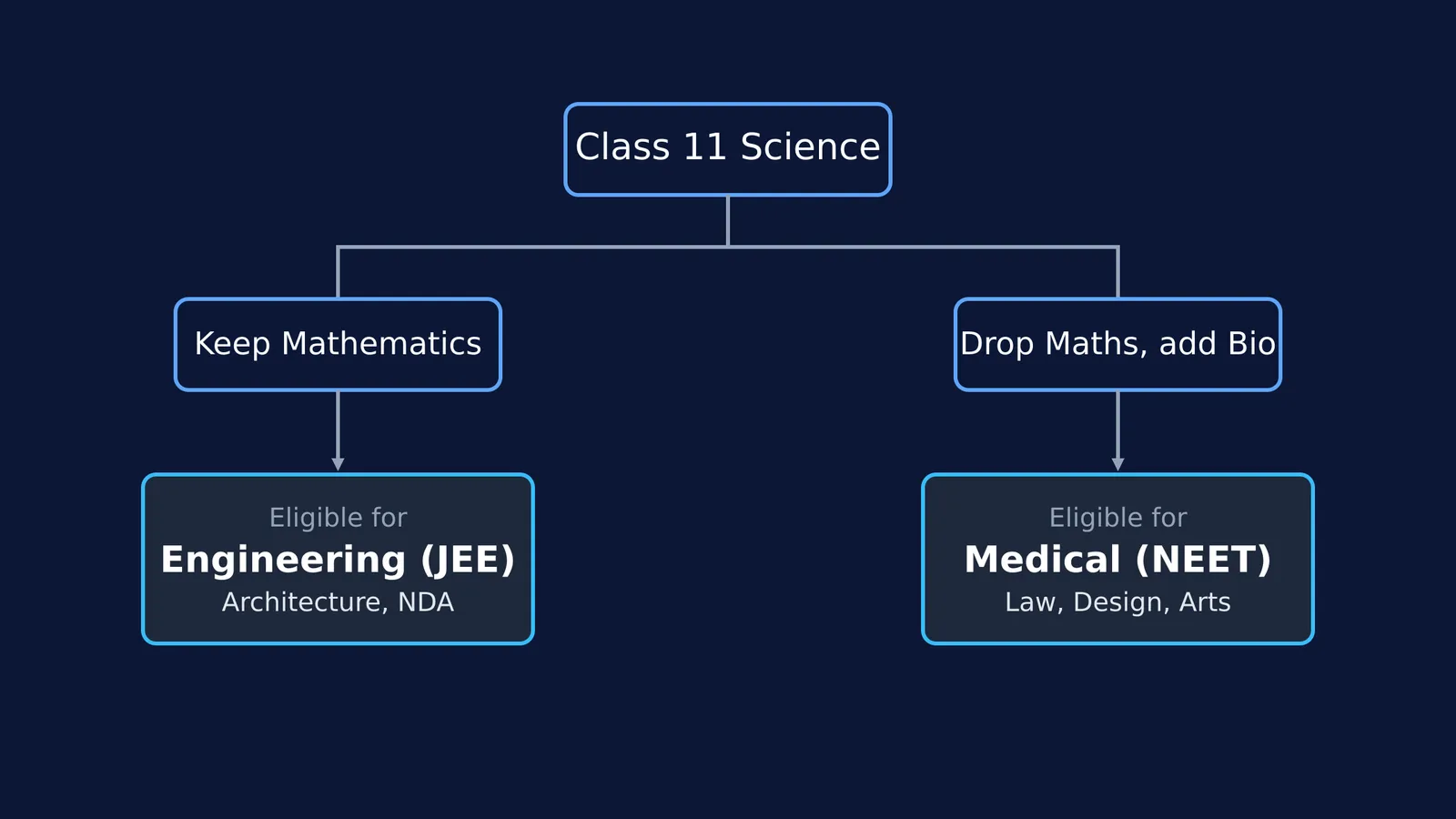
For students aspiring to pursue engineering or architecture, Mathematics is non-negotiable. The National Testing Agency (NTA) stipulates that candidates appearing for JEE Main (for B.E. and B.Tech programs) must have passed their qualifying Class 12 examination with Physics and Mathematics as compulsory subjects. Similarly, admission to B.Arch and B.Planning courses requires Mathematics. Dropping the subject in Class 11 automatically disqualifies a student from entering these fields through standard competitive routes.
However, the medical field remains entirely open. If a student drops Mathematics and replaces it with Biology—effectively shifting from PCM to PCB—they are fully eligible for medical entrance exams. The NEET UG eligibility criteria require candidates to have studied Physics, Chemistry, Biology (or Biotechnology), and English. General category students need a 50% aggregate in the PCB subjects to qualify. Mathematics is not required for NEET or for admission to medical, dental, or veterinary colleges.
What are the career effects of dropping Maths?
Beyond engineering and medicine, dropping Mathematics closes the doors to several other degree programs that heavily rely on quantitative skills.
Degrees in Economics (Honours) at top universities, Data Science, Artificial Intelligence, and Computer Science often require Class 12 Mathematics as a strict prerequisite. Additionally, careers in aviation (such as commercial pilot training) and the National Defence Academy (NDA) for Navy and Air Force wings mandate both Physics and Mathematics.
On the other hand, many fields remain accessible without Class 12 Mathematics. Students can pursue Law (via the CLAT exam), Design (via NID or NIFT), Humanities, Mass Communication, and even pure sciences like a B.Sc. in Biology or Zoology.
How to support a student struggling with science subjects?
If a student wants to drop Mathematics solely because they are finding the numericals too difficult, it is worth investigating how they are studying before making a final decision. Often, the issue is not a lack of ability, but a lack of effective study habits and support, which can easily lead to exam stress in teenagers.
When students get stuck on complex physics or chemistry problems, a common trap is to look up the final answer and try to work backwards. A more active approach is to use the Fermi Problem Library. It offers worked problems with a step-by-step solver that explains the reasoning rather than printing an answer, helping students understand the method rather than just memorising the solution.
If your child is overwhelmed by the syllabus and does not know where to start their daily revision, Fermi's AI tutor can step in. The tutor works out what they already know, builds a plan for the session, and teaches through it. It holds a line of reasoning across a whole session and checks understanding as it goes, ensuring the student is actually learning rather than just passively reading. If you are unsure how to introduce this tool, you can try an AI tutor with your child using our short guide.
Next steps for parents
If you are weighing this decision as a family, use this short checklist to decide:
Talk to the teachers: Ask the school about the student's early performance. Is the struggle with Maths temporary, or is it a fundamental mismatch with their aptitude?
Check university requirements: Look up the exact eligibility criteria for three or four degree courses the student is interested in to ensure they are not accidentally locking themselves out of a desired field.
Act quickly: If the decision is to change subjects, submit the application to the school principal immediately before the CBSE LOC deadline closes.


