

On this page
When a teenager says they want to do research, their first instinct is often impossibly broad: curing cancer, building a fusion reactor, or stopping climate change. A parent's most important early move is not to rent laboratory space, but to help them narrow that impulse into a single testable relationship. Real research is not about complex apparatus; it is about asking, "What happens to variable Y when we change variable X while keeping all other conditions constant?"
How do you help a teen narrow down a research question?
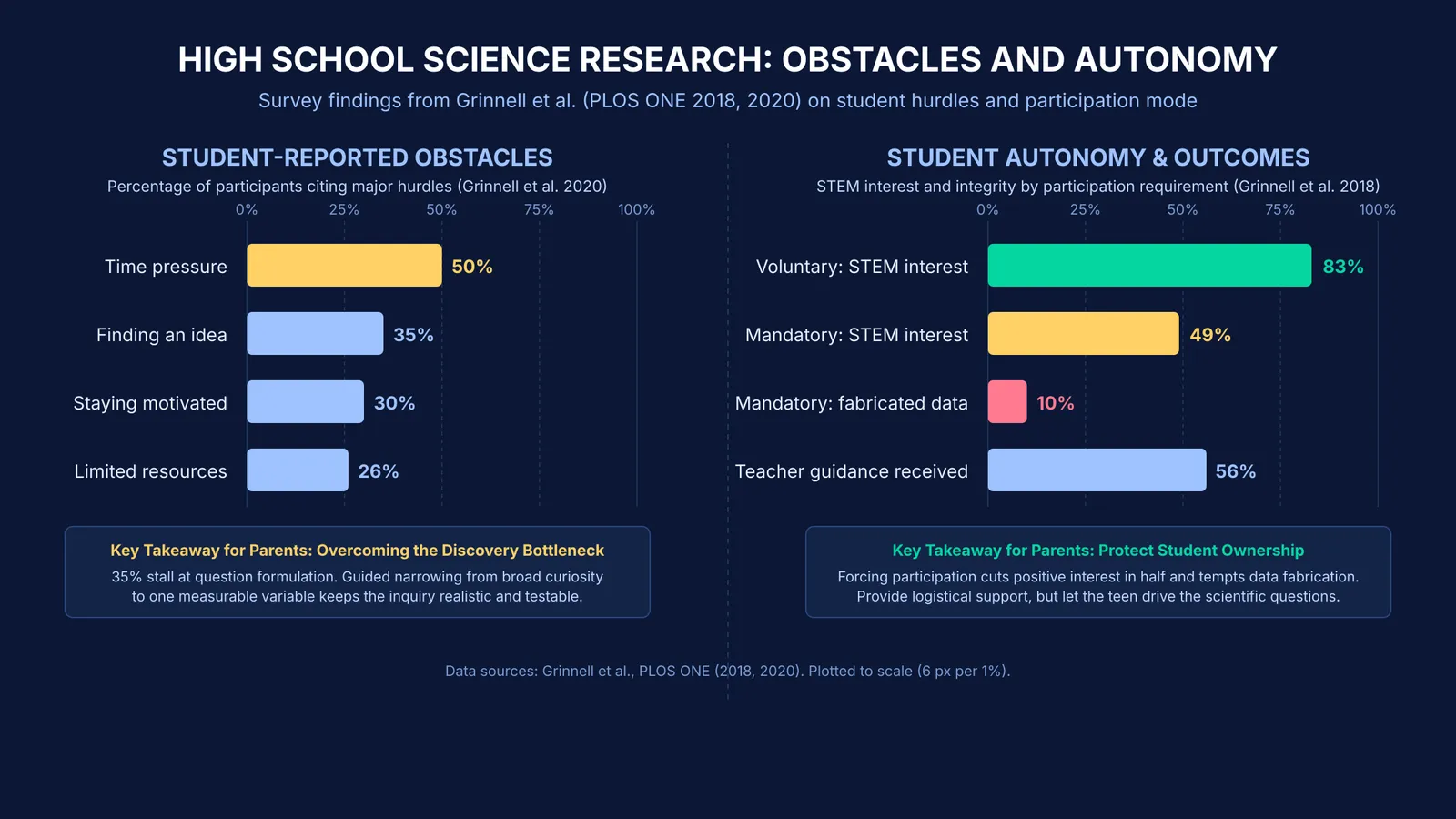
In a study of high school science fair competitors published in *PLOS ONE*, 35% of participants identified "getting the idea" as their single greatest hurdle. Students often stall because they imagine a discovery must be grand to be valuable. In reality, science fair judges and journal reviewers look for depth in a narrow slice of inquiry.
You can guide your child through a four-stage narrowing funnel:
Broad curiosity: Plant growth and urban soil.
Local observation: Marigolds growing along roadside verges seem stunted compared to those in backyard garden beds.
Controlled test: Measuring the seed germination rate and radicle growth of mustard (*Brassica nigra*) across four dilutions of street runoff water versus tap water.
Measurable metric: Millimetres of radicle growth after 7 days, measured with digital callipers across 30 seedlings per dish.
When background concepts feel fuzzy, reviewing foundational biology or chemistry in the Fermi Concept Library can help them see prerequisite principles—like osmotic potential or seed dormancy—before they build their equipment. If you want to walk through experimental design step by step, see our practical guide on turning a question into a fair test.
How can a high school student find a research mentor?
No teenager needs to navigate experimental methods alone. In the same *PLOS ONE* survey, 56% of students relied on schoolteachers and 11% received guidance from professional scientists. While fewer students worked with scientists, having an experienced mentor was the factor most closely tied to overcoming obstacles and developing sustained research skills.
Mentors do not need to be famous laboratory directors. Effective mentors often include a senior school science teacher, an Atal Tinkering Lab coordinator, or a postgraduate research scholar at a local university. Under the guidelines of India's National Children's Science Congress, supported by the Department of Science and Technology, every team of two students must work with an adult guide, with one explicit rule: the guide cannot be a parent or close relative.
Have your teen send a concise, four-sentence email to a prospective mentor:
"Dear Dr. [Name], I am a Class 10 student at [School] investigating how salinity changes the germination rate of locally sourced chickpeas."
"I read your department's recent paper on district soil salinity and would value your guidance on my proposed control group."
"I have drafted a one-page outline detailing my variables, safety controls, and measurement schedule."
"Could I share this outline for a ten-minute critique or advice on measuring electrical conductivity accurately?"
If your child encounters a theoretical hurdle while drafting their hypothesis, Fermi's AI tutor can work through the problem step by step, holding a line of reasoning across the session to diagnose where they are stuck before they reach out to their human mentor.
What is the parent's actual role in a science project?
According to *PLOS ONE*, 54% of student researchers receive help from parents. That assistance is most valuable when kept strictly logistical: providing transport, procuring safe supplies, enforcing safety protocols, and offering patience when runs fail.
When parents take over the design or purchase pre-assembled demonstration kits, they short-circuit the educational benefit. In a companion study in *PLOS ONE*, researchers observed that when students entered science fairs voluntarily, over 80% reported increased interest in STEM careers, compared to roughly 50% when participation was mandatory. In fact, approximately 10% of students forced into participation admitted to fabricating data. Preserving your teen's ownership of the project keeps the science honest and resilient.
How should a teen prepare for a science fair presentation?
Whether your child is entering a school exhibition, the IRIS National Fair entry requirements affiliated with the Society for Science, or NCERT's Rashtriya Bal Vaigyanik Pradarshani, the culmination of the project is the oral interview. Grinnell and colleagues found that interview coaching showed one of the strongest statistical associations with positive student outcomes (p = 0.001) in *PLOS ONE*.
Have your teen practise answering the three questions evaluators ask first:
"Why did you choose this specific independent variable, and how did you keep your controls constant?"
"What was your largest unexpected error or outlier, and what did it teach you?"
"If you had six more months and laboratory funding, what experiment would you run next?"
For physical setups that involve subtle mechanics or dynamic processes, practicing with interactive models in the Fermi Simulation Lab can help students describe the invisible mechanisms behind their measurements with clarity and confidence. A school research project does not need to yield a groundbreaking discovery; its real victory is teaching a student to ask a clean question, collect honest data, and defend their conclusions with evidence.


