

On this page
When a teenager asks to change schools, the reason is often social rather than academic. They might miss a best friend who moved, feel left out of a group, or just want to be where the popular kids are.
It is tempting to say yes to keep them happy, or a quick no because of the disruption. But changing schools is a major life event. Before you make a decision, it helps to know what the research says about friendship stability and how you can support your child through the transition.
Should I let my child change schools for friends?
The main argument a child will make is that they need to stay with their best friend. However, the data suggests that these bonds are more fragile than teenagers believe.
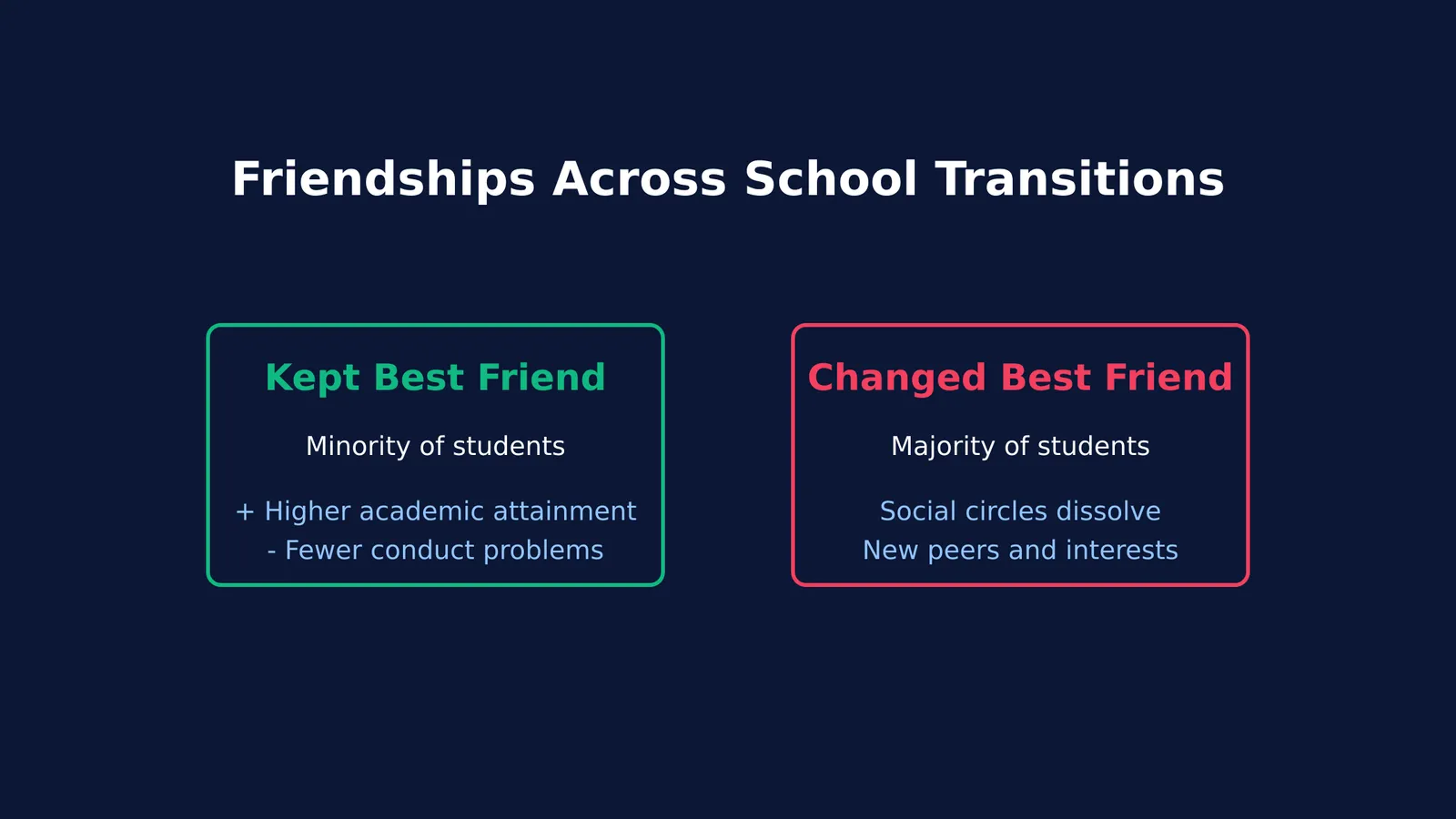
A 2018 study tracked 593 children moving from primary to secondary education in the UK. The researchers found that rates of friendship stability were relatively low across the transition. Social circles naturally dissolve and reform as children meet new peers, face harder classes and develop different interests.
That said, the minority who did maintain their best friendship saw real benefits. The same study noted that children who kept the same best friend achieved higher academic attainment and showed fewer conduct problems. The familiar face acts as a buffer against the stress of a new environment, allowing the student to focus on learning rather than navigating complex new social dynamics.
Does changing schools affect academic performance?
When students change schools, they often experience a "transition dip" in their marks. The stress of navigating a new campus, learning new teachers' expectations, and establishing a new social identity takes mental energy away from studying.
If the move is purely for social reasons, the academic cost might not be worth it. A teenager may need time to feel comfortable enough to engage fully in lessons after a move. On the other hand, if a student has faced severe bullying or isolation, a fresh start can improve their mental health and, consequently, their grades.
If your child is struggling with the academic jump or needs to build confidence in a new setting, Fermi's AI tutor can help them catch up. Instead of just giving answers, it works out what a student already knows, builds a plan for the session, and teaches through it—acting as a stable, patient guide during a turbulent time.
A framework for making the decision
If you are facing this request, use this framework to guide the conversation without starting an argument:
Acknowledge the feeling: Do not dismiss their social pain. Tell them you understand how hard it is to be separated from friends. A simple "I know how much you miss them" goes a long way.
Investigate the root cause: Ask open questions like, "What is it about your current school that makes you unhappy?" Sometimes the desire to move hides a different problem, such as struggling with a specific teacher, feeling overwhelmed by the curriculum, or dealing with hidden academic stress.
Assess the academic fit: Compare the academic offerings. If a new syllabus is causing friction, the Fermi Concept Library holds every concept in physics, chemistry, biology, mathematics and computing, each with its own lesson and its place in the map, so they can fill any gaps independently. If you are debating different systems entirely, look into CBSE, ICSE or state board: how families can compare them to see which aligns better with their long-term goals.
Delay the decision: Suggest a trial period. Say, "Let's give this school one full term. We will try some new ways to connect with your old friends on weekends, and we will review this in December."
Giving them a voice in the process is a prime example of Choice and autonomy: parenting that builds real motivation. When teenagers feel heard and respected, they are more likely to accept a compromise.
Helping them adjust
If they stay at their current school, you can proactively help bridge the social gap. Encourage them to invite their old friends over for a study session or set up a regular weekend activity. This reassures them that they are not losing their past connections.
Meanwhile, urge them to join a club, a sports team, or a volunteering group at their current school to build a new network organically. Friendships are the centre of a teenager's world, but they are also temporary and ever-changing. By balancing empathy with a focus on long-term academic stability, you can help them navigate the transition successfully.


