

On this page
Your child comes out of a 60-minute maths test and says, “I couldn’t finish.” When you look at the paper, the reason is often a single question: a long attempt, crossed-out lines, and blank questions at the end. It is a habit, not a character flaw, and habits can be practised.
Why does my child get stuck on one question?
Three things often happen together.
The question feels nearly solved. In three experiments with unsolvable water-jar puzzles, Stephen Payne and Geoffrey Duggan found that people spent longer on a problem when they had been told it was more likely to be solvable (Memory & Cognition, 2011). A child who has written half a page may feel one step away, so leaving feels like throwing that work away.
Worry takes up thinking space. People with high maths anxiety had smaller working-memory spans, which led to slower answers and more errors on mental addition done while holding something else in mind (Ashcraft and Kirk, 2001). The researchers described this as a temporary disruption of working memory. A stuck child is often a worried child, and worry can make the question harder still.
Nobody has noticed the clock. Some children do not look at the time until it is too late, especially if no one has given them set moments to check.
If the worry seems constant, affects sleep or eating, or spills beyond exams, talk to a school counsellor or a doctor. Tele MANAS, the national mental-health helpline, is free and open 24x7 on 14416 or 1800-891-4416.
What is a skip-and-return rule?
A skip-and-return rule is a time limit your child chooses before the test, plus a fixed routine for what to do when they reach it.
Work out par. Divide the minutes by the number of questions. A 60-minute paper with 20 equal questions gives 3 minutes each. If marks differ, give higher-mark questions proportionally more time.
Set the cap at twice par. Here, that is 6 minutes. This is a family rule of thumb, not a research figure; adjust it after a few tests.
At the cap, stop. Star the question in the margin, write a few words about where you are stuck (“can’t find second equation”), and move on.
Finish the paper once, then return to the starred questions, highest marks first.
Coming back later may help. A meta-analysis of studies on incubation, which means setting a problem aside before trying again, found a positive effect overall, though it varied with the type of problem, and the studies used lab puzzles and creative-thinking tasks, not school exams (Sio and Ormerod, Psychological Bulletin, 2009). The surer gain is simpler: the easier marks later in the paper get collected. For entrance exams, our two-pass plan for the exam hall builds on the same idea.
How can my child practise skipping at home?
Skipping feels wrong the first few times, so practise it when nothing is at stake.
Week 1: a 20-minute practice set with a kitchen timer. You call “check” at each par mark, and your child says out loud which question they are on.
Week 2: your child sets their own cap and uses a watch. Include one question slightly above their level so the rule actually gets used.
Week 3: a full school paper under exam conditions. Count the stars and how many came back solved.
Praise the move, not only the mark: “You left Question 7 at six minutes and came back to it. That was exactly the plan.”
How do you review timing after a test without blame?
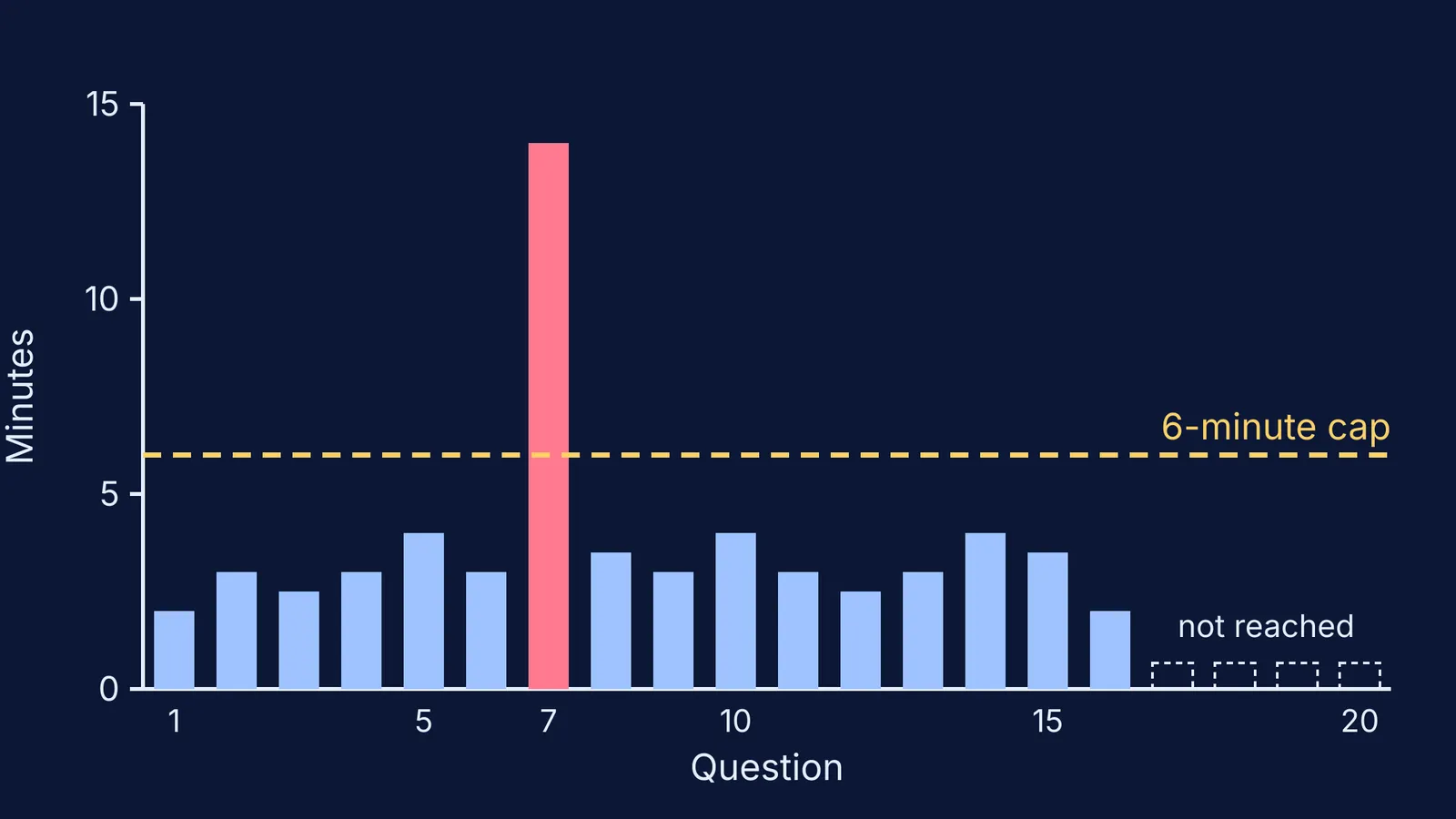
Look at timing together within a day or two, with the paper in front of you. Ask your child to write rough minutes next to each question they remember. For example, in a 60-minute, 20-question test, Question 7 took 14 of the 60 minutes and was still wrong, and Questions 17 to 20 were never reached.
Then ask three questions, in this order:
“Which question took the longest, and when did you first feel stuck?”
“What might have happened if you had left it at six minutes?” In the example, eight minutes would have been free for the last four questions.
“What was the stuck point?” Often it is a missing formula, a misread question or a calculation slip.
Avoid “Why did you waste so much time?” Try instead: “This test showed us one thing to practise. Shall we pick it together?” Our post on talking to your teenager about marks without a fight has more phrases like this, and older students preparing for JEE Main or NEET-UG can follow a full 60-minute mock test review routine.
If the stuck point is a method your child does not yet know, work through a similar problem afterwards. The Fermi Problem Library has worked problems with a step-by-step solver that explains the reasoning rather than printing an answer, so your child can see where their own attempt went off track.
Before the next test, agree on the cap together and have your child write it at the top of the rough sheet.


