

On this page
If your child gets the right answer and still loses marks, the missing marks are usually in the working. In board maths, examiners mark steps, not just the final line. Here is why children jump steps, where the marks sit in a real CBSE question, and three questions that build a show-your-thinking habit at home.
Why does my child skip steps in maths?
Often, children skip steps because the steps have started to feel obvious. Psychologists Stephen Blessing and John Anderson studied this in a 1996 paper, How people learn to skip steps, using a task that works like simple algebra. Their participants solved many problems while the researchers watched their working. When people first stopped writing steps, they still seemed to do those steps in their heads; with more practice, they began using new shortcuts and stopped doing the old steps at all.
That is a normal sign of growing skill. The trouble is that an examiner cannot see inside your child's head. A step done mentally earns nothing on paper, and a step done wrongly in the head cannot be found or fixed.
Other reasons are more ordinary: time pressure in tests, rough work scattered across the page, or a feeling that writing more looks slow. Neat working and a clear layout help with the second.
How many marks are lost for missing working?
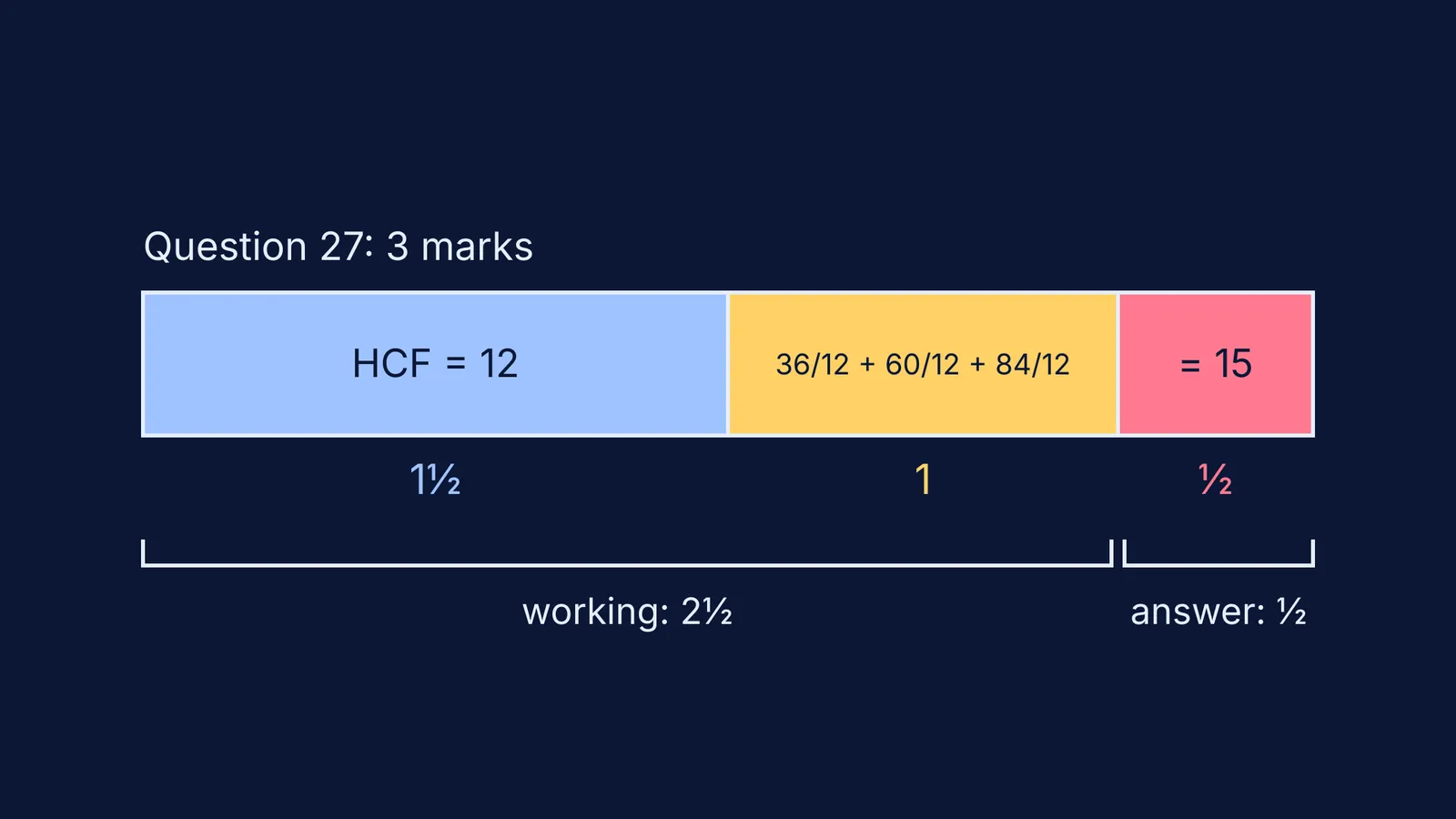
Take question 27 from CBSE's official Class 10 Mathematics Standard sample paper for 2025-26. A workshop has 36 English, 60 Hindi and 84 Science teachers. What is the minimum number of rooms if each room seats the same number of teachers, all of one subject? It carries 3 marks.
The official marking scheme splits those 3 marks like this:
HCF(36, 60, 84) = 12: 1½ marks
Rooms = 36/12 + 60/12 + 84/12: 1 mark
= 3 + 5 + 7 = 15: ½ mark
In this question the final answer line carries ½ of the 3 marks; the other 2½ marks sit in the working. A child who writes only “15 rooms” leaves out the lines that carry most of the marks. The same scheme splits the 3 marks of the trigonometry proof in question 29 into three 1-mark steps.
See also our guide to Class 10 CBSE maths mistakes and how to show working.
Does explaining each step help children learn?
Writing steps is not only about marks. When learners explain to themselves why a step works, researchers call it self-explanation. A 2018 meta-analysis by Kiran Bisra and colleagues pooled 69 effect sizes from 64 research reports and found an average effect of g = 0.55 for learners prompted to self-explain while studying or solving problems.
That paper also notes an earlier maths-only meta-analysis by Bethany Rittle-Johnson and colleagues, which found that prompting students to self-explain had a small to moderate effect on learning outcomes.
In plain terms: a short prompt to explain a step helps, on average. The questions below do exactly that.
What can parents ask at the table?
Sit with one finished homework problem, not the whole set, for a few minutes. Point at the page and ask:
“Where did this line come from?” Point at any line. Your child should name the line or fact before it.
“Why is that allowed?” The answer is a rule, a formula or a reason in words.
“How would you check it?” Substitute back, estimate, or count the units.
Here is how it sounds with the rooms question:
You: “Where did 12 come from?”
Child: “It's the HCF.”
You: “Why HCF and not LCM?”
Child: “Every room has the same number, and the biggest number that divides all three gives the fewest rooms.”
You: “Write that reason as one short line. How would you check 15?”
Child: “12 × 15 = 180, and 36 + 60 + 84 = 180.”
You do not need to remember the maths yourself; the questions work because your child does the explaining. Our post on helping with maths you've forgotten has more questions like these.
How do you turn this into a habit?
Week 1: ask the three questions about one problem on three evenings. Praise the clear line, not the speed.
Week 2: your child writes the “why” in a few words beside each step before you ask.
Week 3: mark one answer together against an official marking scheme, half marks and all.
Every week: keep rough work in a margin column so the main working stays readable.
If your child often cannot see what the next step should be, the Fermi Problem Library has worked problems with a step-by-step solver that explains the reasoning rather than printing an answer, so there is a model of complete working to compare with.
If homework regularly ends in tears, talk to the class teacher before adding more practice.
Start tonight with one problem and one question: where did this line come from?


