

On this page
If a child sits at the back of the classroom and cannot read the board, their learning stops before they even open a textbook. They miss key steps in a calculation, miscopy assignments, and often lose focus because straining to see is exhausting. When a child cannot see the board clearly, it affects their daily study habits and long-term academic performance. They might spend their evenings trying to decipher their own incomplete notes rather than actually studying the material. Over time, this leads to frustration, exam anxiety, and a false belief that they simply do not understand their subjects. The root cause, however, is often purely visual.
Why can't my child see the board from the back of the class?
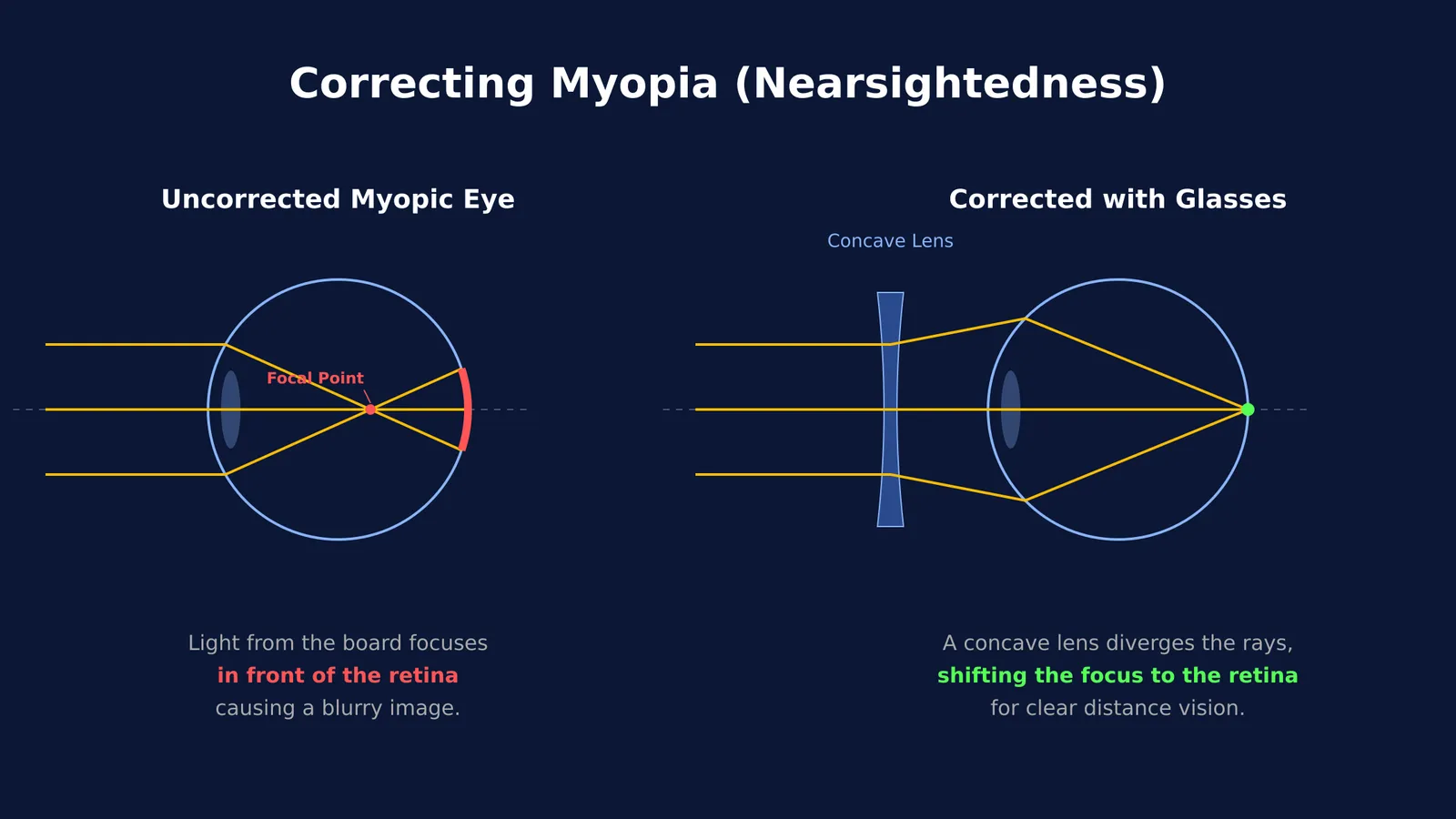
Children rarely know their vision is blurry; they simply assume everyone sees the world the way they do. According to a 2020 meta-analysis by the All India Institute of Medical Sciences (AIIMS), the prevalence of myopia (nearsightedness) has risen significantly, reaching 15.0% in urban Indian children aged 11 to 15 years.
Because they will not tell you their vision is blurry, you have to look for secondary signs:
Frequent headaches: Squinting to bring the board into focus tires the eye muscles quickly.
Incomplete notes: If you check their notebooks and find half-finished sentences or copied mistakes, they might be relying on a desk-mate's notes or guessing.
Avoiding near-work: Though nearsighted children can see close up, the strain of switching focus back and forth can make reading uncomfortable.
Look for physical signs as well. Do they sit unusually close to the television or hold their tablets right up to their face? Do they frequently rub their eyes or complain that their eyes feel tired after school? Nearsightedness often develops gradually during the early school years and accelerates as children grow, meaning a child who had perfect vision in the second standard might suddenly struggle in the fourth.
Why do standard school vision tests miss the problem?
Many parents rely on the annual school eye exam. However, a basic distance visual acuity check (reading letters on a chart) only tests one of many visual skills required for learning.
A school nurse or teacher typically conducts a Snellen chart test, which asks the child to read rows of letters from 20 feet away. While this is excellent for identifying severe myopia, it completely misses how the eyes work together. A child might have perfect distance vision but suffer from a lack of eye coordination, making it difficult to smoothly track words across a page or quickly shift focus from a textbook on their desk to the blackboard at the front of the room. If you suspect an issue, do not wait for the school screening. Book a comprehensive eye exam with a specialist who can check eye tracking, focusing, and coordination.
How do I ask the school to change my child's seat?
If your child is prescribed glasses, or if you are waiting for an appointment but know they are struggling, contact the school immediately. Remember that teachers manage classrooms of 30 or more students and may not have noticed your child squinting. A simple script works best.
Be direct but polite: Email or meet the class teacher. Explain that you suspect your child is having trouble seeing the board, that you have booked an eye exam, and ask if they could move them to the front row while you wait.
Provide documentation: Once the eye exam is complete, bring the optometrist's report to the school office. Inform them that the doctor has prescribed glasses and strongly recommends preferential seating, and provide the doctor's note for their records.
Follow up: Check with your child after a week to ask if it is easier to see the board from their new seat.
Once your child has their glasses and a new seat, they may still take time to adjust. The board will be clear, but they now need to regain the confidence they lost while struggling.
How does Fermi's AI tutor help fill the gaps?
Even after a child gets glasses and a seat in the front row, they may have lingering gaps from the weeks or months they spent unable to see clearly.
If they missed the core explanations for a topic like dispersion of white light by a glass prism or the rules for naming carbon compounds, the Fermi Concept Library can help them catch up. Every concept in physics, chemistry, biology, mathematics and computing has its own lesson and its place in the map.
Often, a child who missed notes will not know where to begin studying. Fermi's AI tutor works out what they already know, builds a plan for the session, and teaches through it. If they make a wrong-method mistake because they miscopied a formula weeks ago, the Fermi Problem Library provides a step-by-step solver that explains the reasoning rather than printing an answer, letting them rebuild their confidence at their own pace.


