

On this page
A familiar evening scene: a student sits with a textbook on the left and a commercial guidebook or coaching manual on the right. Homework sheets fill up quickly and calculations appear flawless. Yet during examinations, the student freezes before standard numericals or derivations.
This gap between neat homework and disappointing marks rarely reflects low ability. It is the predictable outcome of passive exposure versus active retrieval. Understanding why children lean on guidebooks is the first step toward turning solution keys into diagnostic tools.
Why does your child copy answers from guidebooks?
Children rarely copy answers out of laziness. In most cases, copying is a practical response to competing academic pressures:
Heavy homework loads: Facing hours of school and tuition assignments nightly, transcribing solutions becomes a survival strategy to meet deadlines.
Fear of negative evaluation: Spotless copied pages earn praise, whereas honest, messy attempts with crossed-out steps risk criticism.
Intolerance for friction: Unfamiliar problems cause mental discomfort that an open guidebook instantly relieves.
Analyzing homework patterns in *Physical Review Special Topics - Physics Education Research*, researchers discovered that time constraints and late starts—not academic inability—primarily drove copying (Palazzo et al., 2010). When homework measures compliance rather than learning, guidebooks become survival tools.
How does copying solutions weaken long-term memory?
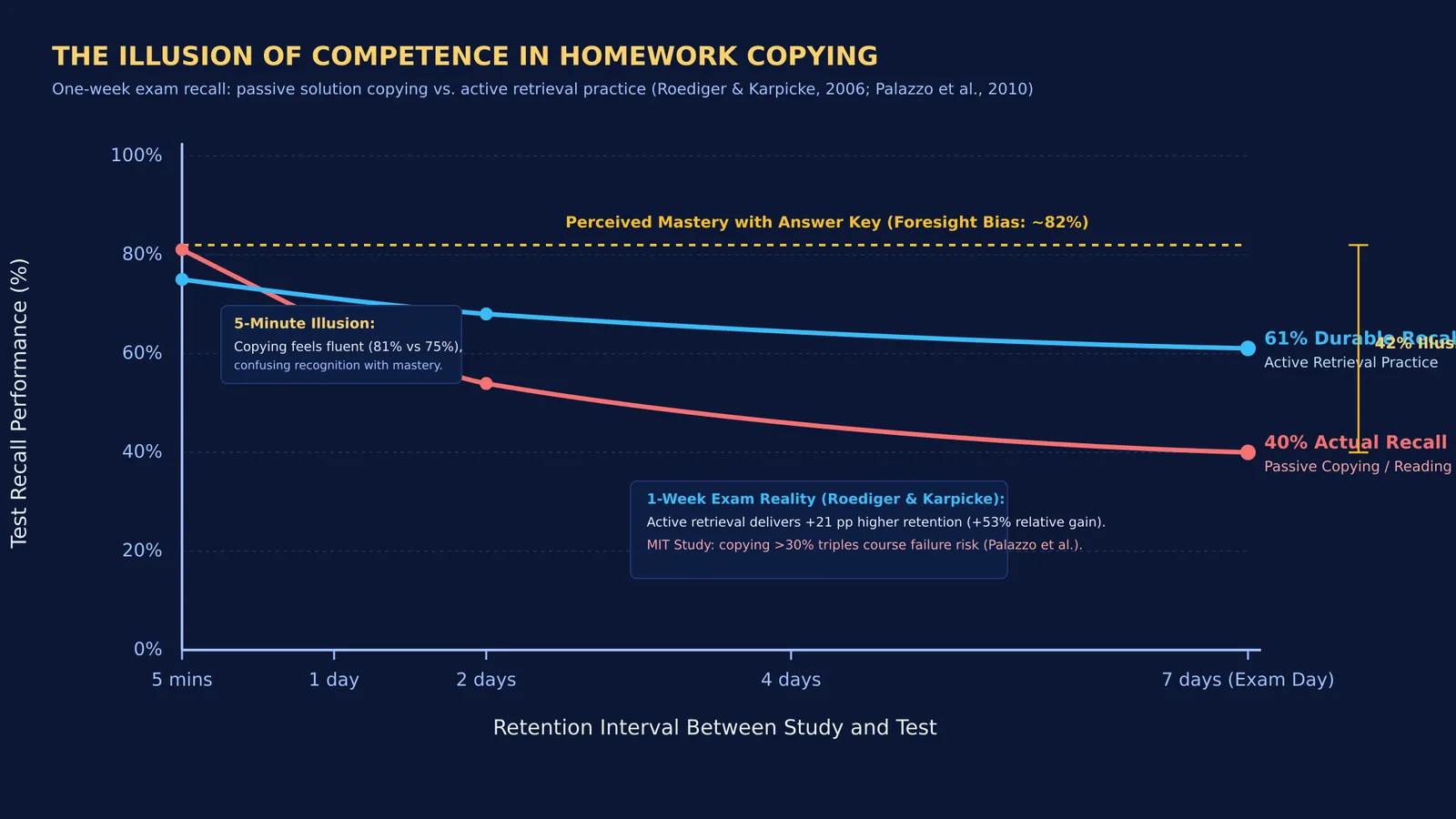
Copying worked solutions triggers the "foresight bias." Research in the *Journal of Experimental Psychology: Learning, Memory, and Cognition* showed that viewing an answer alongside a question makes the reasoning appear obvious (Koriat & Bjork, 2005). The mind mistakes perceptual fluency—the ease of reading a solution—for independent competence.
Reading another's derivation builds negligible retrieval strength. In *Memory*, 84% of surveyed students cited re-reading as their primary strategy, while only 11% practiced retrieval (Karpicke, Butler, & Roediger, 2009). Re-reading feels fluent but conceals genuine confusion, explaining why students feel confident during study yet blank out on tests, an effect examined in research on the feeling of learning vs actual learning.
The academic cost is severe. The MIT study found that students who copied more than 30% of their homework problems were over three times more likely to fail the course, scoring roughly two letter grades lower on final exams than independent peers (Palazzo et al., 2010).
Why is struggling before seeing the answer essential?
Learning happens during the effort to assemble a solution, not when an answer is handed over. Educational researcher Manu Kapur calls this "productive failure." A meta-analysis across 53 studies and more than 12,000 learners showed that students who grapple with problems before receiving instruction develop significantly deeper conceptual understanding and transfer skills than those given solutions upfront (Sinha & Kapur, 2021).
Independent struggle activates prior knowledge, identifies exact reasoning gaps, and prepares the mind to absorb canonical explanations.
When students get stuck, they do not need full solutions; they need prompts that sustain their reasoning. The Fermi Problem Library offers worked problems with a step-by-step solver explaining underlying principles rather than printing answers. Similarly, Fermi's AI tutor identifies where a student is stuck and decides whether to explain, ask, or show, prompting them to derive the next step independently.
How can students use answer keys effectively?
Eliminating answer keys is neither realistic nor helpful; self-study requires feedback. The objective is shifting from copying before thinking to verifying after an honest attempt.
The Two-Pen Checking Protocol
A structured routine turns answer keys into diagnostic tools:
Blue pen for the honest attempt: The student works for 8 to 10 minutes with keys closed. If stuck, they write down their hypothesis or exact question.
Green pen for the key check: The student opens the key only after completing their attempt, using green ink to tick steps and annotate errors.
The 15-minute re-solve: If the key was needed, the student closes it, waits 15 minutes, and solves the question on a clean sheet of paper.
What parents should say
Confronting a child with anger drives copying underground. Shifting to constructive coaching preserves trust, as explored in guides on when to help with homework and when to step back and talking about failure at home.
If you see your child working with an open guidebook, try this script:
*"I see your answer key is open. Are you checking completed work or stuck on a step? Show me where your reasoning stopped, and let's work out what to ask before checking the key."*
By removing shame from the struggle, you help your child build durable problem-solving confidence.


