

On this page
The humble building block is more than a toy. It is a child's first encounter with structural engineering and three-dimensional geometry. When a child loves building blocks, they are not just passing time; they are building the cognitive foundations for advanced mathematics and physics.
What is the hidden mathematics in building blocks?
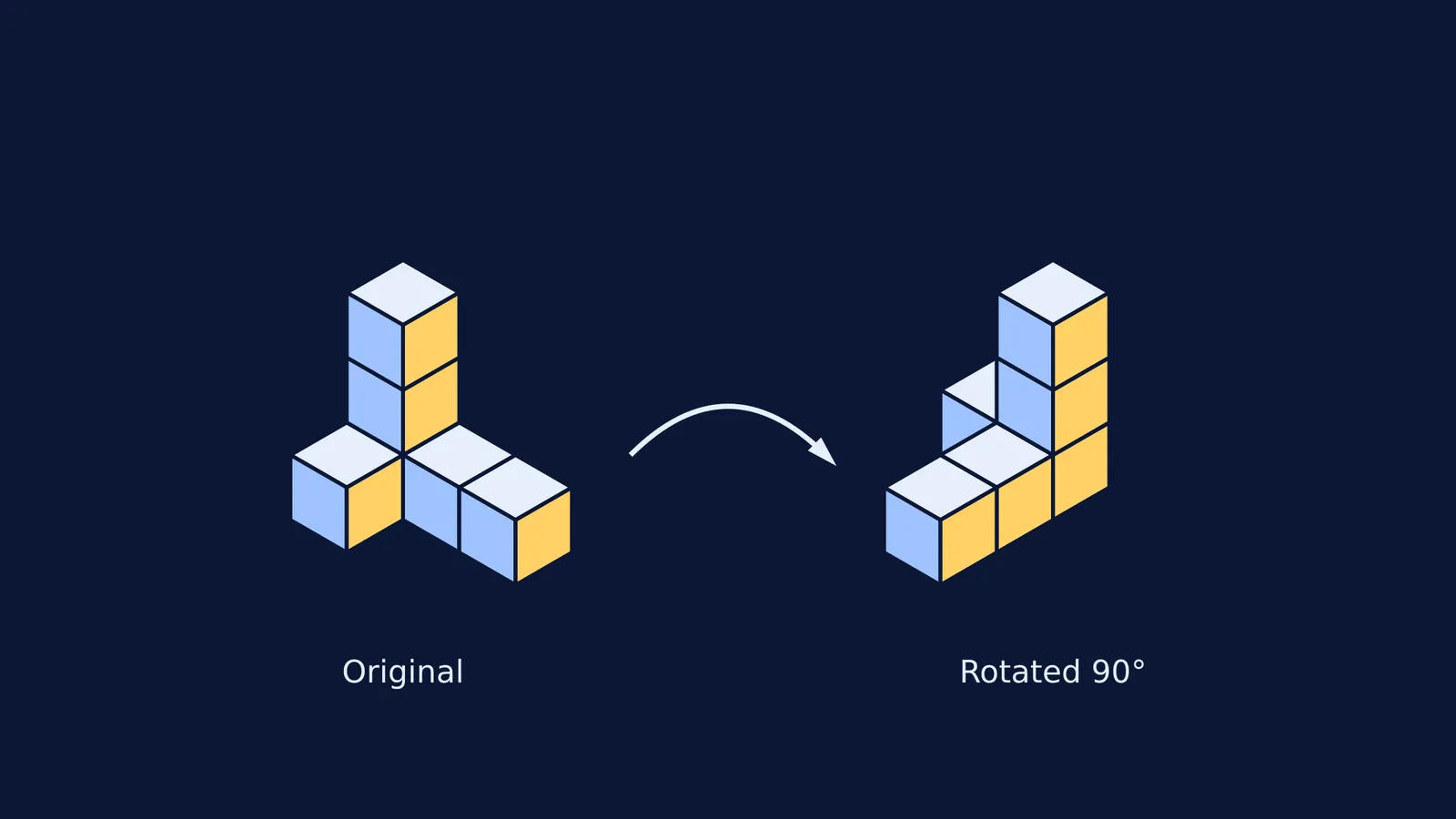
Every time a child rotates a piece to make it fit, spans a gap, or balances a tower, they are practicing spatial reasoning. This is the mental ability to picture a three-dimensional object and imagine how it looks from different angles.
Early spatial skills are surprisingly measurable and highly predictive of later academic success. In a 2017 study, researchers from the University of Delaware and Temple University found a strong link between a preschool child's early spatial skills—measured through their ability to assemble blocks into specific designs—and their mathematics scores at age five. The ability to mentally rotate and manipulate shapes is a core component of general intelligence, setting the stage for everything from geometry to calculus.
Why does guided building beat free play?
While unstructured free play is wonderful for creativity, research shows that "guided play" is where spatial language truly flourishes.
A 2011 study on "block talk" during play found that when parents and children built blocks towards a specific goal—like copying a picture or following a set of instructions—they used significantly more spatial language than during free play. Words like "above", "edge", "parallel", "below", and "corner" help children label the spatial relationships they see.
When parents use these terms actively, children internalise them. They begin to understand not just that a block fits, but why it fits in that specific orientation.
How do block skills translate to physics and engineering?
These early skills compound over time. A landmark 2009 analysis published by the American Psychological Association reviewed 50 years of data on spatial ability and found that spatial reasoning strongly predicted whether a student would eventually earn an advanced degree in a STEM (science, technology, engineering, and mathematics) field.
By the time students reach secondary school, physics and chemistry require intense spatial imagination. Whether it is predicting the 3D shapes of interhalogen compounds or understanding how to apply the section formula in 3D space, the mental rotation practiced with blocks becomes essential.
For students who struggle to picture these abstract concepts, tools like the Fermi Simulation Lab bridge the gap, allowing them to manipulate 3D models and see the physics in action. When problems get complex, Fermi's AI tutor works alongside them, drawing diagrams and breaking down the spatial reasoning step by step.
How can you challenge a child who loves building blocks?
If your child already loves building blocks, how can you stretch their spatial reasoning further? You can use the "Copy, Modify, Invent" framework to turn a simple play session into a structured engineering challenge.
Copy: Show them a picture of a block structure or build a small one yourself, and ask them to replicate it exactly. This forces them to translate a 2D image or a separate 3D object into their own building space.
Modify: Ask them to change one specific thing about the structure they just built. You might say, "Can you make it twice as tall without it falling over?" or "How can we make this bridge strong enough to hold a toy car?"
Invent: Give them a spatial constraint for their own creation. Challenge them to "build a house that has a roof overhang, two windows, and is entirely symmetrical."
By engaging in their play, introducing the vocabulary of geometry, and setting guided goals, you are helping them build a mind ready for the sciences.
The tower might eventually fall down, but the spatial skills they construct will last a lifetime. To see how these 3D skills apply to later science topics, try rotating the models in the Fermi Simulation Lab.


