

On this page
Receiving a call from the school office or a tearful confession at the end of the day about a lost phone or missing lunch money is a rite of passage for many parents. It is incredibly frustrating, especially when the lost item is expensive. However, before you react with anger or rush to buy a replacement device, it helps to view the situation through the lens of child development. Losing an item is often an issue of cognitive overload rather than intentional carelessness.
Why do children lose things so often?
To understand why a child leaves a jacket on the playground or drops their phone in the cafeteria, we have to look at their executive functioning skills. Executive function is the brain's management system, responsible for planning, organizing, and keeping track of information. A critical component of this system is working memory.
Working memory is the ability to hold information in mind while actively using it. In adults, working memory can juggle multiple tasks and items simultaneously. In children, this capacity is still maturing. According to a 2010 study, the working memory capacity of a seven-year-old allows them to hold only about 1.5 items in mind at once (Cowan et al.).
When the end-of-day bell rings, a student has to remember to write down their homework, say goodbye to their friends, pack their folders, zip their bag, and catch the bus. Because their working memory is limited, adding a distraction—like a noisy hallway—can easily push the mental note to "grab my phone" right out of their focus of attention.
What is the natural consequence of losing a phone?
Because a smartphone is a child's primary social lifeline, its loss can trigger intense anxiety. A 2022 study of elementary school students found that 53.1% were most concerned about losing their phones when bringing them to school (Wang et al.).
When the inevitable happens, parents should lean on the framework of natural and logical consequences, first outlined by psychiatrist Rudolf Dreikurs in his 1964 book, *Children: The Challenge*. Dreikurs argued that children learn best when they experience the direct outcomes of their actions, rather than arbitrary punishment.
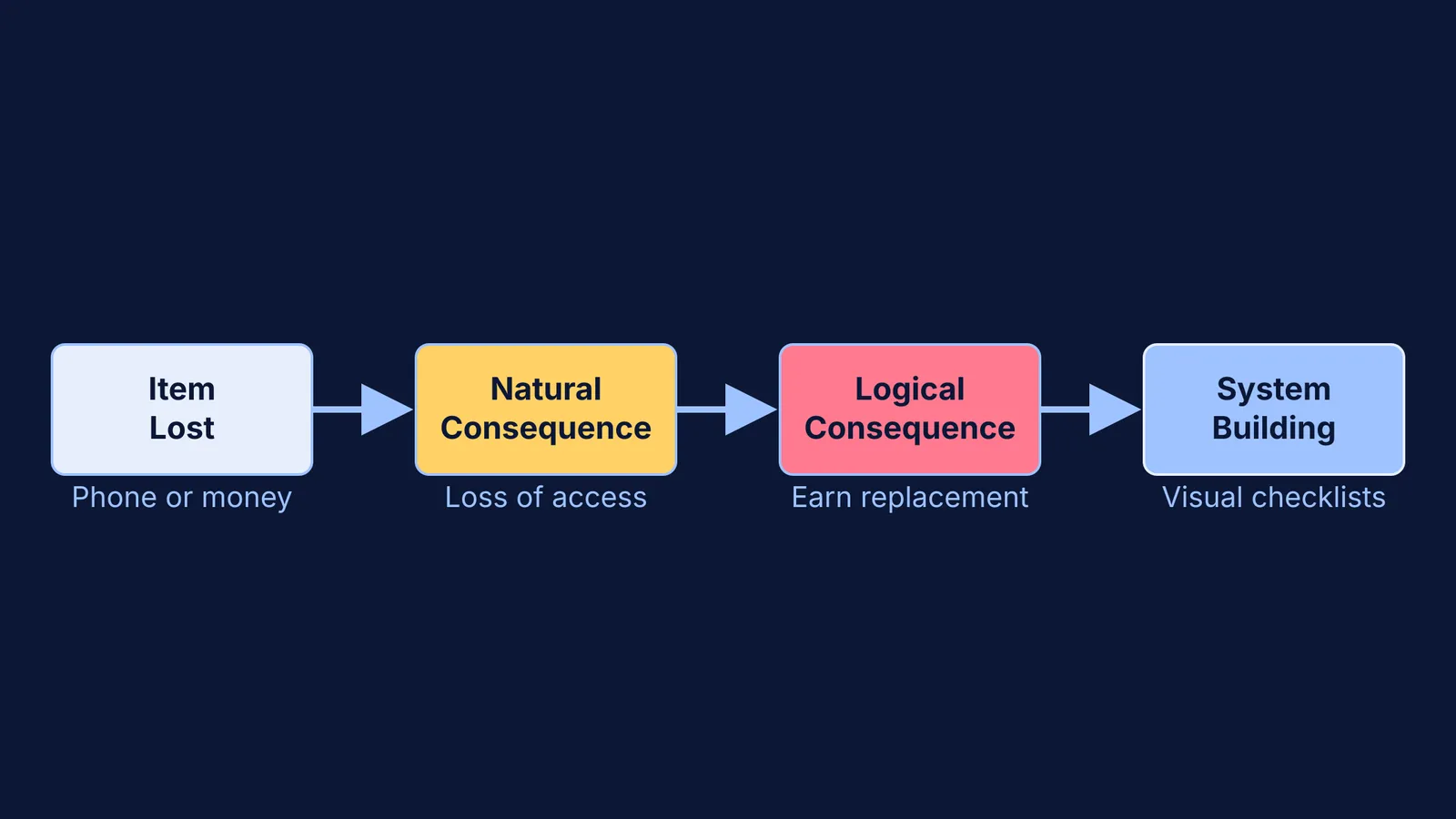
The natural consequence of losing a phone is simply being without it. They cannot message their friends on WhatsApp, play games on the auto rickshaw ride home, or use their favorite apps. You do not need to ground them or take away their television privileges; the pain of the loss is the consequence. Empathize with their frustration—treat them with the same courtesy you would show an adult who misplaced their keys—but do not shield them from the reality that the phone is gone.
Should parents replace a lost phone or money?
If the item cannot be found, you must decide whether to replace it. For lunch money, the logical consequence is that they must carry a packed tiffin from home for the rest of the week using ingredients already in the pantry.
Replacing a smartphone requires a more structured logical consequence. A logical consequence must be related to the event, reasonable, and respectful. If you immediately buy a brand-new device, the child learns that high-value items are easily replaced without effort. Instead, require them to contribute to the cost.
They can use their allowance, birthday money, or perform extra household chores to "earn" a portion of the replacement value. This financial contribution connects the value of the item to the effort required to obtain it, fostering a deep sense of ownership. If a smartphone is too expensive to replace immediately, consider providing a basic feature phone for safety purposes until they can demonstrate better responsibility.
How can you teach a child to keep track of their belongings?
Rather than labeling a child as "irresponsible," help them build robust tracking systems that compensate for their developing working memory.
Visual checklists: Attach a small, durable luggage tag to the zipper of their backpack. List the absolute essentials: Phone, keys, wallet, lunchbox. A visual cue reduces the cognitive load of packing up at the end of the day.
The pat-down routine: Teach your child to physically pat their pockets and check their bag every time they transition from one location to another, such as leaving a classroom or stepping off the school bus.
Recovering lost work: If the loss included a school bag containing their notebooks, they may panic about falling behind. You can help them set up AI study plans so they can bridge the gap in their understanding. For the actual learning, Fermi's AI tutor works out what they already know, builds a plan for the session, and teaches through it so they are not staring at a blank page. Establishing a predictable study routine that lasts at home ensures that a lost item does not derail their entire academic week.
By treating a lost item as a skill-building opportunity rather than a moral failure, you equip your child with the organizational habits they will need for the rest of their lives.


