

On this page
It is a story familiar to thousands of families every year: a student who easily scored high marks in Class 10 brings home a Class 11 unit test with a failing grade. The initial shock is often followed by panic. Parents wonder if they chose the wrong stream, while the student, previously considered "naturally smart," suddenly feels like a failure.
This academic dip is so common that educators often call it a transition shock. However, while the drop in marks is temporary and fixable, the loss of confidence can have a lasting impact if not handled carefully.
Why does the Class 11 dip happen?
The jump from Class 10 to Class 11 is arguably the steepest academic leap in the Indian school system. The sheer volume of the syllabus expands dramatically. In Science and Mathematics, the curriculum moves away from general overviews and rote memorization toward deep, abstract concepts that require independent application.
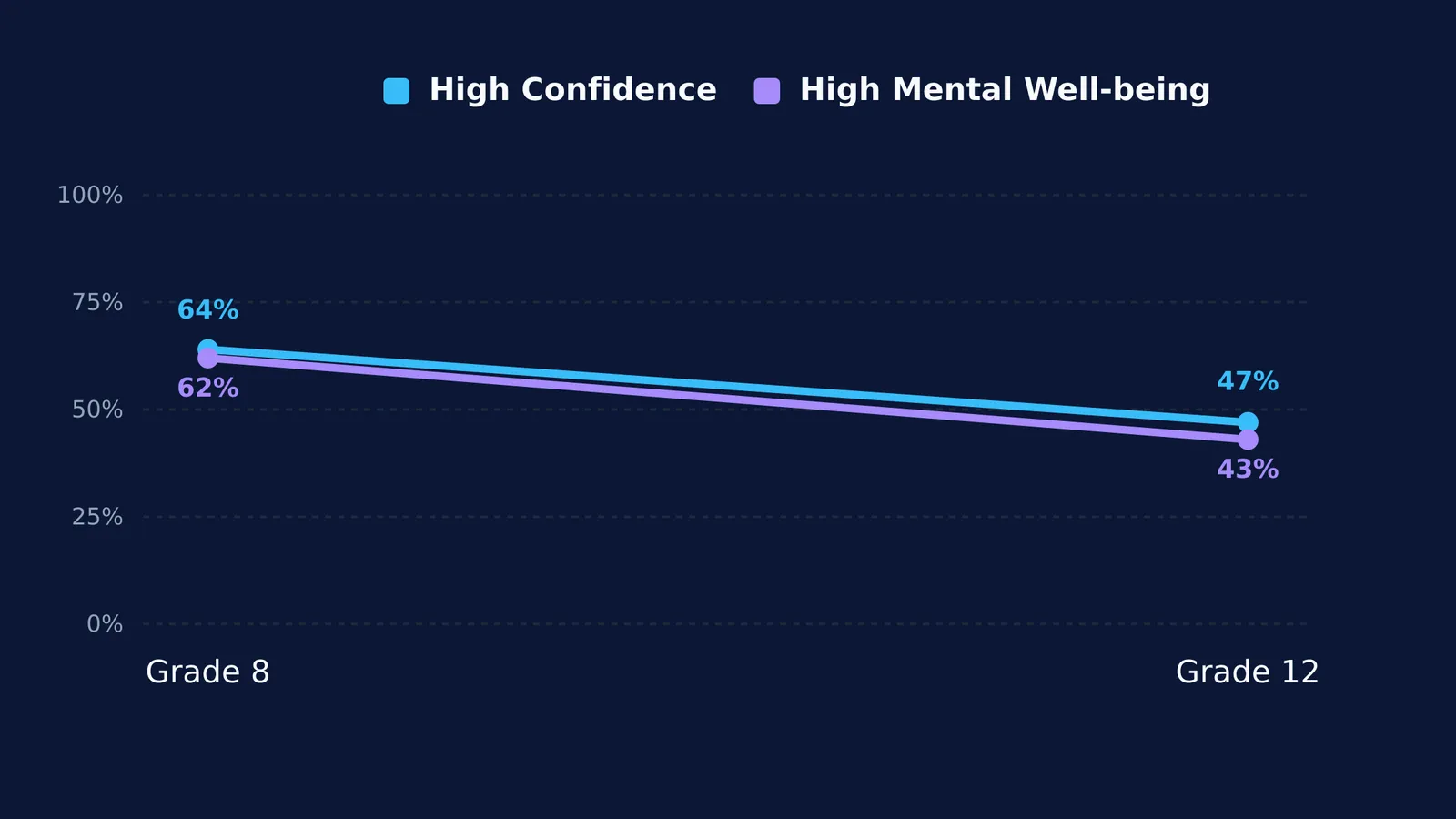
This shift takes a measurable toll on students. According to the Student Well-Being Pulse Report 2026 by the IC3 Institute, high overall mental well-being drops from 62% in Grade 8 to just 43% in Grade 12. Similarly, the proportion of students reporting high confidence falls from 64% to 47% over the same period. The simultaneous pressure of board exams, new conceptual depth, and the start of preparation for competitive exams often leaves students exhausted and anxious.
How does praise affect your child's confidence crash?
Why do students who were previously so successful suddenly lose their motivation when they encounter difficult material? The answer often lies in how they were praised when they were younger.
A landmark 1998 study by researchers Claudia Mueller and Carol Dweck, published in the *Journal of Personality and Social Psychology* (DOI: 10.1037/0022-3514.75.1.33), demonstrated that the type of praise a child receives directly shapes how they handle future failure. The researchers found that students praised for their intelligence (e.g., "You got a high score, you must be really smart") lost confidence as soon as they struggled with a harder task. They interpreted the difficulty as proof that they were not actually smart, and their performance plummeted.
In contrast, students praised for their effort (e.g., "You got a high score, you must have worked really hard") viewed the harder tasks as a challenge rather than a threat to their identity. They remained engaged and tried new strategies.
If your child has spent years being told they are "naturally brilliant" because Class 10 was easy for them, a bad Class 11 test feels like a devastating loss of identity. They may begin avoiding difficult topics entirely to protect themselves from feeling incapable.
What should you say after a bad test result?
Your reaction to the first bad test score sets the tone for the rest of the academic year. If you react with panic or anger, you reinforce the idea that their worth is tied to their marks. Instead, try a calmer approach:
Normalize the struggle: Remind them that the Class 11 transition is notoriously difficult. Tell them, "Everyone finds this jump hard. This test just shows us that the old study methods from last year will not work for this new material."
Shift to process praise: Stop talking about whether they are "smart enough" for the science or commerce stream. Focus entirely on the process. Praise the hours they put in, the strategies they tried, and their willingness to review their mistakes.
Do not immediately suggest dropping subjects: Give them a chance to adjust before treating a bad test as a sign they chose the wrong path.
How can you rebuild a strong study routine?
Once the emotional shock has settled, it is time to look at the mechanics of how they are studying. Class 11 requires active retrieval, not just reading the textbook.
Encourage your child to break down their study sessions and identify exactly where they are getting stuck. Are they struggling with the core concept, or are they making arithmetic errors in the final steps? If they are unsure where to begin their revision, Fermi's AI tutor can work out what they already know and build a plan for the session, so they sit down to a clear next step instead of feeling overwhelmed by a blank page.
It is also crucial to build a routine that does not rely entirely on daily parental checking, which can feel intrusive to a teenager. You might find it helpful to read about how much homework helps and how to transition from managing their time to supporting their autonomy. If they are specifically struggling with the abstract logic required in new subjects, our guide on helping your child with maths word problems offers useful questions you can ask to guide their thinking without doing the work for them.


