

On this page
You know the scenario well. Across the kitchen table, your child brilliantly explains a complex physics concept or the plot of a novel. But when it is time to hand in the assignment, their paper is brief, disjointed, or entirely blank.
It is incredibly frustrating to see a student who clearly grasps the material struggle to prove it on paper. This is not laziness or a lack of understanding. It is a known cognitive hurdle.
Why does my child know answers orally but write poorly?
The gap between what a child can say and what they can write usually comes down to cognitive load. Speaking is a highly practiced, interactive skill. Writing is "decontextualized"—it forces the student to organise their thoughts, choose precise vocabulary, and physically form letters or type words all at once, without a conversational partner to prompt them.
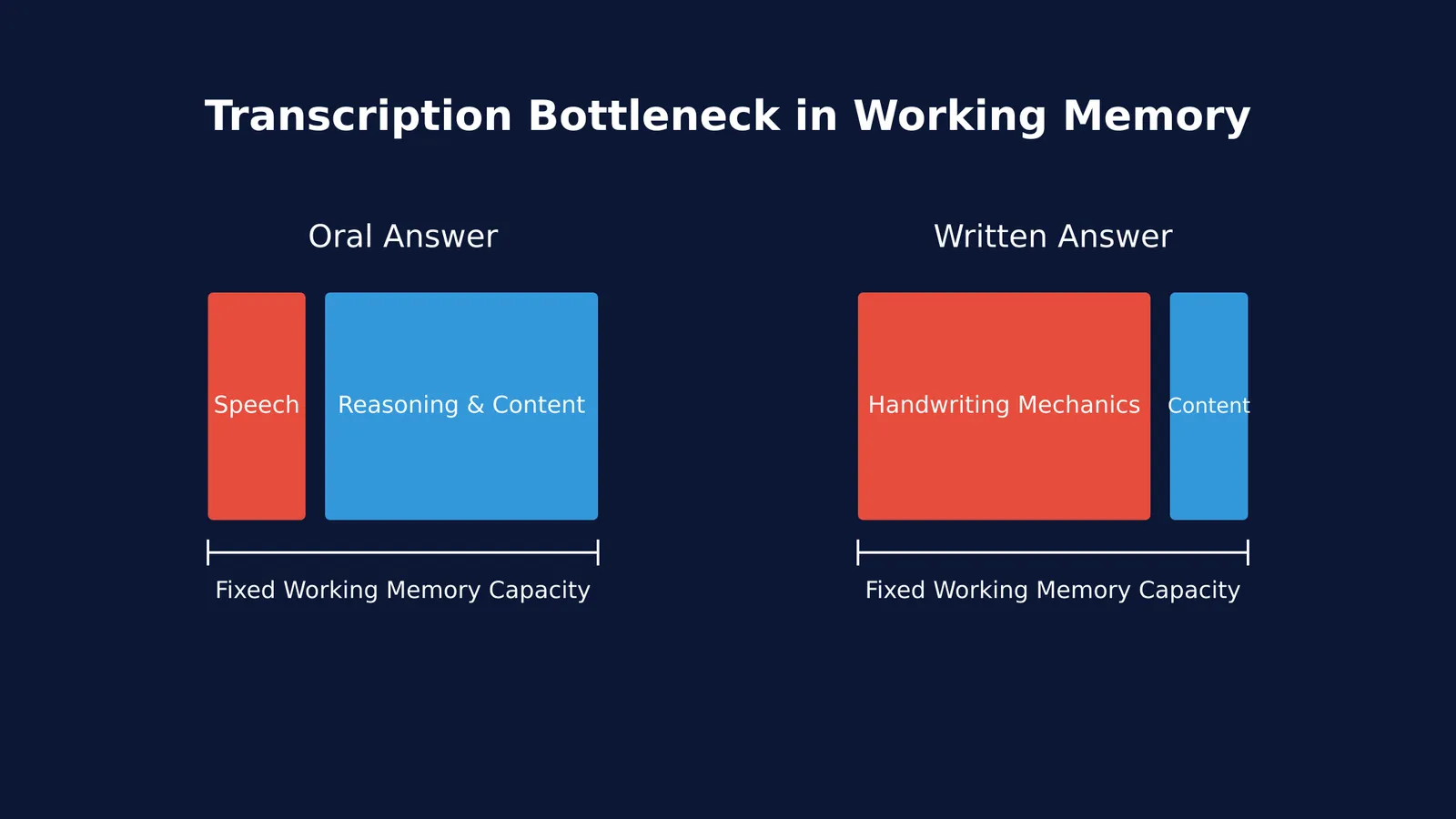
According to a classic study on writing and working memory by Ronald Kellogg, putting ideas into text forces the brain to coordinate planning, sentence generation and reviewing simultaneously (10.1006/ceps.1996.0004). A student must hold the overarching idea in their central executive memory, use their visuospatial sketchpad to lay out the paragraph, and rely on their phonological loop to spell the words. For many students, this simply overloads their working memory. They have the knowledge, but the mental bandwidth required to get it onto paper blocks the exit.
What is the transcription bottleneck?
Educational psychologists call this the "transcription bottleneck". If the mechanical act of handwriting or typing is not completely automatic, it drains the working memory that the brain needs for higher-level reasoning.
Research by Diana Döhla and Stefan Heim estimates that 7% to 15% of school-age children experience developmental writing deficits, often known as dysgraphia, where their written output lags significantly behind their general intelligence and oral abilities (10.3389/fpsyg.2015.02045). Children with these deficits use up so much cognitive energy trying to physically form letters or type on a keyboard that they have no processing power left for the actual content of the answer.
Even students without a diagnosed learning difference often hit this bottleneck when faced with complex high school subjects. The effort of remembering the steps of a physics proof or a chemistry reaction leaves no room to focus on writing it down clearly, which is why helping your child with maths word problems often requires asking them to explain their logic first.
How can I help my child bridge the gap?
If you notice a sharp contrast between your child's spoken understanding and their written work, telling them to "just write what you said" rarely works. That instruction still requires them to coordinate all the steps of writing at once.
Instead, you need to break the task down so they only have to do one cognitive job at a time. When your child says 'I'm bad at maths', it is sometimes because they cannot translate their intuitive understanding into the formal written steps the exam requires.
The "Say, Map, Write" protocol is a proven way to scaffold this:
Say it aloud: Let your child explain the concept or solve the problem verbally first. Ask questions to help them clarify their reasoning. Talking is contextual and immediate, which is much easier on the brain.
Map the route: Have them write down just three or four key words or bullet points based on what they said. This offloads the structure from their working memory onto the paper, acting as a permanent reference.
Write the sentences: Now, ask them to expand those bullet points into full sentences. Providing sentence starters like "The process begins when..." or "Therefore, the final result is..." can help them over the initial hurdle of a blank page.
Can an AI tutor teach the steps of reasoning?
Working through a long problem set can be exhausting when a student struggles with written expression. When you cannot be there to prompt them or act as a sounding board, an intelligent tool can step in to provide that conversational scaffolding.
Fermi's AI tutor teaches by holding a line of reasoning across a session. If a student is stuck on a multi-step question in the Fermi Problem Library, the tutor works out what they already know and builds a plan for the session. Rather than demanding a complete, perfectly written answer immediately, it checks understanding as it goes, asking the student for one piece of the puzzle at a time.
If they are struggling to structure a long answer, they can also review the Concept Library to see how a topic is laid out in a logical map. By breaking complex reasoning down into manageable conversational steps, you can help your child bypass the transcription bottleneck and show what they truly know.


