

On this page
It is a familiar source of frustration for parents and students alike: your child studies for hours, answers every question perfectly at the kitchen table, and seems fully prepared. Then, the exam paper arrives, their mind goes blank, and the marks come back lower than anyone expected.
When a child knows answers at home but forgets in exam conditions, it is tempting to blame a lack of effort or simply 'bad memory'. However, learning science points to two specific culprits: the illusion of competence and state-dependent anxiety.
The illusion of competence: reading is not retrieving
Many students rely on passive study methods like rereading their notes, highlighting textbooks, or watching lecture videos. A 2009 study by Jeffrey Karpicke and colleagues found that 84% of college students reported rereading as a primary study strategy, and 55% ranked it as their number one method (Source). Only 11% reported practising retrieval.
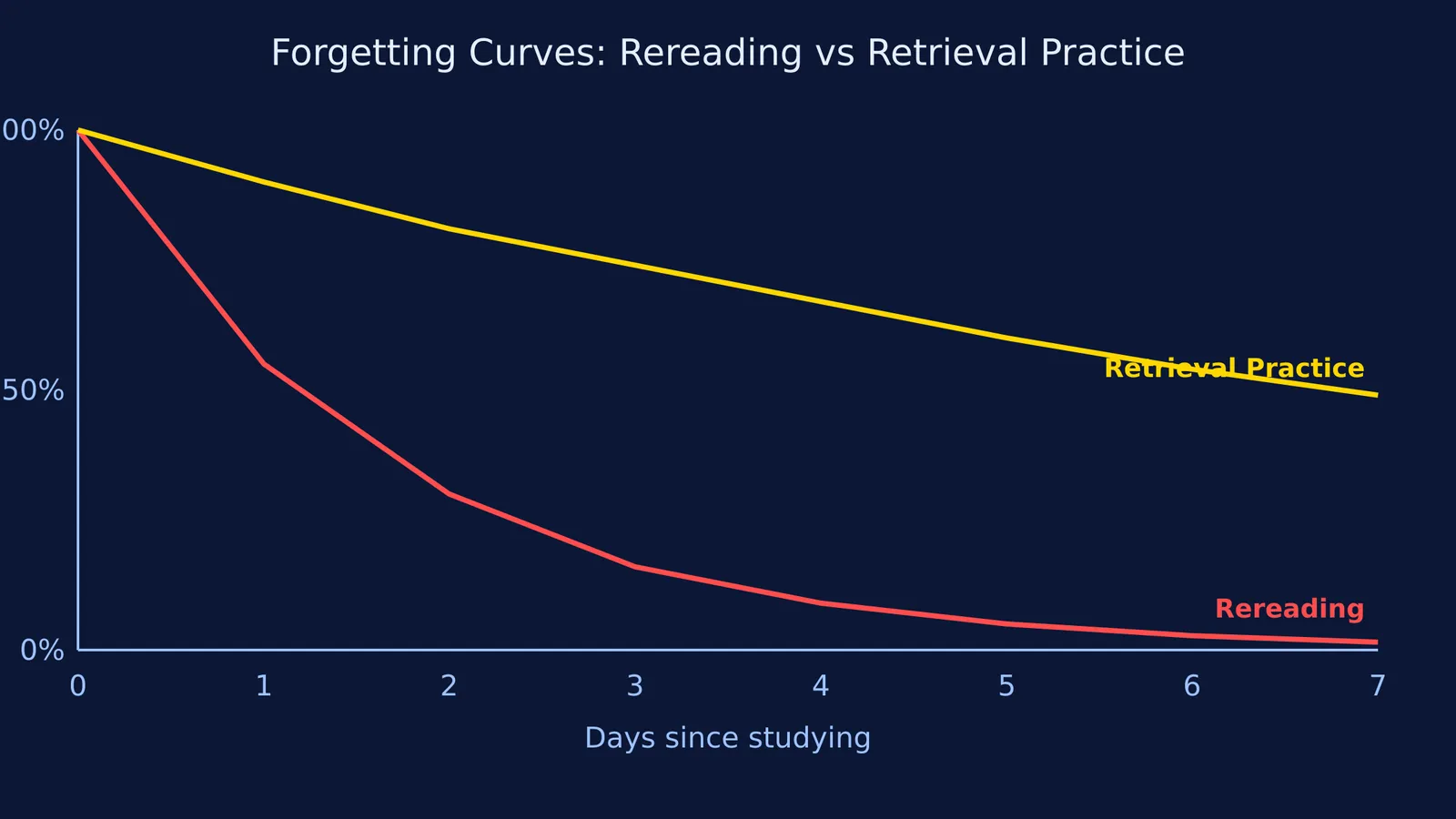
Passive review creates what cognitive scientists call the illusion of competence (or the illusion of fluency). When a child rereads a chapter, the text feels familiar. The brain processes the information easily, and the student mistakes this ease for mastery.
At home, with notes open and no time pressure, they are relying on recognition. In the exam hall, they must rely on retrieval — pulling a fact from memory without cues. If they have only practised recognition, the neural pathways for retrieval remain weak, and the answer will not come when they need it most.
Why does test anxiety cause a blank mind?
Even when a student has genuinely learned the material, stress can block access to it. High-stakes exams trigger the body's stress response, releasing cortisol. This hormone impairs the prefrontal cortex, the part of the brain responsible for working memory and recalling complex information.
This is why a child might suddenly remember the answer the moment they walk out of the exam hall and the stress subsides. To combat this, study habits must build memories that are robust enough to withstand a cortisol spike. Endel Tulving's work on memory long ago established that the way a memory is stored directly affects how easily it can be retrieved.
How to build stress-resistant memory with retrieval practice?
If rereading creates a fragile illusion of competence, the antidote is retrieval practice. This means putting the books away and forcing the brain to recall the information from scratch.
It feels much harder than highlighting, which is why students often avoid it. Yet, the struggle of recalling a fact is exactly what wires it permanently into the brain (as noted in the 2013 Dunlosky learning techniques review).
Retrieval practice does more than just improve memory; it directly reduces stress. In a 2014 study of 1,408 middle and high school students, researchers found that 72% of students reported that regular, low-stakes retrieval practice made them feel less nervous for tests (Source).
When a student is used to retrieving information under mild pressure at home, doing it in the exam hall no longer triggers a panic response.
What parents can do to help
If your child is caught in this cycle, you can help them shift their habits using a few practical steps:
Swap reading for brain dumps: Instead of rereading a chapter, ask them to take a blank sheet of paper and write down everything they can remember about the topic in five minutes. Afterwards, they can open the book to see what they missed.
Use practice tests without the safety net: When solving problems, they should not look at the textbook or previous examples. If they get stuck with a wrong method, the Fermi Problem Library has worked problems with a step-by-step solver that explains the reasoning rather than printing an answer.
Recreate exam conditions at home: Practise under timed conditions at a clear desk, without music or snacks. This desensitises the student to the strict environment of the actual exam.
Encourage a calm pre-exam routine: Rushing and last-minute cramming outside the exam hall spikes cortisol. Arriving with time to spare and avoiding classmates who are panic-revising can keep working memory clear.
The goal is to make the act of remembering so familiar that it happens automatically, even when the pressure is on. By testing themselves before the exam does, students can leave the illusion of competence behind and walk into the hall knowing exactly what they are capable of.


