

On this page
It can be baffling when a young child understands that putting two blocks with three blocks makes five, but then writes 3 − 2 = 5 on a worksheet. It is common for a child to confuse addition and subtraction signs. When this happens, they are usually struggling to translate abstract symbols into real quantities, rather than showing a lack of mathematical ability.
Why does my child confuse addition and subtraction?
When a child learns arithmetic, they must map the physical world onto symbols. To a six-year-old, a plus sign (+) and a minus sign (−) are just abstract crossbars. They may understand the concepts of "more" and "less" perfectly well, but under the pressure of a worksheet, their working memory becomes overloaded and they simply guess the operation.
Furthermore, young children do not picture numbers the way adults do. Research by Siegler and Booth on children's numerical estimation shows that a linear mental number line only develops between the ages of six and eight [[1]](https://doi.org/10.1111/j.1467-8624.2004.00684.x). Before this developmental shift, children view numbers logarithmically, bunching large numbers together in their minds. This makes it incredibly difficult to mentally "jump forward" for addition or "jump backward" for subtraction.
Is it dyscalculia?
When a child struggles persistently, parents sometimes worry about a deeper learning issue. Dyscalculia is a specific learning disorder characterized by persistent difficulty in understanding, learning, and performing mathematical calculations and arithmetic, affecting approximately 3% to 6% of the population [[2]](https://en.wikipedia.org/wiki/Dyscalculia).
However, early confusion between a plus and minus sign is far more likely to be a normal developmental hurdle than dyscalculia. Children with dyscalculia often present with broader difficulties, such as an inability to intuitively know which of two numbers is larger, or an inability to instantly recognize the number of objects in a small group without counting them one by one (a skill called subitizing). In contrast, if a child can easily tell you that five cookies are more than three cookies, their simple sign confusion on a worksheet is usually just an issue of working memory and symbol recognition, not a lifelong condition.
How do you explain addition and subtraction to a child?
When a child confuses addition and subtraction, the most effective intervention is to step back from the abstract symbols and return to the concrete. You must rebuild the bridge between the physical action and the written sign.
Here is a simple three-step plan to guide your child through basic operations:
Colour-code the worksheet. Before they solve a single problem, hand them a green and a red highlighter. Ask them to highlight every plus sign in green ("go/add") and every minus sign in red ("stop/take away"). This simple visual cue removes the cognitive load of reading the abstract black-and-white sign while they are also trying to hold numbers and counting strategies in their working memory.
Count concrete objects. Return to physical manipulatives like wooden blocks, dried beans, or coins. If the problem is 4 + 3, have them place four beans on the table, point to the green plus sign out loud, and physically bring three more beans into the pile. Physically adding or removing items proves to the child that the abstract symbol dictates a real-world action.
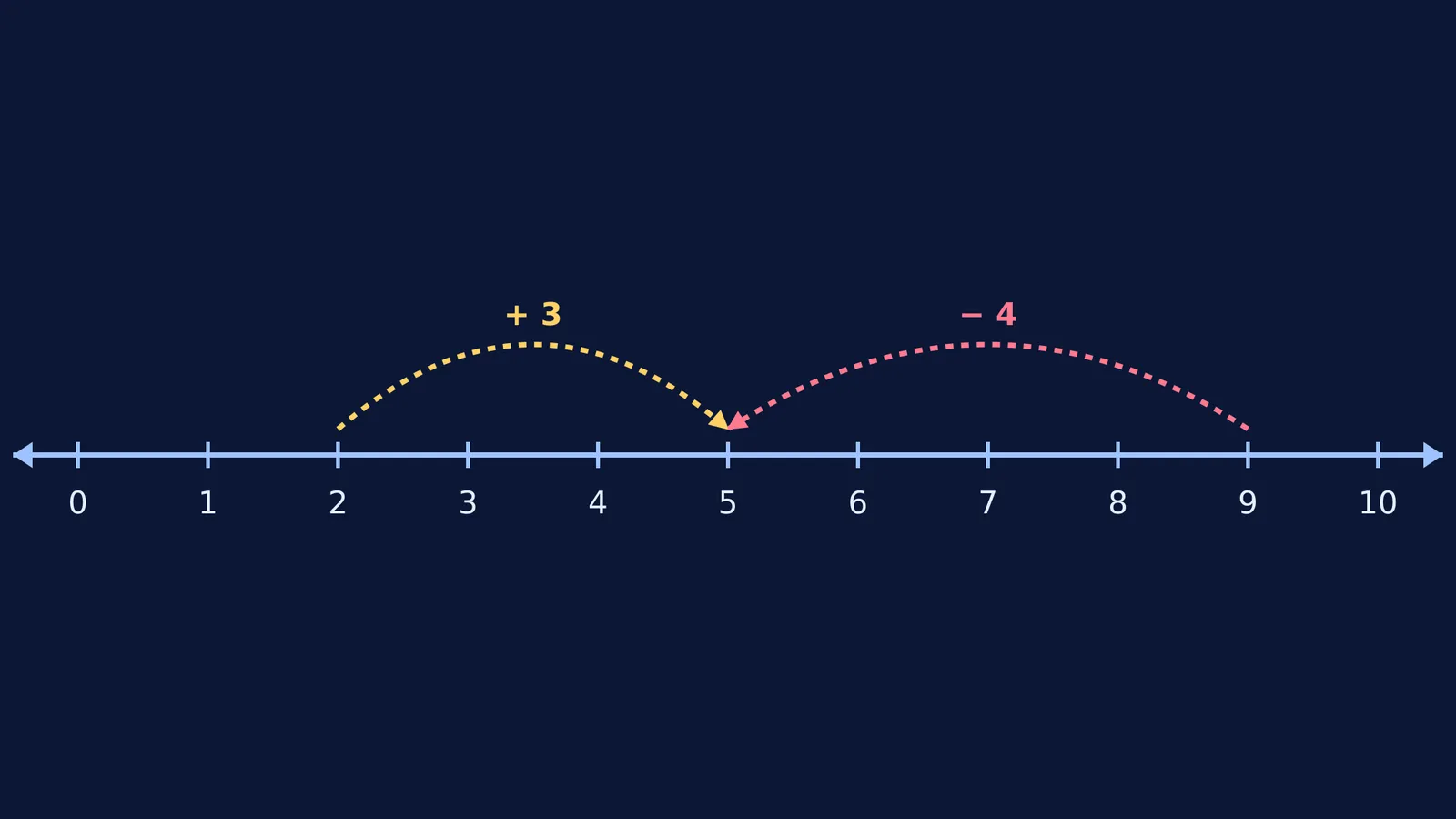
Walk the physical number line. Draw a large, evenly spaced number line from 0 to 10 on a piece of paper. Explain that the number line is a map. For addition, place a finger on the starting number and physically hop it to the right, counting the spaces (not the tick marks). For subtraction, hop the finger to the left. Moving their hand reinforces the directional difference between the two operations and builds the linear mental map that their developing brain needs.
What if conceptual gaps persist into later years?
If a student never builds a strong mental model for addition and subtraction, they often struggle when introducing negative numbers or algebra in later years. For a high school student tackling advanced maths where these foundational gaps start to show, Fermi's AI tutor can work out what you already know and build a plan for the session, so you sit down to a clear next step. If they are stuck on a specific procedure, the Fermi Problem Library has worked problems with a step-by-step solver that explains the reasoning rather than printing an answer.


