

On this page
Why does your child think their tuition teacher teaches better?
When your child comes home and announces that their tuition teacher explains physics or maths far better than their school teacher, they are describing a real sensation. In a private tutoring session or small batch, the teacher speaks directly to their misunderstandings, stops whenever their eyebrows furrow, and paces every explanation to their working memory.
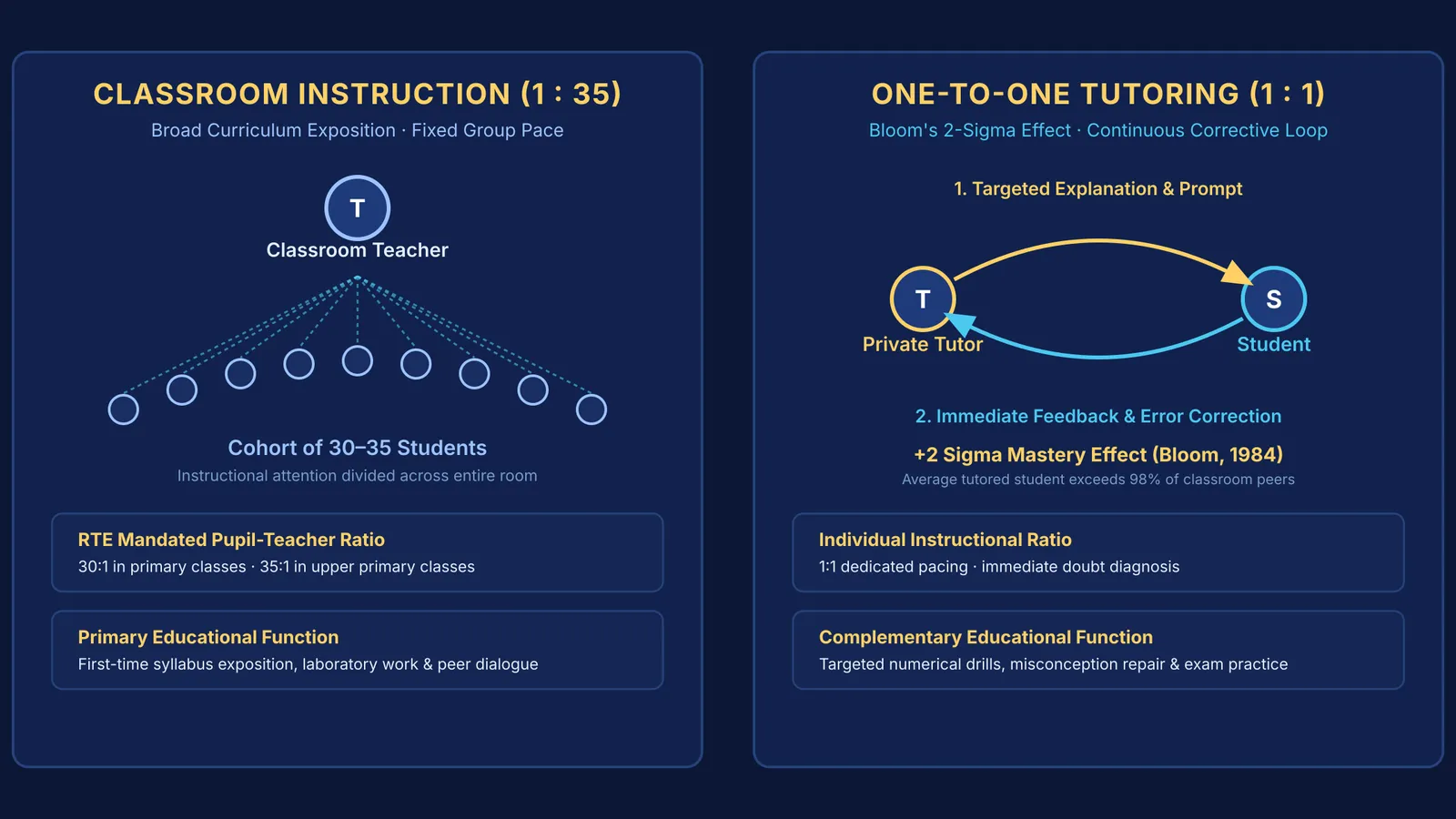
That cognitive difference is well documented in educational science. In his landmark 1984 study, educational psychologist Benjamin Bloom demonstrated that students receiving one-to-one tutoring combined with regular corrective feedback scored two standard deviations (2 sigma) higher than students taught in conventional group classrooms (Bloom, 1984). A 2-sigma shift means the average tutored student scored above roughly 98% of students in a standard classroom setting. As we explore in our analysis of Bloom's 2 sigma problem, personal tutoring eliminates the delays between confusion and correction.
There is also an optical illusion at play: the cognitive contrast effect. When a child learns a new topic in school, their brain is doing the heavy cognitive work of building a first mental model from scratch. By the evening, when the tuition teacher revisits that same chapter, the student's brain already recognises the terminology and formulas. The tuition teacher gets credit for clarity, but the school teacher did the invisible heavy lifting of introducing the concept for the first time.
How does classroom teaching differ structurally from private tutoring?
Comparing a school teacher to a tuition teacher treats two entirely different educational roles as though they were competing for the same prize. Their constraints, mandates, and instructional goals are completely distinct.
Under India's Right of Children to Free and Compulsory Education (RTE) Act, elementary schools operate with mandated pupil-teacher ratios of 30:1 for primary classes and 35:1 for upper primary classes (Ministry of Education), while secondary classrooms frequently seat 40 or more students together. A classroom teacher cannot stop the entire room of 35 students every time one individual stumbles on an algebraic sign change. They must balance curricular timelines, direct laboratory experiments, manage classroom behaviour, and build collaborative peer discussion.
In contrast, private supplementary tutoring—what UNESCO researcher Mark Bray terms "shadow education"—operates outside these civic mandates (Bray, 2009). A private tutor does not conduct school examinations, manage institutional assemblies, or deliver the full breadth of a civic curriculum. Instead, they focus narrowly on exam technique, numerical drills, and immediate doubt clearance. According to the Annual Status of Education Report (ASER) 2022, 30.5% of Indian elementary students take paid private tuition (ASER Centre), highlighting how widespread supplemental coaching has become to bridge individual learning needs.
Why does criticising the school teacher hurt your child's learning?
When parents validate a child's complaint by saying, "Yes, your school teachers do not care," they inadvertently destroy the student's motivation for five to six hours of their daily routine. If a teenager believes school is useless, they stop taking notes, tune out classroom discussions, and arrive at tuition tired and unprepared.
The academic consequences of this classroom detachment are real. In a longitudinal study published in *Comparative Education Review*, researchers found that students who participated consistently in shadow education exhibited 0.114 standard deviations greater behavioral disengagement in regular classrooms, showing increased daytime fatigue, inattention, and sleeping during lessons (Byun et al., 2026). When a child dismisses their school teacher, they abandon active listening during primary instruction, forcing their evening tutor to double their workload.
What should you say when your child makes the comparison?
Responding effectively requires validating your child's emotional experience without diminishing their school teacher. Here is a three-step conversation script to reset the frame:
Acknowledge the comfort of personal attention: "It feels so much easier when a teacher sits right next to you, watches your pen, and answers your exact question immediately, doesn't it?"
Reframe the structural roles: "Your school teacher has to introduce a brand-new concept to 35 students at once and keep everyone moving forward. Your tuition teacher is working with you on material you have already seen earlier today."
Shift from complaining to active inquiry: "Instead of tuning out in school, let us write down the exact step or formula where you get stuck during class. That way, you have a precise question ready for your tutor or our evening review."
If your child consistently struggles with a specific school subject, do not let frustration turn into resentment. Review our guide on parent-teacher meeting questions to approach your child's school teacher collaboratively about classroom engagement and focus areas.
How can you coordinate school and supplemental study effectively?
To prevent school and coaching from working against each other, families need a deliberate strategy that aligns both resources:
Protect energy with structured schedules: Attending school followed by several hours of coaching creates cognitive overload. Establish a predictable routine using weekly time blocking for school and coaching so that revision does not cut into essential sleep.
Assign distinct jobs to each setting: Use school for first-time syllabus exposition, peer problem-solving, and practical science demonstrations. Use tutoring sessions strictly for targeted practice and clarifying residual doubts.
Bridge independent study with on-demand tools: When a student hits an impasse late in the evening and neither teacher is available, the Fermi Problem Library provides worked problems with a step-by-step solver that explains the reasoning rather than printing an answer.
Rebuild foundational concepts: If a student missed an earlier mathematical prerequisite that makes classroom lectures confusing, Fermi's AI tutor can work out what they already know and build a plan for the session, noticing where they are stuck and deciding whether to explain, ask, or show.
By helping your child respect their school teacher's broad mandate while using supplemental coaching surgically, you turn a potential conflict into a balanced learning system.


