

On this page
Receiving a phone call from school reporting that your child was caught copying, carrying notes, or checking a smuggled phone during an exam is every parent's dread. The immediate reaction is usually a storm of shock, anger, and embarrassment. Yet developmental psychologists emphasize that cheating in school is rarely proof of a broken moral compass. Instead, it is almost always a desperate coping mechanism triggered when academic panic collides with a fear of failure. In high school surveys published by Donald L. McCabe and colleagues in Ethics & Behavior, over 64% of secondary students admitted to serious test cheating, showing that dishonest shortcuts are a systemic symptom of high-stakes testing rather than isolated deviance.
What should you do in the first 24 hours?
How you react at home sets the tone for whether your child retreats into secrecy or engages in honest reflection. In a seminal review on moral emotions in the Annual Review of Psychology, psychologists June Price Tangney, Jeff Stuewig, and Debra J. Mashek showed that shaming an individual—labeling them as bad or defective—provokes denial, hostility, and concealment. Conversely, fostering guilt—evaluating the specific wrongful act rather than the child's identity—promotes constructive empathy and a desire to make amends.
When you sit down together, use a structured restorative conversation:
Regulate first: Wait until your initial anger cools so the conversation does not become a lecture.
Ask what happened: Say, "The school called about the test. Tell me what happened in the exam hall from your perspective," and listen without interrupting.
Find the breaking point: Ask, "At what point in your revision did you feel you could not do this paper honestly?"
Separate deed from identity: Clarify, "Copying was a serious violation of trust, but you are not a dishonest person. We will face the consequence and fix this together."
Processing an academic crisis calmly helps children treat setbacks as problems to solve; our guide on talking about failure at home outlines how parents can model this mindset.
Why do students cheat on exams?
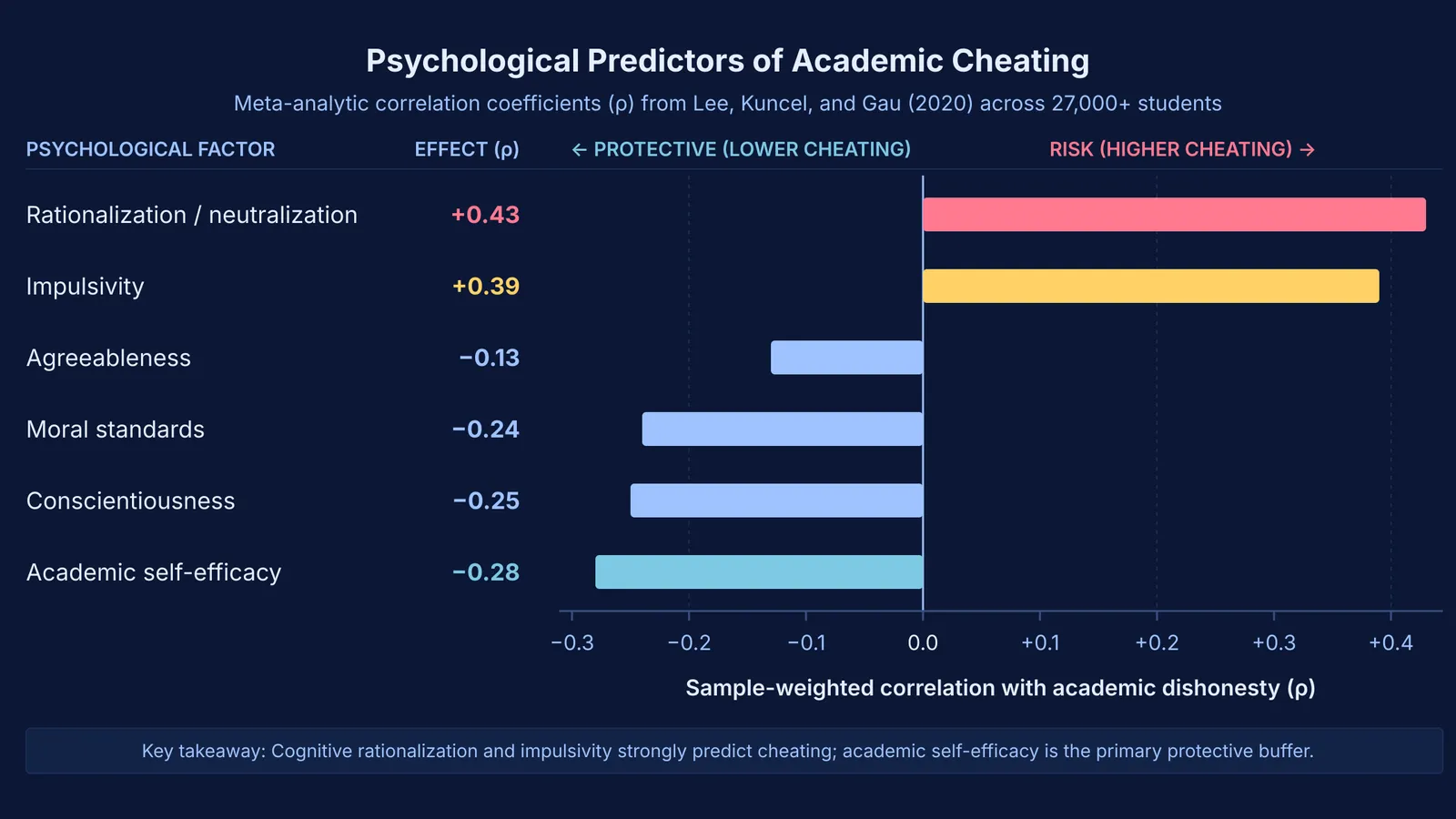
Cheating rarely happens because a teenager rejects honesty; it occurs when performance pressure overwhelms self-regulation. A meta-analysis of over 27,000 students across 75 samples by Samuel D. Lee, Nathan R. Kuncel, and Jacob Gau in Psychological Bulletin identified the strongest psychological correlates of academic dishonesty. They found that cognitive rationalization—what psychologists call neutralization, such as believing a test is unfair or that everyone cheats—is the single strongest predictor of cheating, with a correlation of ρ = 0.43. Impulsivity followed closely at ρ = 0.39.
Crucially, the meta-analysis found that academic self-efficacy is a powerful protective factor against cheating, with a negative correlation of ρ = −0.28. When students believe they can master the syllabus, cheating drops sharply. Educational psychologists Tamera B. Murdock and Eric M. Anderman in Educational Psychologist showed that environments fixated on performance goals—such as peer rank and marks—induce far more dishonesty than environments emphasizing mastery goals and conceptual learning. Understanding the distinction between high parental expectations versus pressure is vital to preventing panic from driving misconduct.
How do you rebuild trust and academic integrity?
Restoring integrity requires concrete restitution and practical changes in preparation:
Respect school sanctions: Support the school's disciplinary decision. If the teacher awards a zero or requires a retake, accept it without arguing for exemptions. Encourage your teenager to submit a written apology acknowledging the breach of trust and expressing willingness to earn credibility back.
Diagnose the learning gaps: Investigate where revision broke down. Did your child freeze on physics numericals, struggle with organic mechanisms, or fall behind due to procrastination? When preparing for future tests, the Fermi Problem Library provides worked problems with a step-by-step solver that explains the reasoning rather than printing an answer, helping students build genuine mastery without panic.
Shift focus away from marks: Focus routine conversations on weekly study habits rather than exam scores; our guide on helping children learn without adding pressure explains how to keep daily routines focused on mastery and curiosity rather than panic.
What if the cheating happened in a board exam?
If an unfair means (UFM) incident occurs during a formal examination such as CBSE Class 10 or Class 12, strict statutory rules apply. Under Rule 36 of the CBSE Examination Bye-Laws, offenses are categorized by severity. Category 1 offenses, such as possessing unauthorized notes during a paper, result in cancellation of that specific exam, though candidates are generally permitted to reappear during supplementary exams. In contrast, Category 3 offenses, such as bringing mobile phones or smartwatches into the hall, carry cancellation of all exams for the year and debarment from the following year's examinations.
Under Rule 36.3, candidates have the procedural right to explain their conduct before the Result Committee. Parents should accompany their child calmly, state the facts truthfully, and treat the consequence as a bounded procedural outcome rather than a life-defining disaster. With steady parental support, an exam crisis can become the turning point where a teenager develops lasting accountability.


