

On this page
When a child says "I knew the answers, I just didn't finish", the problem is often how the minutes were spent, not slow handwriting. Pacing is a skill, and you can practise it at home with a clock, an old paper and about an hour a week.
Why does my child run out of time in exams?
Most unfinished papers come from one or more of these:
No plan at the start. CBSE introduced 15 minutes of reading time because students "start answering the questions in their answer books immediately, sometimes without adequate planning", and "a fear of paucity of time forces them to relentlessly engage themselves in writing the answers without sufficient reflection" (CBSE Circular 29/2005).
One question eats the clock. A child stuck on a 3-mark proof for 15 minutes has used the time meant for several short questions.
Answer length does not match the marks. A full page for a 2-mark question is an easy leak to miss.
Methods are known but slow to recall. In one study, students who practised recalling material remembered more a week later than students who re-read it, even though re-reading made them feel more confident (Roediger and Karpicke, 2006).
Worry takes up working memory. Ashcraft and Krause report that maths anxiety compromises working memory, and that preoccupation with maths fears works like a resource-demanding second task (Psychonomic Bulletin and Review, 2007).
If your child is slow at reading and writing in every subject, not just under pressure, ask the school about an assessment. A 2016 CBSE circular listed dyslexic candidates among those allowed a scribe or compensatory time in board exams (CBSE Circular Acad-06/2016); check the current rules with the school. See our guide to signs of dyslexia and dyscalculia.
How much time should each section of the paper get?
Use a minutes-per-mark budget. Take the CBSE Class 10 Mathematics Standard sample paper for 2025-26: 80 marks, 3 hours and 38 questions in five sections (CBSE sample question paper).
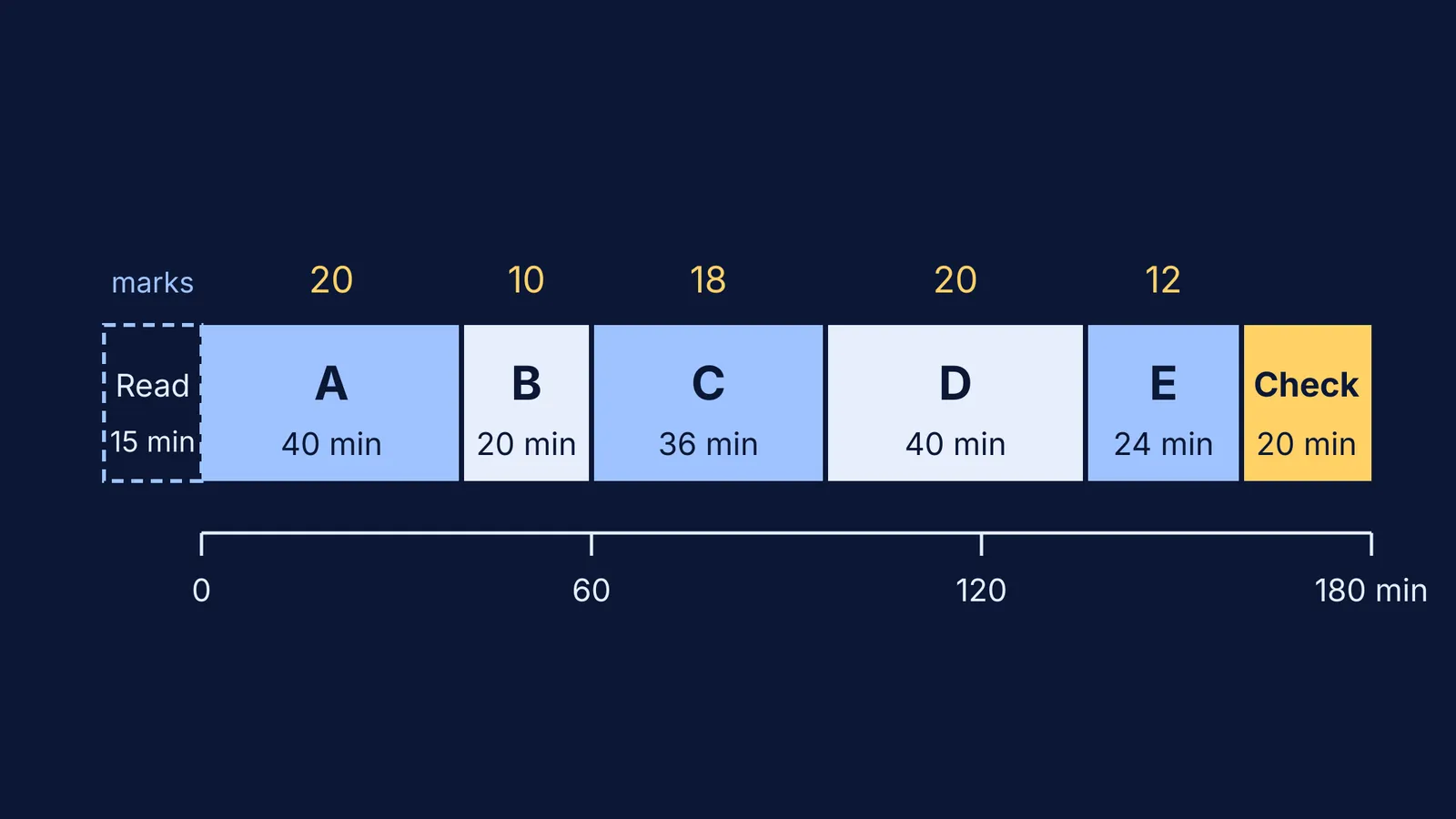
Three hours is 180 minutes, or 2.25 minutes per mark. Budget 2 minutes per mark instead, and your child keeps 20 minutes in hand:
Section A, 20 one-mark questions: 40 minutes
Section B, five 2-mark questions: 20 minutes
Section C, six 3-mark questions: 36 minutes
Section D, four 5-mark questions: 40 minutes
Section E, three 4-mark case studies: 24 minutes
Buffer: 20 minutes for skipped questions and checking
Turn this into clock times your child writes at the top of the rough sheet. If writing starts at 10:30, Section A should be done by 11:10, B by 11:30, C by 12:06, D by 12:46 and E by 13:10. Checkpoints warn them early, not in the last ten minutes.
Add one skip rule: if a question has taken one and a half times its budget, leave space, circle its number in the margin and move on.
How should my child choose between questions with internal choice?
The same sample paper offers internal choices in Sections B, C, D and E (CBSE sample question paper). Choice saves time only if it is decided once. Teach this rule for the reading time:
Read both options to the end.
Pick the one where you can already see the method or the last step, not the one that looks shorter.
Tick it on the question paper and do not look at the other again.
Drill it: five choice pairs from old papers, two minutes, and your child says the first step of each pick aloud. Speed comes from deciding, not from writing faster.
What does a four-week home practice plan look like?
Week 1, measure. One section, untimed. Your child notes the start and end time of each question, so you both see where the minutes go.
Week 2, timed sections. Two sessions, one section each, against the budget, with a kitchen timer. Mark only after time is up.
Week 3, sections plus choice. Two sections back to back, starting with ten minutes of reading in which your child plans the order, ticks choices and writes checkpoint times.
Week 4, full paper. One full paper at the real exam time of day, then a review of which questions overran and why. Our guide to analysing a mock test shows how to sort the losses.
If the review shows minutes lost to choosing the wrong method, the Fermi Problem Library has worked problems with a step-by-step solver that explains the reasoning rather than printing an answer. For tactics inside the hall, see time management in the exam.
When is it more than a timing problem?
If your child blanks out, cannot sleep before tests, or feels sick at the thought of exams, timing drills will not fix that on their own. Talk to their class teacher or school counsellor. India's Tele MANAS helpline, 14416, is toll-free and available 24x7 (Press Information Bureau).
Start this week with one section, one timer and a notebook of minutes.


