

On this page
Children are driven to build a map of how the world works. A 2017 survey led by child psychologist Dr. Sam Wass found that children ask an average of 73 questions a day. The questioning peaks at age four, with parents fielding queries for up to 14 hours a day. It is no surprise that 63% of parents admitted they struggle to answer many of their children's questions, often turning to search engines for help.
When a child asks "Where did the first person come from?" or "How was the Earth made?", the difficulty is not just that the science is complex. It is that these events happen on a scale of time and space a child cannot easily picture.
How do you explain the Big Bang to a child?
Children often picture the Big Bang as a firework exploding into an empty room. This implies there was a center to the explosion and an edge to the universe. The real science is closer to a balloon inflating: space itself is stretching everywhere at once.
The balloon analogy: Draw several dots on a deflated balloon with a marker. As you blow it up, tell your child to watch the dots move apart. Explain that the universe is not exploding into an empty space; the space between everything is stretching, just like the rubber. No matter which dot you look from, all the other dots are moving away.
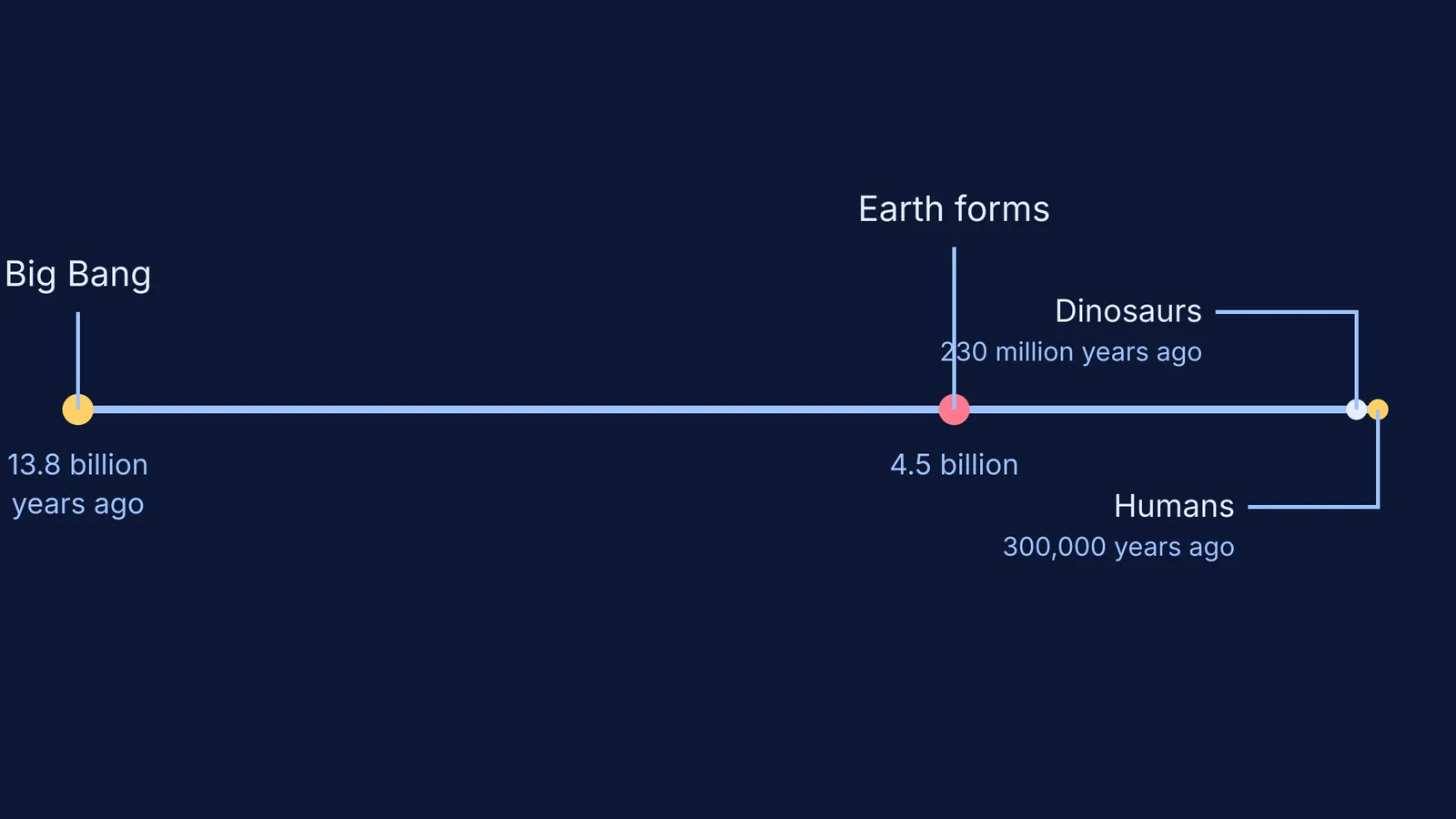
The Cosmic Calendar: The universe is 13.8 billion years old. Large numbers lose their meaning for adults, let alone a four-year-old. To make this visible, use astronomer Carl Sagan's Cosmic Calendar, which compresses all of time into a single calendar year. If the Big Bang happened at the stroke of midnight on January 1st, the Milky Way forms in May, and the Earth forms in September. Human ancestors do not appear until 10:30 p.m. on December 31st. Every person from history lived in the final ten seconds.
If you are looking for a visual way to explain physical ideas as they grow older, you can explore the Fermi Simulation Lab together, offering interactive simulations for ideas that are easier to see than read.
How do you explain evolution to a child?
Evolution is the story of how living things change to fit their homes over millions of years. It can be tempting to simplify by saying "we came from monkeys," but this creates confusion about why monkeys are still here. Instead, explain that humans and chimpanzees are like distant cousins. You do not come from your cousin, but you both share a great-great-grandparent from a long time ago.
The recipe typo: Explain DNA as an instruction recipe passed from parent to child. Sometimes there is a tiny "typo" in the recipe. If that typo gives an animal a helpful trait—like thicker fur for a bear living in the cold—it stays healthier and passes the new recipe to its babies. Over millions of years and thousands of typos, these tiny changes add up to entirely new animals.
Grandmother Fish: For younger children, Jonathan Tweet's book *Grandmother Fish* traces human ancestry back through apes, mammals, reptiles, and fish. It encourages children to wiggle like a fish, crawl like a reptile, and hoot like an ape, turning a complex timeline into a memorable game of physical action.
What should you say when you do not know the answer?
You do not need to be a science expert to field difficult questions. When you confidently say, "I don't know, let's find out together," you show your child that learning does not stop when you grow up. This models a growth mindset and is a highly effective way of encouraging curiosity at home.
You can look up the answer together, visit a natural history museum to look at real fossils, or note the question down to ask a science teacher. If your older child wants to go deeper into biology or physics but you are unsure of the specific facts, Fermi's AI tutor can guide them step-by-step through the concepts. The tutor teaches rather than answers: it holds a line of reasoning across a session, checks understanding as it goes, and ensures they grasp the basics before moving on. This gives them a clear, actionable next step while helping children learn without pressure.


