

On this page
The rapid rise of AI in education has left many parents wondering how to manage its use at home. According to a 2026 Pew Research Center study, 54% of US teens say they have used AI chatbots to help with schoolwork. With these tools now easily accessible on every smartphone and laptop, it is natural to worry that your child might be letting a machine do the thinking for them.
If you suspect your child is taking shortcuts, your first instinct might be to run their essay through an online AI detector. But that approach often causes more problems than it solves.
Why should you avoid AI text detectors?
AI detectors are marketed as a quick way to catch cheating, but they are surprisingly unreliable. They work by measuring "perplexity"—how predictable a piece of text is. If the words and sentences are common and straightforward, the detector assumes a machine wrote them, whereas human writing is assumed to have more varied vocabulary and unexpected phrasing.
This creates a serious bias. A 2023 study published in the journal *Patterns* found that seven popular AI detectors falsely flagged 61.3% of essays written by non-native English speakers as AI-generated (Liang et al., 2023). Because students who are still developing their vocabulary tend to write simpler, more structured sentences, detectors routinely penalise them. Relying on these tools can lead to false accusations that damage a student's confidence and trust. They provide a probabilistic guess, not definitive proof of academic misconduct.
How to know if your child's homework is AI-written?
Instead of using flawed software, you can look for changes in your child's writing process and the output itself. Here is what you should notice without needing a detector:
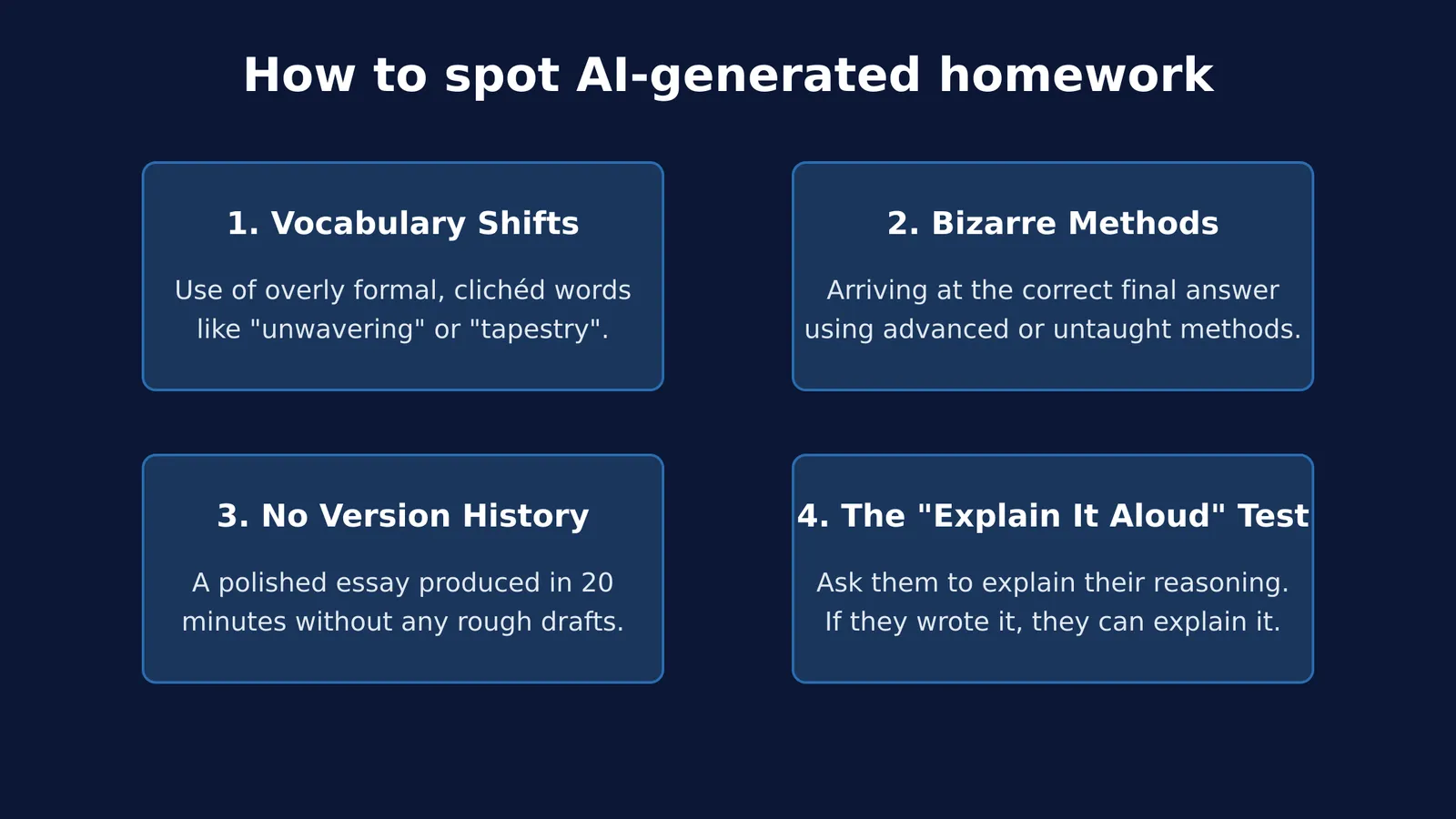
The sudden vocabulary shift: Does a 14-year-old suddenly use words like "unwavering", "tapestry", "testament", or "multifaceted"? AI models default to an overly formal, slightly clichéd tone that rarely sounds like a typical teenager's voice.
The "perfect but wrong" math problem: In mathematics or physics, an AI might arrive at the correct final answer but use a bizarre or highly advanced method that was never taught in class. Alternatively, it might make a glaring arithmetic error in the middle of a flawlessly formatted proof.
No drafts or history: Writing is inherently a messy process. If your child produces a polished 1,000-word essay in 20 minutes without any rough notes, outlines, or version history in their word processor, they likely copied it from a chatbot.
Lack of class context: AI does not know what happened in Tuesday's history lesson or the specific classroom debates you had. Its answers are general. If an essay completely misses the specific themes the teacher asked the class to focus on, it might be machine-generated.
What should you do if you suspect AI use?
If you think your child submitted AI-generated work, it is important to approach the situation calmly. Direct accusations often shut down communication and make children defensive. Instead, focus entirely on checking their understanding.
Ask them casual, open-ended questions about their assignment: "This is a really interesting point about the causes of the French Revolution—how did you decide to focus on that?" or "Can you show me how you got from step two to step three in this equation?" If they wrote it, they can explain the choices they made.
How should you talk about using AI for learning?
The goal is not to ban AI entirely from your home, but to teach your child how to use it as a learning aid rather than an answer key.
Set clear boundaries: Agree together that AI can be used for brainstorming ideas, explaining difficult concepts, or creating practice quizzes. However, it should not be used for writing the final text or solving the homework problems directly.
Focus on reasoning: Emphasise that the purpose of homework is about building brain connections, not just submitting a finished page. Copying an answer means missing out on the cognitive workout.
Use the right tools: Chatbots are designed to print answers immediately, but a dedicated AI tutor will guide the student step-by-step. For example, Fermi's AI tutor teaches by holding a line of reasoning, noticing where a student is stuck, and deciding whether to explain, ask, or show, rather than just doing the work for them.
If your child is struggling and taking shortcuts, they might be leaning on AI because they feel overwhelmed with the workload. You can read more about AI-writing detectors: why they misfire, and what students can do or explore a practical guide on Trying an AI tutor with your child: a 20-minute parent's guide to help them use technology productively.


