

On this page
When students enter Class 9, families often assume subject planning can wait until Class 10. In CBSE schools, however, Class 9 and 10 form a composite two-year curriculum. The subjects registered with the Central Board of Secondary Education in Class 9 are carried directly into the Class 10 board examinations. Understanding how core subjects, languages, mathematics levels, and skill electives interact helps parents support their teenagers with confidence.
What are the compulsory subjects in CBSE Class 9 and 10?
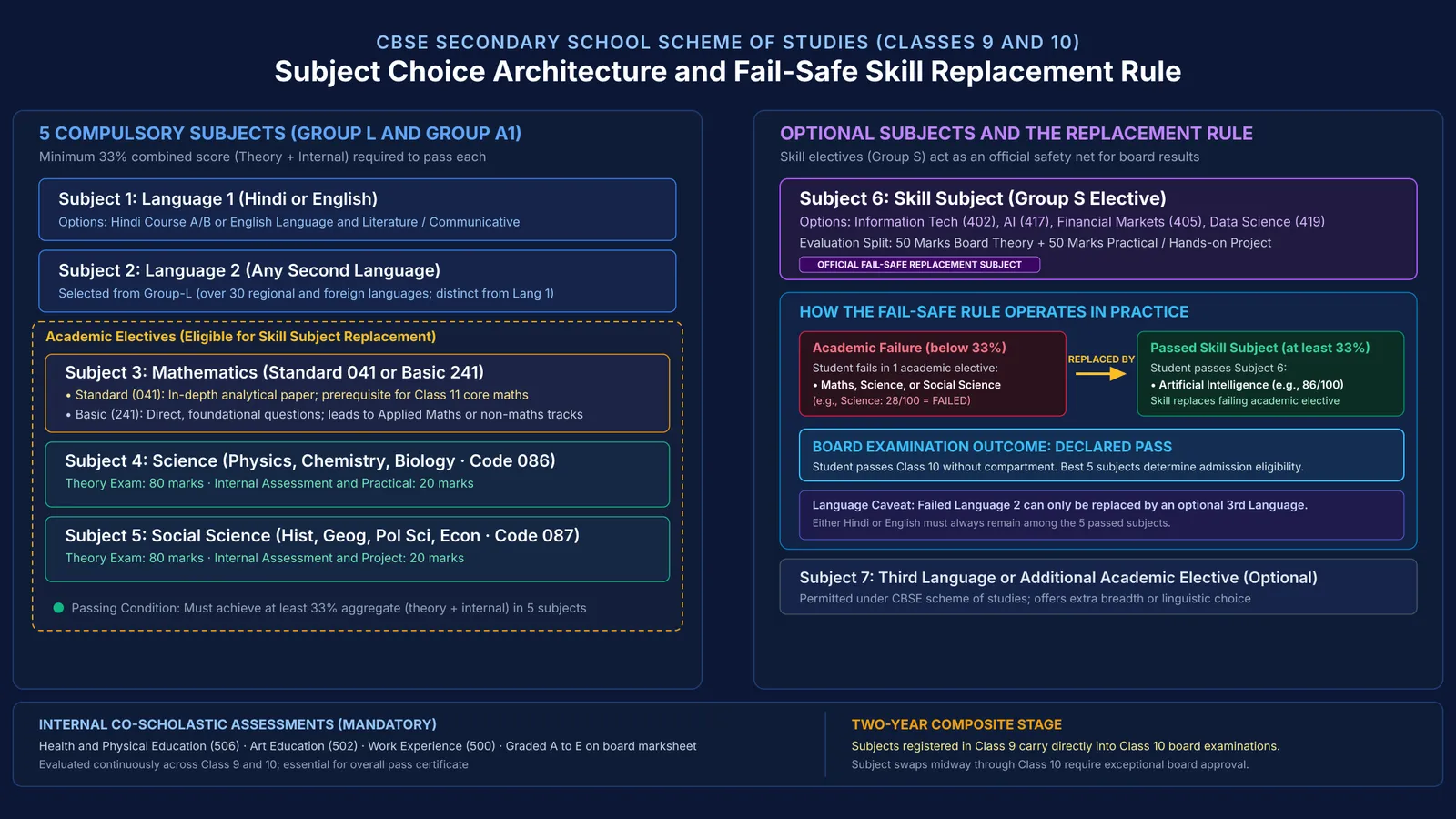
Under the official CBSE Secondary School Curriculum, every student must take five compulsory subjects:
Language 1: English (Language and Literature or Communicative) or Hindi (Course A or B).
Language 2: Any second language from the Group L list of over 30 languages, distinct from Language 1. At least one of the two languages must be English or Hindi.
Mathematics: Mathematics Standard (Code 041) or Mathematics Basic (Code 241).
Science: Integrated physics, chemistry, and biology.
Social Science: History, geography, political science, and economics.
Students must secure at least 33% marks in each subject (combining theory and internal assessment) to pass. Schools also conduct mandatory internal assessments in Health and Physical Education, Art Education, and Work Experience, graded from A to E on the final marksheet.
How does the sixth skill subject replacement rule work?
Under the CBSE Skill Education scheme, schools can offer an optional sixth subject from Group S, such as Information Technology (Code 402), Artificial Intelligence (Code 417), or Introduction to Financial Markets (Code 405).
A sixth skill subject introduces practical skills and provides an official academic safety net:
Main subject replacement: If a candidate fails in any one of the three compulsory academic subjects—Mathematics, Science, or Social Science—the failed subject is replaced by the passed skill subject to declare the student passed in the Class 10 board results.
Language replacement: A failed Language 2 can be replaced by a third language taken as Subject 6 or 7, provided Hindi or English remains among the passed five.
Result calculation: While CBSE itself does not declare an overall percentage or award divisions on the marksheet, senior secondary schools and admitting institutions commonly evaluate the best five subjects to calculate admission percentages.
For example, if a student scores 78 in English, 72 in Hindi, 70 in Social Science, 86 in Artificial Intelligence, but scores 28 in Science (below the 33% passing cutoff), Artificial Intelligence replaces Science to declare the student passed. However, if that student plans to study science in Class 11, senior secondary schools will still review their individual Science score.
Should your child choose Mathematics Standard or Mathematics Basic?
Under official CBSE examination guidelines, schools offer two mathematics options: Mathematics Standard (Code 041) and Mathematics Basic (Code 241). Both follow the identical syllabus and use the same textbooks in Class 9 and 10. The only difference is the Class 10 board examination question paper:
Mathematics Standard assesses conceptual depth, mathematical proofs, and multi-step applications. It is intended for students planning to take mathematics, engineering, or physical sciences in Class 11 and 12.
Mathematics Basic assesses direct, formula-based questions. It is designed for students moving into humanities, commerce without maths, or medical streams.
Choosing Mathematics Basic traditionally prevents enrolling in core Mathematics (041) in Class 11, though students can take Applied Mathematics. Even with recent notifications granting school heads discretion to evaluate student readiness, Mathematics Standard remains the safest choice for students undecided on future careers.
When students struggle with secondary-level maths, the challenge is usually conceptual jumps rather than lack of ability. When a child feels anxious about maths, methodical practice helps rebuild confidence. The Fermi Problem Library provides worked problems with a step-by-step solver that explains the reasoning rather than printing an answer. For mastering core science concepts, the Fermi Concept Library covers every concept in physics, chemistry, biology, mathematics and computing, each with its own lesson and its place in the map.
How should parents decide on optional subjects and languages?
Selecting subjects in Class 9 works best when parents and teenagers discuss options together:
Confirm school course availability: While CBSE lists dozens of skill subjects, schools only offer electives for which they have qualified teachers and lab infrastructure.
Balance practical coursework: Under the CBSE Skill Education curriculum, skill subjects assign 50 marks to practicals and projects. Check that your child can manage project deadlines alongside academic studies.
Keep future stream eligibility open: If your child is interested in engineering, economics, or computing, staying with Mathematics Standard keeps options open. Families planning ahead can read our guide on choosing a stream after Class 10.
Take advantage of safety buffers: With reforms like the CBSE Class 10 board exam system, a sixth skill subject reduces exam stress while broadening practical knowledge.
Involving your teenager in these decisions transforms subject selection from a stressful administrative deadline into a motivating first step toward high school learning.


