

On this page
Starting a small book club for children with your neighbours or friends is one of the best ways to turn reading from a solitary task into a social event. But a successful kids' book club is not just a scaled-down version of an adult one; it requires a bit more structure, more hands-on activities, and a focus on keeping the environment light and engaging.
Why is reading together good for children?
When children read and discuss books with their peers, they practice a form of collaborative learning known as peer reading or peer tutoring. This approach has measurable academic benefits.
The Education Endowment Foundation (EEF) found that peer tutoring, where children read or learn together, can add an average of six additional months of academic progress over a year.
Beyond reading fluency, book clubs help children develop social and emotional skills. Discussing a character's choices requires empathy and active listening. It also teaches them how to disagree respectfully and realise that other people can have entirely different interpretations of the same story. If you are already trying to establish a family quiet hour for reading at home, adding a social element can give reluctant readers the extra motivation they need.
How do you start a kids' book club?
The logistics of a children's book club should be kept simple. Here is a framework to get you started:
Define the group size and age: Keep the group small, ideally between four and eight children. This ensures everyone gets a chance to speak without the conversation becoming chaotic. Try to group children of a similar age and reading ability. If reading levels vary, select books that are accessible to the youngest or least confident reader in the group.
Set a schedule: Meeting every four to six weeks gives children enough time to finish the book without feeling rushed. A meeting length of 60 to 90 minutes is usually the sweet spot for maintaining focus.
Rotate the venue: Take turns hosting the club at different parents' homes. For a change of pace, you might occasionally meet at a local park or library.
Let the children choose: Give the kids a sense of ownership by offering a shortlist of three to five books and letting them vote on what to read next. Alternate between fiction, non-fiction and graphic novels to keep things interesting.
What types of books work best for a children's book club?
Choosing the right book is just as important as the activities you plan. While letting the children vote is crucial, parents can help by curating a diverse shortlist that appeals to different tastes.
First books in a series: Starting with the first book of a popular series is a great way to hook readers. If they enjoy it, they might continue reading the rest of the series independently.
Graphic novels: Do not dismiss graphic novels. They are excellent for building reading confidence, and their visual nature often prompts rich discussions about the artwork and how it adds to the story.
Biographies and non-fiction: Real-world stories about historical figures, scientists, or explorers can inspire hands-on experiments or field trips.
Books with a movie adaptation: Sometimes, knowing there is a movie night planned as a reward after finishing the book is the perfect incentive for a reluctant reader.
When selecting books, remember that the goal is shared enjoyment. A book that is slightly below a child's reading level but highly engaging is always a better choice than a difficult book that feels like a chore.
What should a meeting look like?
Children do not want to attend a book club that feels like an exam. If they think they are going to be grilled on plot points, they will lose interest quickly.
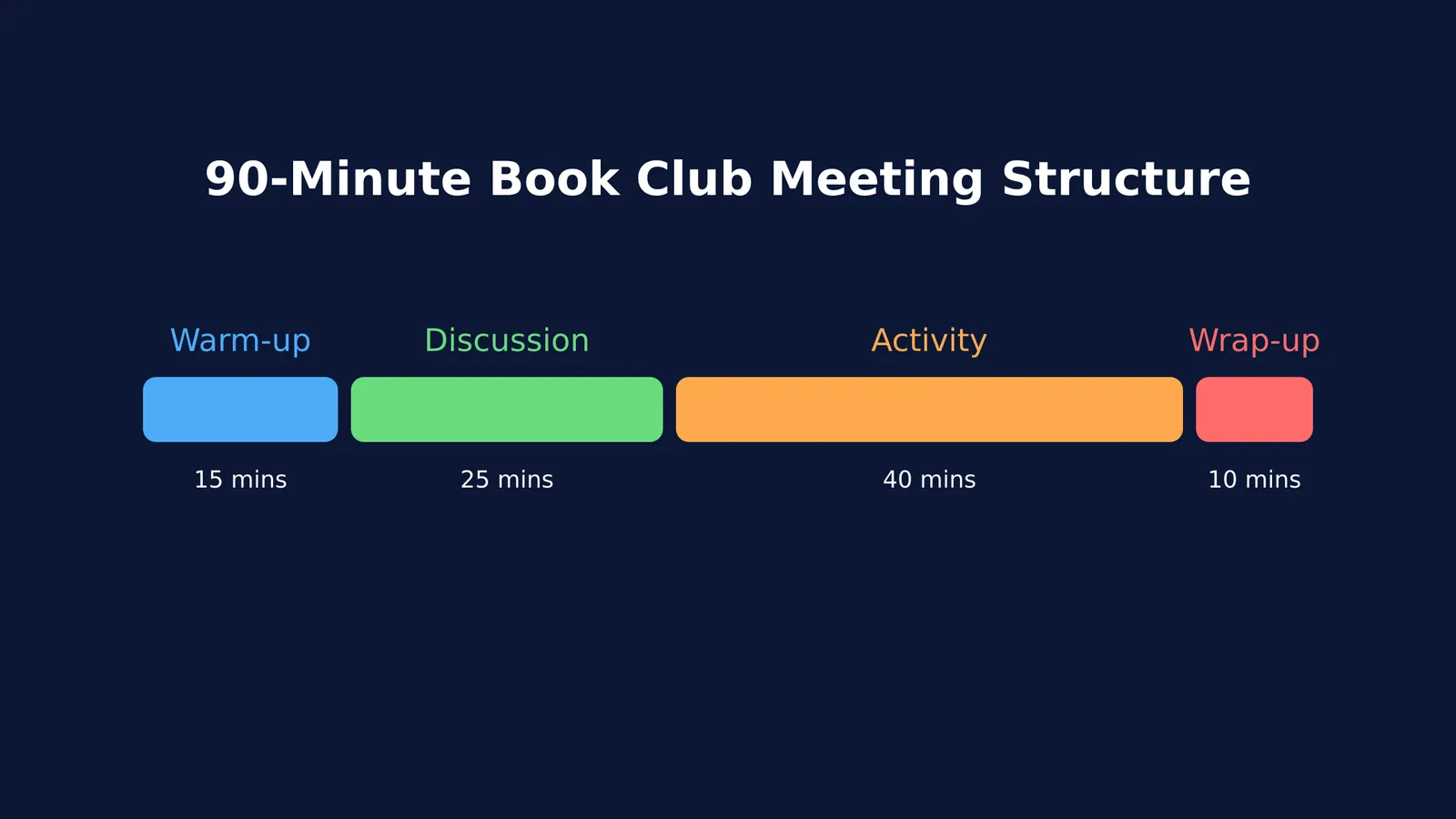
A successful meeting usually follows this structure:
The warm-up (10–15 minutes): Start with snacks and casual conversation to let the children settle in. Themed snacks (such as blue food for Percy Jackson or honeydukes sweets for Harry Potter) can make the meeting feel special.
The discussion (20–30 minutes): Lead the conversation with open-ended questions. Instead of asking "What happened in chapter three?", ask "Which character would you most want to be friends with and why?" or "What surprised you the most about the ending?".
The activity (30–40 minutes): Connect the book to a hands-on project. If you are reading a mystery, set up a small scavenger hunt. If the book is about space, build simple rockets out of cardboard. If a book sparks a deeper curiosity about a science topic, you can explore it in the Fermi Concept Library, which has every concept in physics, chemistry, biology, mathematics and computing, each with its own lesson and its place in the map.
The wrap-up (10 minutes): Vote on the next book and confirm the date of the next meeting.
How do you keep children motivated to read?
The social aspect of a book club is often enough to keep children motivated. Just as older students benefit from study groups that work, younger children thrive when they have a shared goal with their friends.
To keep the momentum going, involve the parents. Make the book club a collaborative effort where different parents take turns leading the discussion or organising the activity. The goal is to create a scrappy, fun environment where reading is celebrated, not tested.


