

On this page
Many students face a frustrating paradox in Class 12: they score highly in competitive JEE Main mock exams, yet their marks drop in school pre-boards. If your child is solving complex physics numericals rapidly but losing marks on the same topics in a subjective school exam, the problem is rarely a lack of understanding.
The gap usually comes down to how different exam formats test the brain, and how board evaluation rubrics reward the working process rather than just the final number.
Why do students score well in JEE mocks but fail boards?
A multiple-choice test provides the answer right on the page, hidden among incorrect options. When a student reads the options, their brain uses recognition. A 1999 study in Educational Psychologist found that multiple-choice questions primarily test this lower-load recognition, while constructed-response questions (like those in board exams) require the heavier cognitive load of active recall.
In a JEE mock test, the given options act as cognitive scaffolds. A student might calculate halfway, see only one option that matches the rough magnitude of their partial result, and mark it correctly without finishing the arithmetic. Following a disciplined review method like how to analyse a mock test: a 60-minute review routine helps spot whether unearned marks came from lucky guesses or shortcuts. In a board exam, the blank page offers no such hints. The student must generate the entire logical path from memory and carry the calculation through to the final decimal point. This switch from recognition to recall exposes gaps in the student's ability to structure an argument.
How do board exams award marks differently?
Competitive exams reward speed and correct final answers. Board exams reward the method. A student trained heavily for entrance exams naturally learns to skip steps, use mental shortcuts, and write down only the final result to save time.
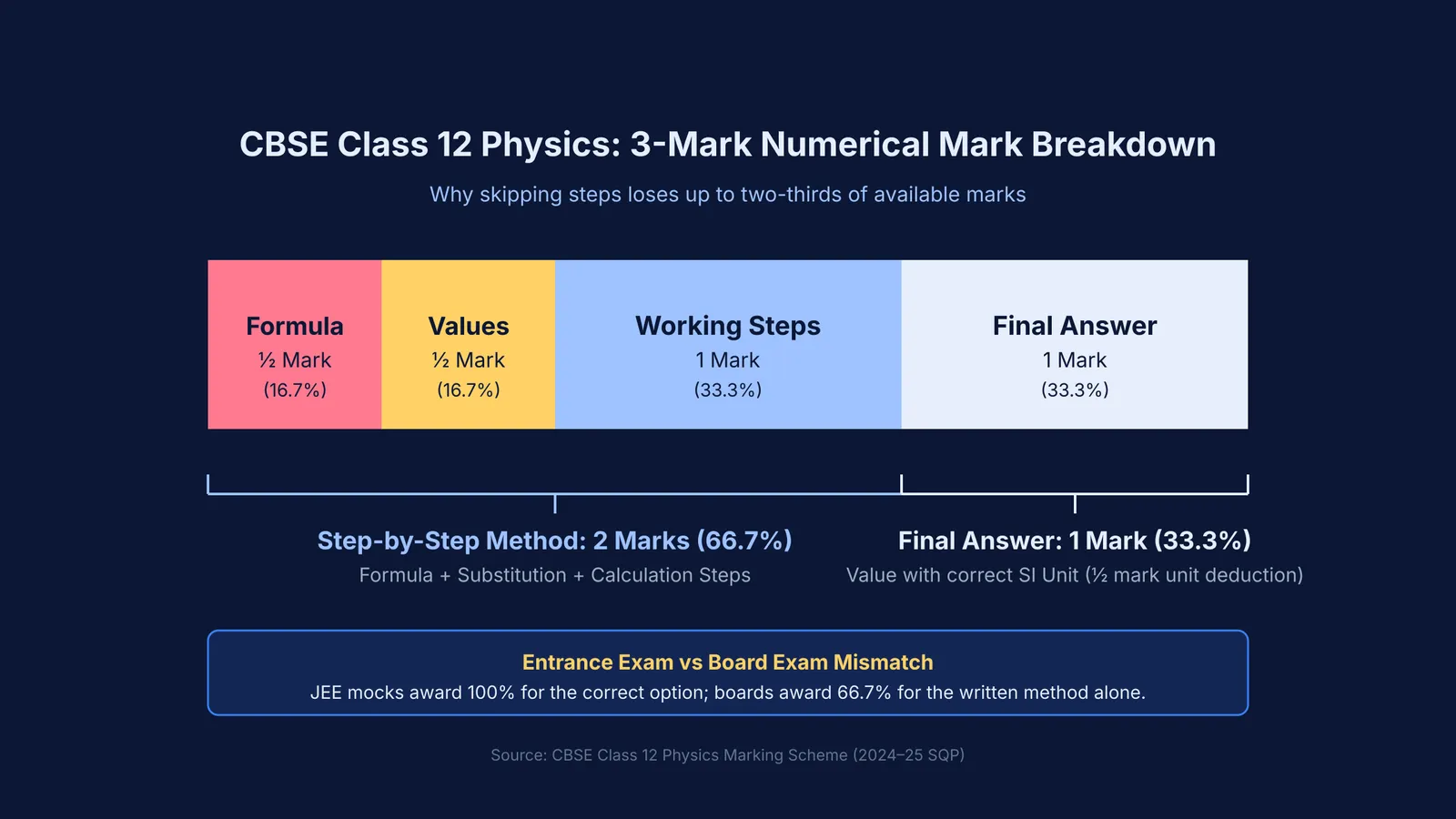
This approach is heavily penalised in subjective exams. For example, the official CBSE Class 12 physics marking scheme for a typical 3-mark numerical allocates the marks strictly by step. A student receives ½ mark for writing the formula and ½ mark for substituting the correct values. The logical working steps carry 1 mark, and the final answer carries only 1 mark (with a ½ mark deduction if the SI unit is missing or incorrect).
If a student writes down a perfectly correct final answer without showing the intermediate steps, they receive only 1 out of 3 marks. They lose two-thirds (roughly 66%) of the credit despite knowing the physics perfectly. To an examiner, a skipped step looks like a guessed or copied answer.
How can you plan for both entrance exams and boards?
You can help your child translate their competitive strength into board exam success without doubling their workload. For families navigating Class 12, understanding how parents can help children learn without adding pressure is crucial to avoid burnout. Research exploring high expectations vs pressure: what research separates shows that children perform best when parental support focuses on structure rather than anxiety over marks.
Write it out once a week: Your child does not need to write full steps for every practice problem. For most of the week, they can stick to their fast, entrance-exam methods to build speed. However, set aside one block of time—perhaps Sunday morning—for purely subjective practice. Ask them to solve a set of problems as if they were writing a final board exam, explicitly stating every formula, substitution, and unit.
Focus on the reasoning: When a student makes a wrong-method mistake during their weekend practice, they need to trace the logic rather than just checking the answer key. This is where the Fermi Problem Library helps. It offers worked problems with a step-by-step solver that explains the reasoning rather than printing an answer, showing exactly how a structured solution should look on paper.
Build a structured plan: If your child is overwhelmed by the dual pressure of boards and entrance prep and does not know where to start, Fermi's AI tutor can guide them. A student brings a topic, a course, or a problem set; Fermi works out what they already know, builds a plan for the session, and teaches through it—writing on a board, drawing the figure, and checking understanding as it goes.
By understanding that board exams test the communication of a concept as much as the concept itself, you can help your child secure the marks their hard work deserves.


