

On this page
Under Rule 33.3 of the CBSE Examination Bye-Laws, the Central Board of Secondary Education allots candidates to an external school for Class 10 and Class 12 board examinations. Seeing an unfamiliar school on an admit card can feel disorienting, but external centre allocation is standard national practice to safeguard impartial invigilation. When families understand the administrative rules, the strict reporting deadlines, and the cognitive benefits of an advance visit, what feels like an intimidating hurdle becomes a predictable routine.
Why is your board exam centre allotted at a different school?
Indian education boards maintain strict separation between where students study and where they write terminal examinations. Under Rule 33.3 of the CBSE Examination Bye-Laws, schools cannot host board exams for their own candidates except in rare single-school areas. The board strictly prohibits mutual interchange—School A sending candidates to School B while School B sends candidates to School A—to eliminate informal reciprocity. External superintendents manage seating plans and preserve question paper security, ensuring every student is assessed under identical, neutral conditions. If your teenager feels anxious about unfamiliar territory, discussing supporting a child through exam stress helps separate administrative logistics from academic capabilities.
What does cognitive science say about unfamiliar exam halls?
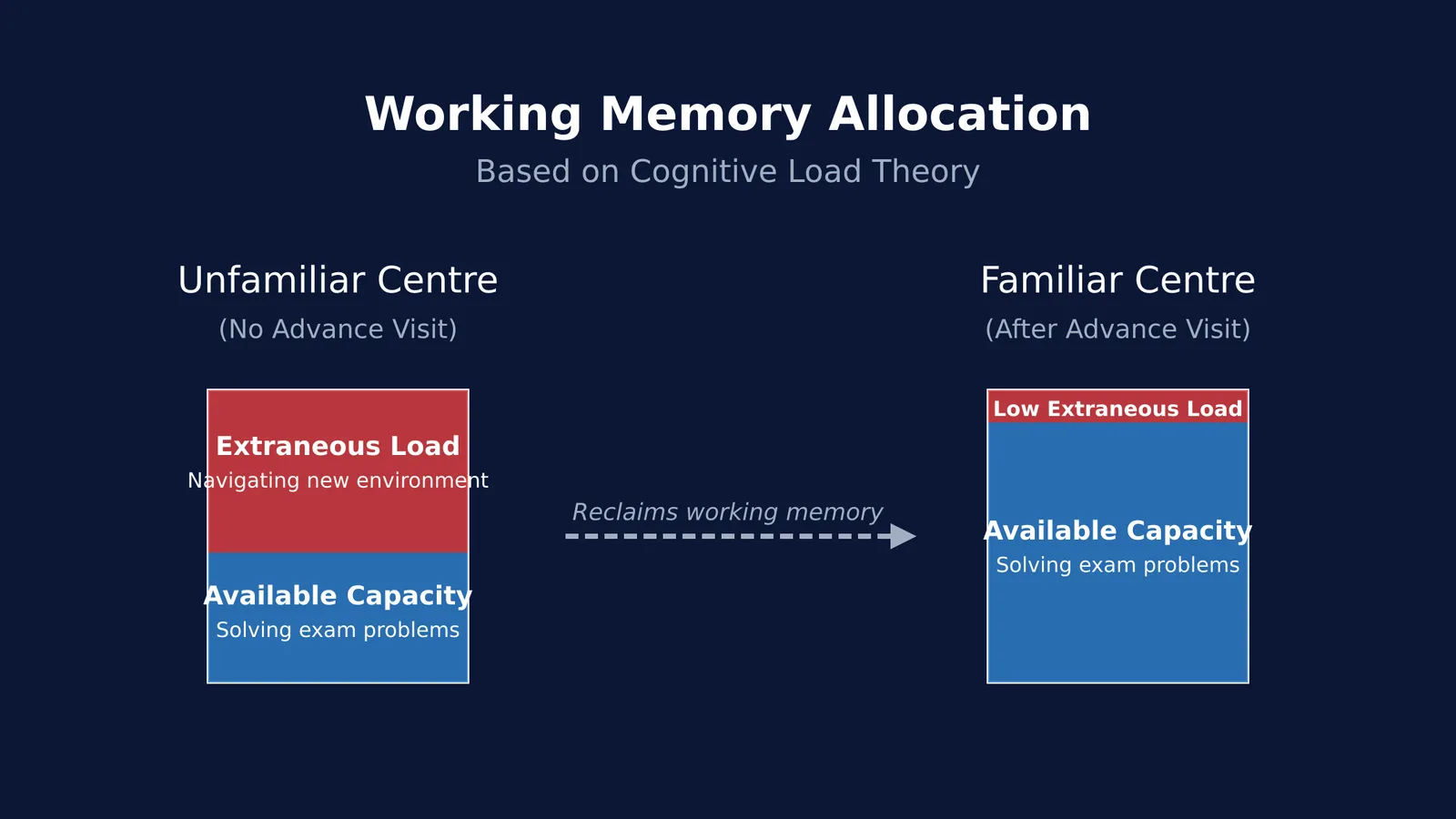
The unease students experience in a new school reflects measurable cognitive demands. Cognitive load theory, synthesised by Sweller, van Merriënboer, and Paas (1998), shows that working memory has finite capacity. In an unfamiliar campus, a student's brain tracks irrelevant stimuli: deciphering wing signage, finding staircases, and adjusting to strange room acoustics. This friction generates extraneous cognitive load, consuming working memory bandwidth needed for solving exam problems.
Memory retrieval also links to physical surroundings. A meta-analysis by Smith and Vela (2001) in *Psychonomic Bulletin & Review* showed that shifting to an unfamiliar exam venue impairs recall, but prior exposure or mental reinstatement—briefly visualising the original study room—neutralises this deficit.
When environmental novelty combines with morning rushing, performance drops further. Research by Ramirez and Beilock (2011) in *Science* demonstrated that acute test worries deplete working memory, while a brief writing exercise protects test scores. Learning cognitive reappraisal of exam anxiety frames a racing heart as biological readiness. When evening revision feels chaotic, Fermi's AI tutor works out what the student knows and builds a plan for the session, replacing last-minute panic with structured, step-by-step review.
What should you check during the advance centre visit?
Official circulars on the CBSE official portal urge students and parents to visit their allotted centre at least one day before the first exam, as digital map estimates miss morning bottlenecks and diversions.
A physical dry run turns unfamiliar grounds into known terrain. Use this five-step protocol:
Verify the active gate: Confirm with security staff which specific perimeter gate admits candidates at 09:00 AM.
Find the notice board: Seating charts are posted near the main entrance; locate this board so your child heads straight to it.
Locate essential facilities: Map out student washrooms and water points on the ground floor to prevent morning searching.
Fix the drop-off zone: School gates congest after 09:15 AM; choose a nearby drop-off point a short walk away to avoid gridlock.
Agree on a pickup point: Fix an exact meeting spot for dismissal when exams finish at 01:30 PM.
How should families plan travel time and reporting on exam morning?
Exam morning timing leaves no margin for error. As mandated on the CBSE official portal, gates shut permanently at 10:00 AM. Question papers are distributed at 10:15 AM for a mandatory 15-minute reading period, and writing commences at 10:30 AM. Candidates arriving after 10:00 AM are barred from entry.
Follow this structured morning timeline:
07:30 AM (Breakfast): Have a light meal; avoid frantic last-minute formula cramming.
08:15 AM (Pouch check): Confirm the admit card has student, parent, and principal signatures, packed with school ID and pens in a transparent pouch.
08:30 AM (Departure): Depart with an ample contingency margin over standard transit time to absorb traffic delays.
09:15 AM to 09:30 AM (Arrival): Reach the centre unhurriedly, clear security frisking, and locate the examination room without rushing.
10:00 AM (Gates lock): All candidates are in their seats as gates close.
10:15 AM (Reading time): The 15-minute reading window begins, allowing students to plan their time before writing starts at 10:30 AM.
Parents who teach children structured planning skills build lifelong logistical confidence. When students want to calmly review key definitions before exam day, the Fermi Concept Library covers every concept in physics, chemistry, biology, mathematics and computing, each with its own lesson. If exam stress feels overwhelming, families can contact the national Tele-MANAS helpline at 14416 for free, confidential support.


