

On this page
When you sit down with a JEE or NEET mechanics problem, the hardest part is often the first step. You read the question, draw the diagram, and then face a choice: which method should you use? A block sliding down a track or a pendulum swinging on a cart can usually be solved with Newton's laws (forces and acceleration) or with the Work-Energy theorem (speeds and distances).
Picking the wrong path will not necessarily lead to the wrong answer, but it can turn a two-minute shortcut into a fifteen-minute maze of vector components, substitutions and calculus. In an exam where time is your most limited resource, knowing how to choose is a hallmark of expert problem-solving. But how do you train yourself to make the right choice instantly?
Why does the method matter?
The difference between a student who struggles with physics and one who solves problems intuitively comes down to how they look at the world. In a classic 1981 study, novices categorized physics problems by surface features like "pulleys", while experts grouped them by underlying principles such as conservation of energy (Chi, Feltovich, and Glaser).
Novices looked at the literal objects drawn on the page. They would put all the inclined plane problems into one pile and all the spring problems into another. The experts ignored the objects and looked at the deep structure. They recognised that a block compressing a spring and a roller coaster doing a loop are mathematically identical if you use the right energy principle.
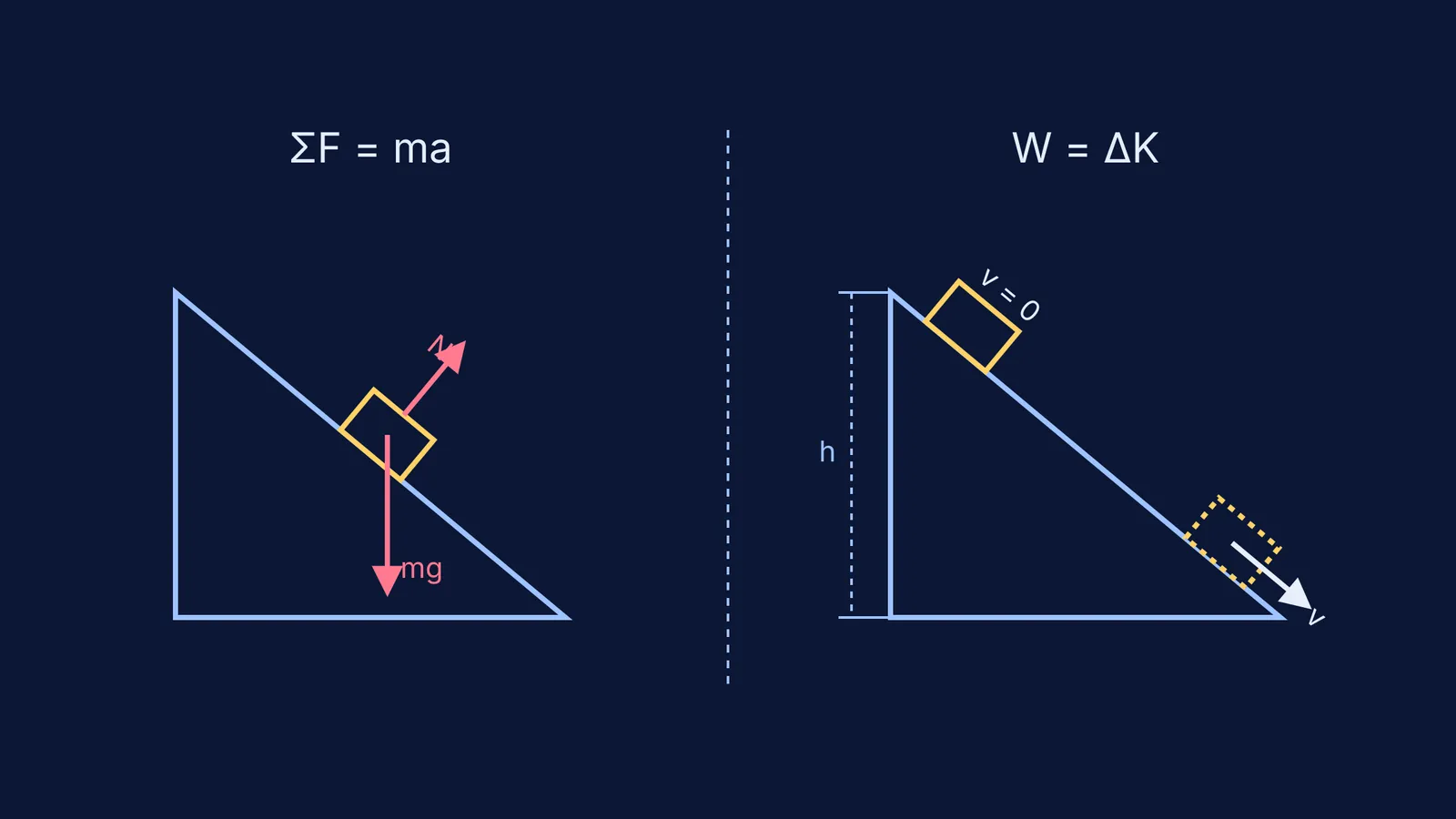
When you look at the deep structure first, you know which equations to write down immediately. Newton's laws (ΣF = ma) are vector equations, meaning you have to resolve forces into horizontal and vertical components. You have to worry about angles and negative signs. The Work-Energy theorem (W = ΔK) uses scalars, letting you simply add up the energies without worrying about which way the vectors are pointing.
When should I use the Work-Energy theorem?
The fastest way to decide is to look at the variables the question gives you and the variables it asks for.
Energy methods are usually faster when the forces are not constant. If a block slides along a curved track or has a variable acceleration, the force changes at every point. Using Newton's laws here would require setting up a difficult integral. The Work-Energy theorem bypasses the complex path entirely by only looking at the start and end points of the motion. If a problem asks you to find speed at a certain distance, energy is almost always the safest and shortest route.
However, energy equations do not contain a variable for time. If a question asks how long it takes for a block to slide down a rough incline, you cannot use energy alone. You must use Newton's laws to find the acceleration, and then use kinematics to find the time.
How do you ask your AI tutor for help?
When practicing at home, it is tempting to paste a hard question into a chat window and let it print out the answer. But reading a finished solution does not teach you how to choose the method yourself. Instead, use an AI tutor to choose Work-Energy or Newton's laws before you even begin the maths.
You can use this script with your AI tutor to force it to teach you the strategy:
"I am working on this mechanics problem: [Insert problem text or image]."
"Do not solve it yet. First, tell me if it is better to use Newton's laws or the Work-Energy theorem and why."
"Then, guide me through solving it both ways so I can compare which was shorter and safer."
By running both methods side by side on the same problem, you prove to yourself that physics is consistent. You will quickly see how many lines of algebra the energy method saves when vectors are involved.
If you are using Fermi, the tutor teaches rather than answers. It works out what you know and builds a plan for the session, holding a line of reasoning while checking your understanding as it goes. For complex systems where you want to see exactly how the vectors break down, the Fermi Problem Library has worked problems with a step-by-step solver that explains the reasoning rather than printing an answer.
Training yourself to choose the method before writing any equations moves you away from the novice habit of hunting for a formula. By asking the right questions, you learn to see the deep structure of the physics.


