

On this page
You paste a tough physics problem into an AI, hoping for clarity. Instead, it spits out a wall of algebra and jargon that leaves you more confused than when you started. It is tempting to close the tab or assume the topic is just too hard. But the problem usually isn't you, and it isn't the AI—it is the prompt.
AI explanation not making sense: what to do?
A 2024 study by Sawalha, Taj and Shoufan published in Cogent Education analyzed how students interact with AI tools. They found that 47% of students use a "single copy-and-paste" method, simply dropping a question into the chat without modification. This passive approach resulted in the lowest response accuracy. Meanwhile, the 40% of students who used "multiple-question prompting"—engaging in a back-and-forth dialogue to clarify the answer—performed measurably better on their final exams.
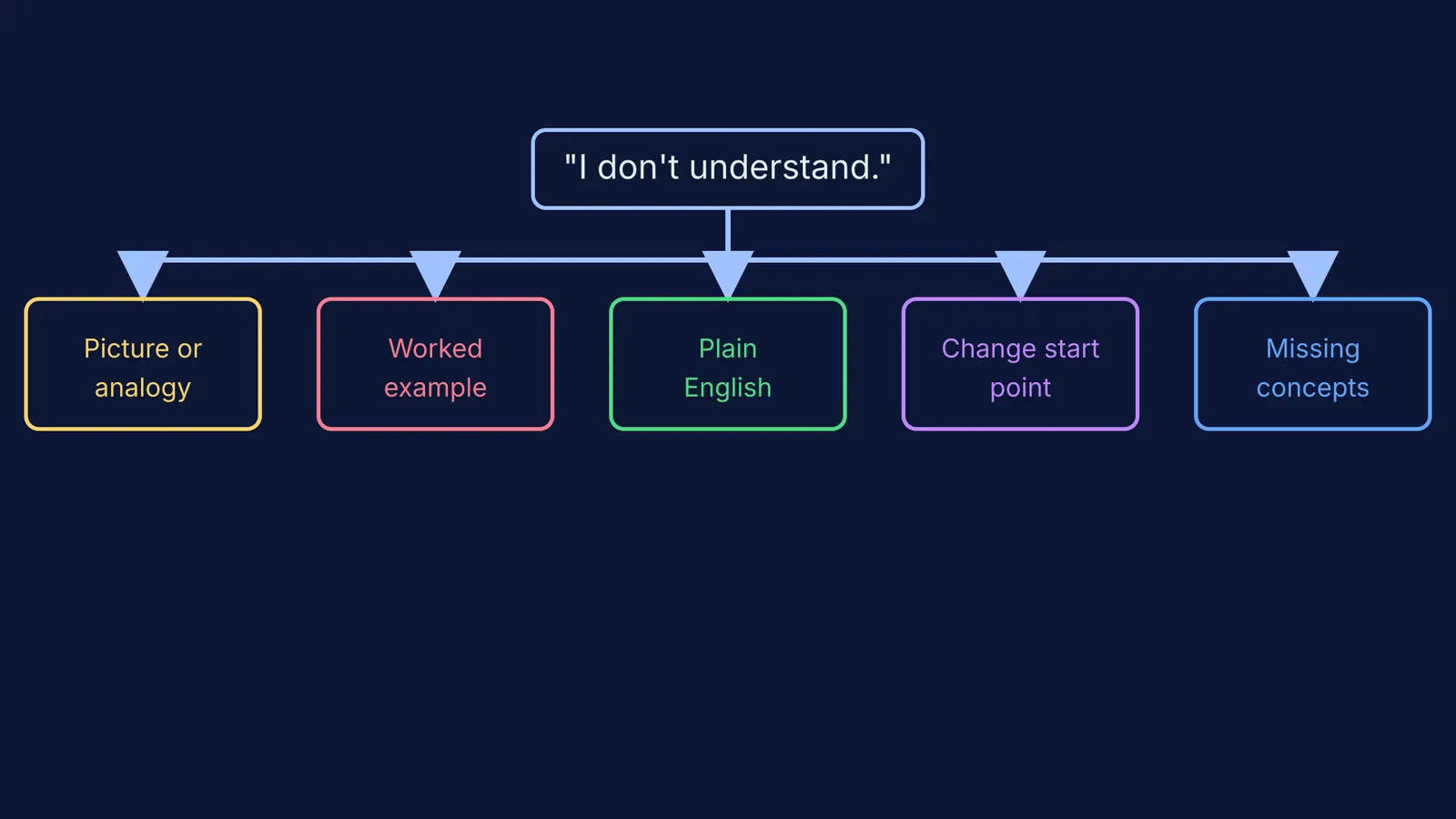
If the AI's first attempt does not make sense, do not just ask it to "explain again" or re-paste the identical problem. You need to actively direct the model. Here are five specific ways to pivot the conversation and get an explanation that actually clicks.
How do I ask for a picture or analogy?
When abstract concepts like electric flux, molecular orbitals, or chemical bonding feel impenetrable in text, force the AI to change its medium. Text-heavy explanations of physical phenomena often fail because they lack spatial context.
What to say: "I cannot picture this. Describe a real-world analogy, or explain what a diagram of this would look like."
If you are using Fermi's AI tutor, it teaches through the session by drawing the figure or running the simulation for the ideas that are easier to see than to read. For other text-based tools, asking for a physical analogy bridges the gap between raw equations and human intuition, giving your brain a familiar anchor.
How do I ask an AI for a better example?
AI often defaults to general rules and abstract definitions. If an explanation of Newton's laws, probability distributions, or the chain rule is too theoretical, bring it down to earth. Reading the formula for variance is very different from seeing it applied to a set of five test scores.
What to say: "Give me a simple, worked example using real numbers and take me through it step by step."
What if the AI uses too much math jargon?
Sometimes, an explanation is mathematically correct but pedagogically useless because it introduces five new variables at once. You can set constraints on the AI's vocabulary to ensure it speaks at your current level of understanding.
What to say: "Explain this again, but use plain English instead of mathematical symbols. Do not use words like 'derivative' or 'coefficient' until I understand the core idea."
If you rely entirely on the AI's initial output without filtering out the jargon, you might end up memorising symbols rather than understanding them. This superficial learning is often a primary reason Why AI chatbots get maths wrong, and a five-step way to check is necessary to verify the logic.
How do I change the starting point?
If the AI assumes you know how to balance a complex chemical equation when you are still struggling with basic moles, its explanation will never land. You need to reset the baseline so the explanation begins where your actual knowledge ends.
What to say: "You are starting too far ahead. I am comfortable with [Topic A], but I lose you at [Topic B]. Start the explanation from there."
This is why effective tutoring involves more than just answering questions. A good system works out what you already know and builds a plan for the session, so you sit down to a clear next step.
What am I expected to already know?
Sometimes you simply do not know what you are missing. If an AI explanation seems like an impossible leap of logic, you might be missing a foundational piece of knowledge that the AI silently assumes you possess. This phenomenon directly ties into the concept of Knowing what you know: why students misjudge their own learning.
What to say: "What concepts am I expected to already know to understand this explanation? List them briefly."
If the AI lists "vectors" and "trigonometry," and you have not studied them yet, you now know exactly what you need to look up before returning to the original problem. It gives you a roadmap instead of a roadblock.
Build the habit of active prompting
Treat an AI explanation as a starting point, not the final word. By actively steering the conversation—asking for examples, simplifying the language, or identifying your knowledge gaps—you turn a confusing output into a highly productive study session. The next time an explanation does not click, use one of these five prompts to try again.


