

On this page
If you pour a cup of sand into a cup of marbles, you do not get two cups of mixture. The sand simply falls into the empty spaces between the marbles. In physical chemistry, a similar thing happens when you mix different liquids, leading to a surprising result for a basic maths problem: 50 + 50 ≠ 100.
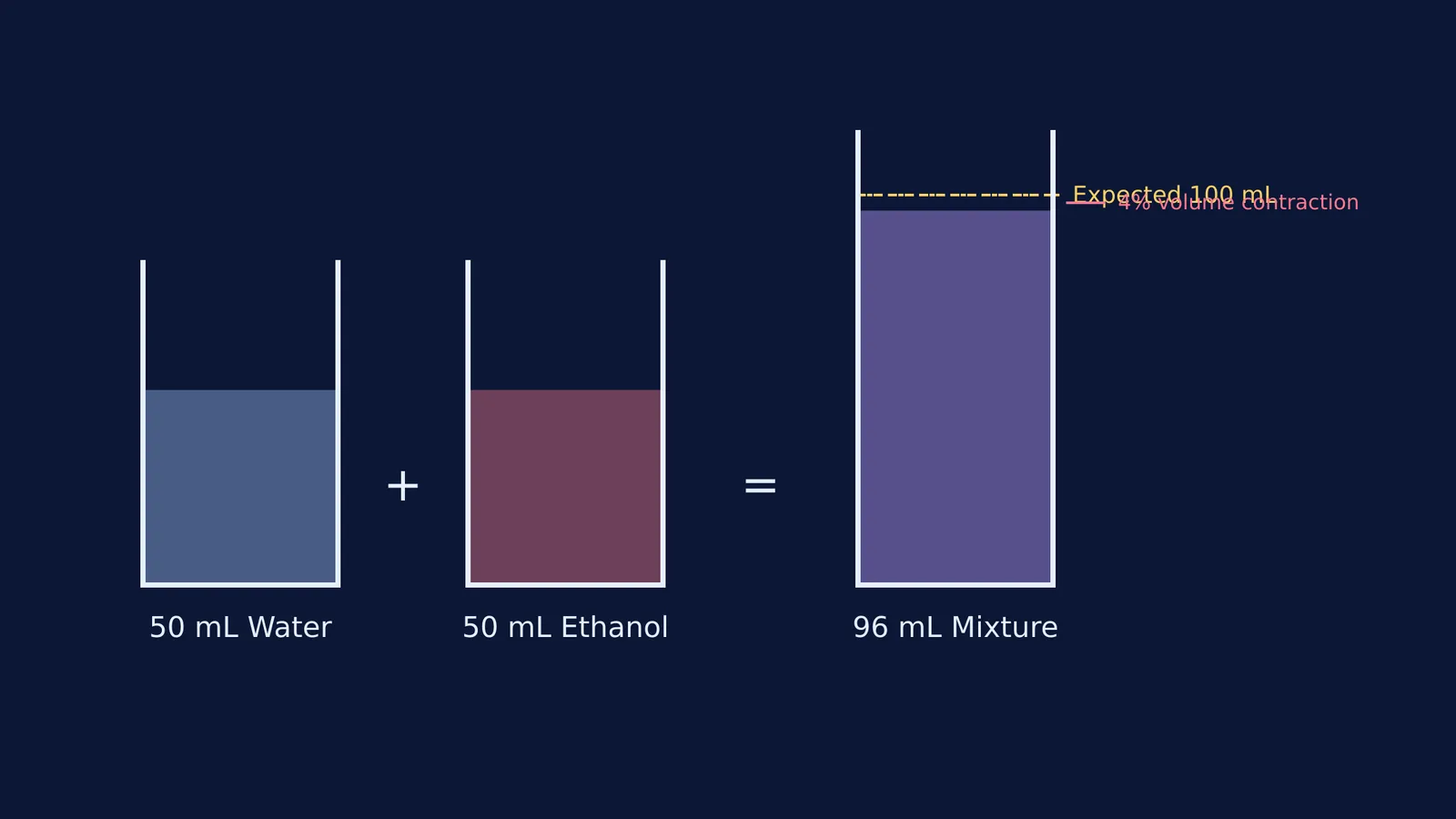
When you mix 50 mL of pure water and 50 mL of pure ethanol, the final volume is only about 96 mL.
This missing 4% is a classic example of non-ideal solution behaviour. It is a frequent concept tested in JEE and NEET chemistry, designed to catch students who assume volumes can simply be added together without considering molecular interactions.
Why do 50 mL water and 50 mL alcohol make less than 100 mL?
The total volume shrinks because of a phenomenon known as volume contraction, or negative excess molar volume. It is driven by two main factors at the molecular level, both of which allow the liquids to take up less space together than they did apart:
Molecular packing: Water molecules are significantly smaller than ethanol molecules. Just like the sand and marbles, the small water molecules can slide into the temporary voids between the larger, bulkier ethanol molecules. This allows the combined liquid to arrange itself more compactly.
Hydrogen bonding: Both liquids are highly polar. When they mix, the water and ethanol molecules form strong hydrogen bonds with each other. These cross-attractions between the unlike molecules pull them closer together than the attractions between identical molecules in their pure states.
Is mass still conserved when mixing liquids?
Yes. While volumes are not strictly additive, the law of conservation of mass holds perfectly. You can never lose mass by simply mixing two liquids in a closed container. The atoms themselves do not disappear; they are just packed into a tighter arrangement.
This difference between volume and mass requires careful handling in the laboratory, especially when mixing and diluting solutions to find the final molarity. Because the volume changes, preparing a precise concentration of ethanol and ethanoic acid relies on weighing the liquids or filling a volumetric flask to a specific mark, rather than measuring the two liquids separately and hoping they add up to the correct total.
For example, the spirits and distilling industry must account for this contraction when diluting high-proof alcohol to a specific bottling strength. If a commercial distillery needs exactly 1000 litres of 50% alcohol by volume, they cannot just pump 500 litres of water and 500 litres of pure ethanol into a vat. The resulting mixture would fall short of the required total. Instead, they must carefully calculate the masses involved, using standard alcoholometric tables to ensure the final product meets exact legal and chemical specifications.
How do you find the mixture's true density?
You can prove the contraction by calculating the final density of the mixture. Because mass is conserved but volume decreases, the resulting liquid will be denser than a simple average would suggest.
Water: 50 mL at a density of 0.998 g/mL) gives a mass of 49.9 g.
Ethanol: 50 mL at a density of 0.789 g/mL gives a mass of 39.45 g.
Total mass: The mixture weighs exactly 89.35 g.
If the volume were an ideal 100 mL, the density would be 0.894 g/mL. However, because the actual volume is 96 mL, the true density of the mixture is 89.35 ÷ 96 = 0.931 g/mL. The liquid is denser than expected because the molecules are packed more efficiently.
How to picture non-ideal solutions?
It is one thing to read that molecules pack into gaps, but another to picture the chaos of billions of moving particles forming hydrogen bonds. In physical chemistry, getting a feel for how particles interact on a microscopic scale is often the hardest part of the syllabus.
Visualising how different molecules fit together is easier when you can see them in action. The Fermi Simulation Lab lets you run interactive simulations of liquids mixing to see volume contraction at the particle level. Rather than memorising that 50 + 50 = 96, you can watch the spaces disappear as the bonds form.
When you can link the mathematical formula for density directly to the visual reality of molecules packing tightly together, these abstract chemistry concepts become intuitive.


