

On this page
If you have ever tried to recall the equation of trajectory of a projectile or a biology cycle during an exam, you know that reading notes silently is rarely enough. The material feels familiar on the page, but disappears when the page is taken away.
Using a voice mode AI tutor for revision changes this by forcing you to speak. Taking that conversation on a walk adds movement. This combination is a powerful way to review theory, but it has limits when it comes to mathematics. Here is what the science says about when to talk and when to sit down and write.
Why does speaking aloud improve memory?
When you read a textbook silently, your brain processes the visual information, but it does not have to do much else. When you explain a concept aloud, you add a motor action (moving your mouth) and an auditory input (hearing your own voice).
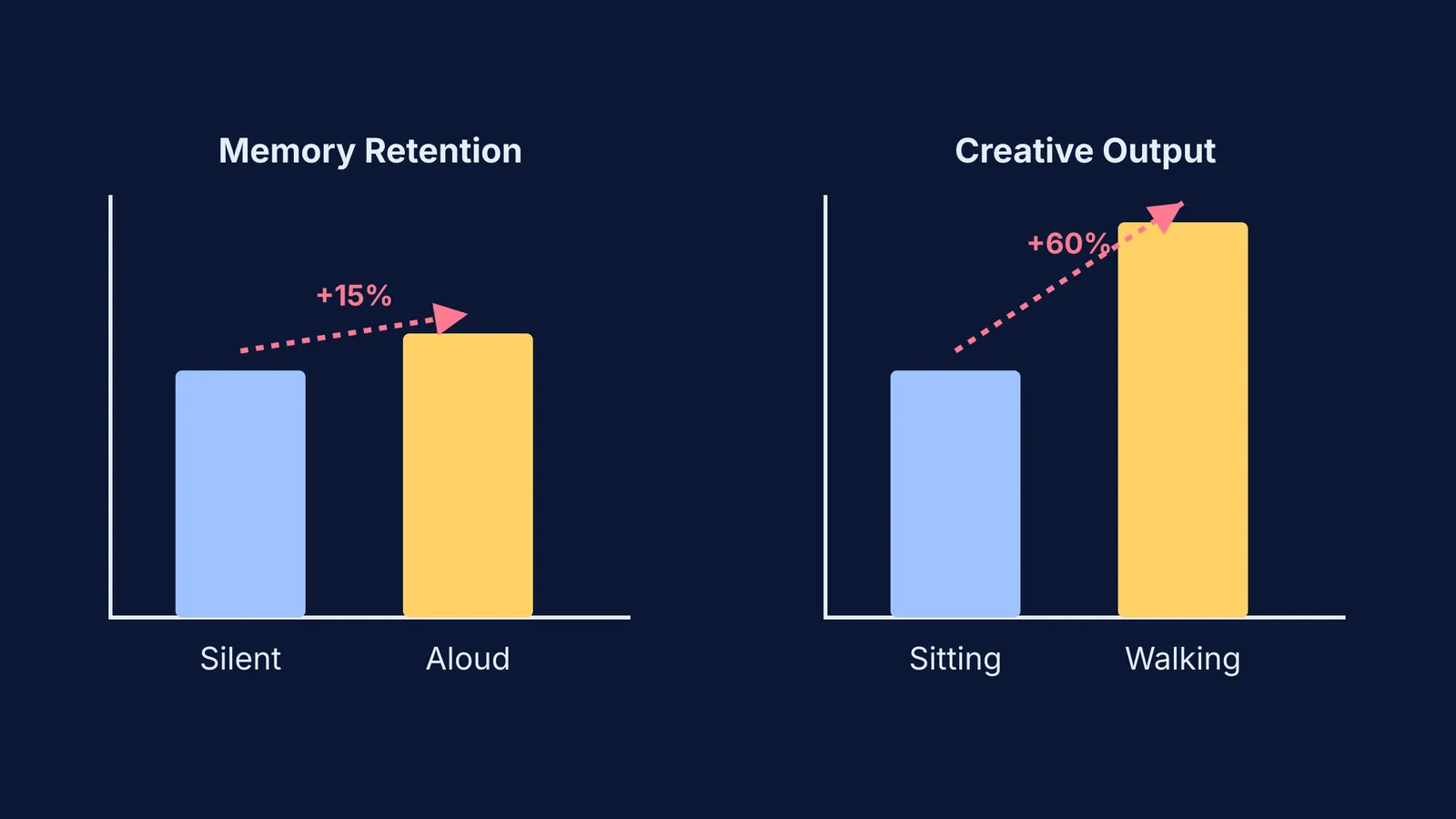
Psychologists call this the "production effect". In a series of studies culminating in a 2017 paper, researcher Colin MacLeod and his colleagues at the University of Waterloo found that speaking words aloud resulted in a 15% memory advantage compared to reading them silently. The effect is strongest when you hear yourself speak in real time, because it creates a distinct, self-referential memory.
This is where a conversational AI becomes useful. When you are choosing an AI tutor, look for one that asks you questions instead of just reading you a lecture. Fermi's AI tutor works out what you already know, builds a plan for the session, and teaches through it, checking understanding as it goes by prompting you to articulate the ideas yourself.
Does walking help you think?
Taking your voice session outside adds another layer. A 2014 study by Marily Oppezzo and Daniel Schwartz at Stanford University measured the effect of walking on creative, divergent thinking—the ability to generate many different ideas or connect broad concepts.
The results were striking. Walking increased creative output by an average of 60% compared to sitting. Interestingly, the environment did not matter much; walking on a treadmill facing a blank wall produced nearly the same boost as walking outdoors. The physical act of moving was the trigger.
This makes a walking voice session ideal for subjects where you need to connect ideas, such as mapping out the nitrogen cycle in biology or discussing the implications of Faraday's law for a changing B in physics.
Why does maths still need pen and paper?
Walking and talking fall apart when you hit complex problem solving. The same Stanford study found that walking slightly decreased performance on convergent thinking tasks, which require focused concentration to find a single correct answer.
The bottleneck is your working memory. Your brain's "mental chalkboard" can only hold about 3 to 5 chunks of information at once. When you try to solve an equation like 2x - 40 = 60 in your head, you have to hold the original numbers, the operation, and the intermediate results simultaneously.
If you find that you understand the theory but still fail numericals, the gap is often in your working memory. Using pen and paper acts as an external memory aid, significantly reducing this cognitive load. By writing down each step, you offload the intermediate data, freeing up mental space to focus on the next logical leap. When revising numericals, you need to sit down. The Fermi Problem Library has worked problems with a step-by-step solver that explains the reasoning, but you should always write the steps out yourself to prevent overloading your working memory.
How do you script a walking revision session?
To get the most out of a voice mode AI tutor for revision on a walk, set the ground rules before you start moving. Use this script to configure the session:
Set the topic and limits: "I am going on a 20-minute walk to revise the nitrogen cycle. Please act as my examiner."
Ban long answers: "Do not give me long explanations. Ask me one specific question at a time."
Focus on gaps: "If I get it right, move to the next concept. If I struggle, ask a guiding question to help me find the answer myself."
By using voice mode for theory and reserving your desk for maths, you align your study habits with how your memory actually works.


