

On this page
Why is resolving vectors into components a stumbling block?
Students often memorise a single rule for vector components: the horizontal (x) component is V cos θ and the vertical (y) component is V sin θ. While this rule is valid when the angle is measured from the positive x-axis, it fails completely when the angle is given relative to the y-axis. You will encounter this constantly in physics, such as when a pendulum swings from the ceiling or a block rests on an incline.
A foundational 2003 study published in the American Journal of Physics investigated this confusion. Researchers tested over 2000 students and found that more than 50% of those beginning their second semester of algebra-based physics were still unable to correctly perform two-dimensional vector addition. Without a solid grasp of vector resolution, every subsequent topic from electromagnetism to circular motion becomes unnecessarily difficult.
When do you use sine instead of cosine?
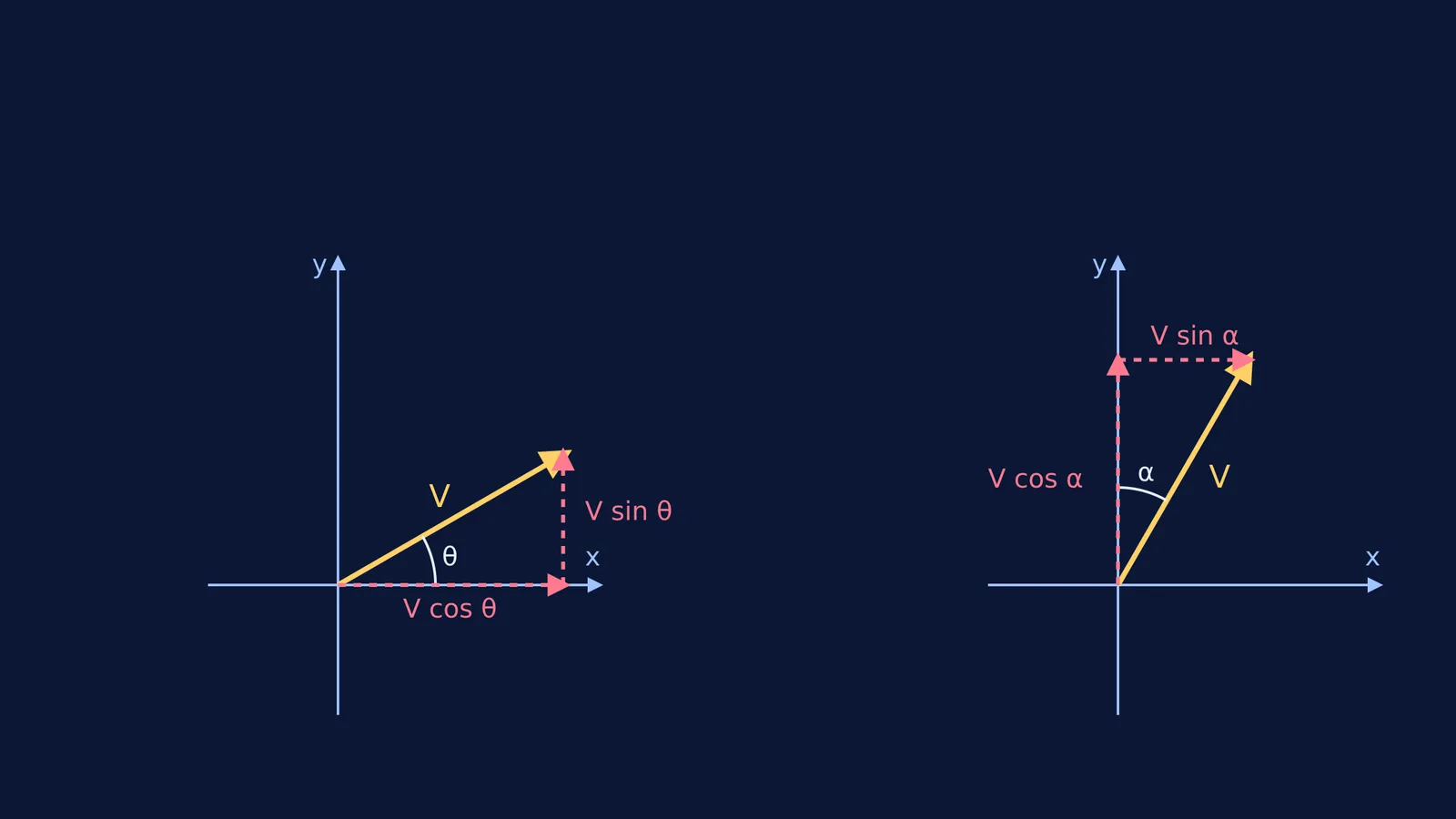
When you resolve a vector, you are mentally drawing a right-angled triangle where the original vector is the hypotenuse. The choice of sine or cosine depends entirely on where the angle sits inside that triangle.
Angle with the x-axis: The horizontal component is adjacent to the angle, making it V cos θ. The vertical component is opposite the angle, making it V sin θ.
Angle with the y-axis: The vertical component is now adjacent to the angle, making it V cos α. The horizontal component is opposite, making it V sin α.
Many students apply the x-axis rule blindly. If a pendulum string makes an angle θ with the vertical ceiling, the tension's vertical component is T cos θ, not T sin θ. This is because the vertical line forms the adjacent side of the triangle created by the pendulum string.
The inclined plane is perhaps the most notorious trap. On an incline, the weight vector mg points straight down toward the centre of the Earth. However, we usually tilt our coordinate axes so that the x-axis runs parallel to the surface and the y-axis aligns with the normal force. In this tilted coordinate system, the angle of the incline is the exact same angle that mg makes with the negative y-axis. Because of this geometry, the component of gravity pulling the block down the plane (along the x-axis) becomes mg sin θ, completely reversing the standard rule.
Failing to verify the angle reference leads to a cascade of errors in Newton's laws or projectile motion problems, such as finding the equation of trajectory of a projectile.
How do you apply this in a real problem?
Imagine pulling a suitcase with a strap at 30 degrees above the horizontal floor. The tension is 100 Newtons. The forward pull is the adjacent component, 100 cos(30°), which gives 86.6 Newtons. The vertical component lifting the suitcase is opposite the angle, 100 sin(30°), yielding 50 Newtons. Breaking the vector apart is the foundation for advanced applications like finding torque about a point with vectors or proving collinear points with vectors.
Do you need AI help resolving vectors into components?
If you are repeatedly getting the wrong sign, swapping trigonometric functions, or struggling to draw the initial diagram correctly, Fermi can help. Because Fermi's AI tutor teaches rather than answers, it does not just hand you the final algebraic components. It holds a line of reasoning across a session, notices where a student is stuck, and decides whether to explain, ask or show.
When you upload a tricky inclined plane or relative velocity problem, you can ask the tutor:
Can you draw the figure and show me which side is adjacent?
I used mg sin θ here. Did I choose the right angle reference?
Walk me through how you set up the x and y axes for this specific diagram.
By checking your understanding as it goes, the AI tutor helps you build the spatial reasoning needed for tougher applications. It helps you move from memorising formulas to understanding the geometry of the physical system.
How can you use Fermi to practise vector resolution?
For targeted practice, the Fermi Problem Library provides a step-by-step solver that explains the reasoning rather than printing an answer. You can work through classical mechanics problems knowing that if you resolve a force incorrectly, the platform will catch the error in your free-body diagram before you spend ten minutes crunching the wrong algebra.
If you are unsure where to begin, the tutor works out what you already know and builds a plan for the session. This ensures you master foundational vector geometry before moving on to complex dynamics. Whether you are dealing with a simple block on a ramp or multiple interacting forces, checking your angle references correctly is a reliable way to build your physics understanding.


